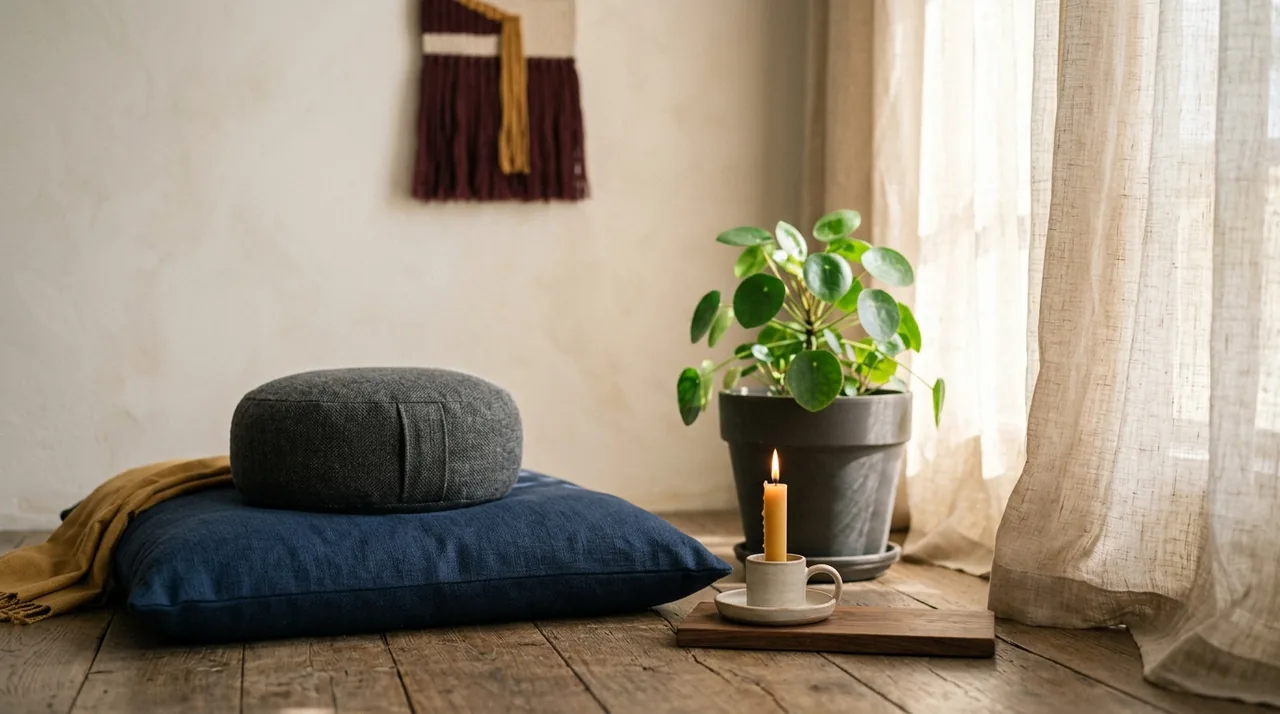
Start meditating without pressure or complex techniques. This 7-day plan will help you smoothly transition into mindfulness, breath, relaxation, and improved focus.
Meditation for beginners: how to ease into the practice over your first 7 days
Meditation doesn’t have to start with prolonged silence or remarkable results. For many people, the hardest part is simply beginning: sitting down, slowing the breath, and realizing that the mind won’t stop racing immediately. This is completely normal. If you wish to approach meditation calmly, without pressure or feelings of failure, it’s best to treat the first week as a gentle introduction. That’s exactly what this plan offers.
According to the American Psychological Association, mindfulness may help alleviate stress and enhance self-regulation, but it doesn’t work like a light switch. It’s a skill that develops through consistent practice. A review published in JAMA Internal Medicine by Goyal et al. in 2014 showed that meditation programs can lead to moderate improvements in areas like anxiety, stress, and low mood. At the same time, the researchers emphasized that the effects depend on consistency and vary from person to person. That’s why, during the first 7 days, simplicity, repetition, and self-compassion are the most important.
If you wish, you can support your beginning with simple tools such as a meditation timer, a short session in the meditation zone, or exercises from the breath section. The key is not to do everything at once. The focus is on returning each day to one brief practice.
What you should know before you start
At the outset, it's helpful to let go of two misconceptions. The first is that meditation means having no thoughts. The second is that you must immediately feel deep relaxation. In reality, meditation is about noticing what’s happening without constantly being drawn into every thought. One moment might feel calm, while the next may feel scattered. Both situations are part of the mindfulness journey.
The National Center for Complementary and Integrative Health (NCCIH) states in a 2022 resource that meditation and mindfulness may support mental well-being and assist in stress management, but they do not substitute for professional help. If you are experiencing severe symptoms of anxiety, depression, insomnia, or are in the midst of a mental health crisis, consider this text as educational material, not a substitute for therapy. If necessary, consult a specialist.
- Choose a consistent time, ideally in the morning or evening.
- Set a short duration, from 3 to 10 minutes.
- Sit comfortably; cross-legged posture is not required.
- Focus your attention on the breath, sound, or bodily sensations.
- Do not evaluate the session based on whether it felt pleasant, but on whether you showed up.
Day 1: sit down and do not force anything
On the first day, your goal is not to achieve perfect meditation, but simply to begin. Sit on a chair or cushion. Keep your back relaxed and upright, and rest your hands on your thighs. Set a timer for 3 minutes. Close your eyes or lower your gaze. Then, notice your natural breath. Do not attempt to change it. Just feel the air flowing in and out.
If thoughts arise, briefly label them in your mind, like "thinking" or "planning," then return your focus to the breath. This is the essence of mindfulness practice: not to battle the mind, but to return. This simple exercise enhances concentration, teaching you to direct your attention where you want it rather than following every distraction.
At the end, ask yourself what you noticed. Perhaps tension in your shoulders, a sense of rushing, or even a bit of relaxation. Nothing needs to be extraordinary.
Day 2: the breath as an anchor for mindfulness
On the second day, extend the session to 4 minutes. This time, focus on the area where you can feel your breath most distinctly. For some, it may be the nostrils; for others, it might be the chest or abdomen. Avoid switching points every few seconds. Stay with one focal point.
Mindfulness researchers often refer to the breath as an anchor for attention because it is always accessible and neutral. Creswell, in a 2017 review, highlighted that mindfulness-based interventions can improve attention regulation and stress reactivity. For beginners, this has very practical significance. When the mind wanders, simply return to the breath. When tension arises, return to the breath. When you’re unsure if you’re doing it right, return to the breath.
If you like, after the session, spend an additional minute calmly counting your exhales from 1 to 5. This is a simple way to enhance concentration without excessive effort.
Day 3: notice the body and signs of tension
On the third day, incorporate a brief body scan into your meditation. Set the duration to 5 minutes. Start by observing your breath for one minute. Then, sequentially direct your attention to your forehead, jaw, shoulders, hands, belly, and legs. Do not attempt to relax everything at once. First, identify where tension already exists.
This is important because many people find they spend more time in their thoughts than in their bodies. Mindfulness helps restore contact with present-moment experiences. According to the APA, regular mindfulness practice may foster greater awareness of stress responses. When you can recognize tension more swiftly, you stand a better chance of responding before fatigue or irritation sets in.
After this session, try incorporating one simple habit throughout your day. Every time you find yourself waiting, like for water to boil or a web page to load, take one calm inhale and one longer exhale. This is a micro-practice of relaxation that requires no extra time.
Day 4: moving meditation and mindfulness beyond the cushion
On the fourth day, you don’t have to sit down. You can engage in 5 to 7 minutes of mindful walking. Walk slower than usual. Feel your feet connect with the ground, the shifting of your body weight, the movement of your arms, and the temperature of the air. Whenever your mind wanders, return to the sensations of your steps.
This is a crucial moment, as meditation doesn’t conclude with a formal session. The aim is not to confine mindfulness to one ritual, but to integrate it into your everyday life. That’s why many mindfulness programs teach not only sitting practices but also mindful eating, walking, and listening. If you find it easier to focus in motion than in stillness, consider that valuable information rather than an obstacle.
You can also use the materials in the meditation catalog to discover which method best supports your relaxation and focus as you embark on this path.
Day 5: Working with Distractions Without Self-Judgment
The fifth day can be a pivotal moment, as the initial enthusiasm often diminishes. This is when many people conclude that meditation isn't for them. However, distraction is not a sign of failure; it serves as material for practice. Set your timer for 6 minutes and observe your breath. Each time you realize your mind has wandered, gently return your focus without any commentary or frustration.
Meta-analyses of mindfulness-based interventions, including a 2018 review by Goldberg et al., indicate that regular practice may alleviate symptoms across various areas of mental health. However, the quality of studies varies, and effects differ from person to person. For you, this means one thing: gauge your progress not by the volume of thoughts but by how quickly you can recognize distractions and return to the present moment.
- Take a seat and set your timer.
- Direct your attention to your breath.
- Notice when your focus drifts.
- Briefly label it, for example, as "thought."
- Return your focus to your breath.
- Repeat this process as often as necessary.
That's how you cultivate concentration: not by forcing silence in your mind, but by gently training yourself to return.
Day 6: Relaxation Doesn't Always Come Immediately
On the sixth day, try a practice that emphasizes a longer exhale. Meditate for 6 to 8 minutes. Breathe naturally, but allow your exhales to be slightly longer than your inhales. Don’t force it. If you experience discomfort, revert to your normal breathing. This type of practice can be beneficial when your system is overstimulated and finding calm is challenging.
It's important to remember that research does not support guarantees of immediate effects for everyone. NCCIH notes that individuals respond to meditation differently. Some find relaxation instantly, while others may initially experience anxiety or fatigue, as it often takes silence for tension to become apparent. That response is perfectly normal.
If you're looking to enhance your evening relaxation, consider pairing this session with gentle background sounds. However, first, determine whether you benefit more from silence or subtle support. The objective is not to create ideal circumstances, but to cultivate conditions you can realistically return to.
Day 7: Reflection and Planning for the Week Ahead
On the seventh day, engage in 8 to 10 minutes of breath meditation. While this is still a short duration, it's sufficient to perceive the difference between aimless sitting and intentional practice. Begin with a minute focused on body awareness, then shift to your breath, allowing the last minute for open awareness. Welcome sounds, sensations, and thoughts as they arise, noticing them without attachment.
At the end, take a moment to reflect in your mind or in your notebook:
- What time of day felt best for meditation?
- Was it easier to focus on the breath, the body, or movement?
- What distracted you most frequently?
- After a week, are you finding it easier to recognize tension and return to the present moment?
This realization matters more than seeking grand experiences. Meditation flourishes through consistency. Even just 5 minutes a day can be more beneficial than one lengthy session each week. The WHO emphasizes that supporting mental health requires daily habits that foster resilience, sleep, relationships, and stress management. Mindfulness can be one of those vital habits.
Common Mistakes at the Beginning
Beginners often abandon meditation not because it's ineffective, but due to unrealistic expectations. The most frequent misstep is selecting sessions that are too long. The second is evaluating every practice harshly. The third is interpreting distraction as evidence that you're not suited for meditation.
It's also helpful to reduce multitasking after your session. If you finish meditating and immediately grab your phone, the calming effect can dissipate rapidly. Allow yourself at least a minute of transition. Stand up slowly, stretch, and take a mindful breath. If you wish to maintain your rhythm, utilize simple tools such as a meditation timer or short guided sessions in meditate.
How to Sustain Your Practice After the First Week
After 7 days, there's no need to increase the duration of your practice each day. Consistency is more valuable than ambition. For the next week, you can continue with sessions of 8 to 10 minutes. If you've found breath meditation effective, keep practicing it. If movement works better for you, incorporate mindful walking. If you need help calming down, explore materials from the breath field or relaxation practices in the meditation section.
The most achievable goal is: I meditate briefly, but regularly. This approach aligns with what research on mindfulness reveals: benefits are more frequently associated with consistency rather than infrequent intensity. You don't need to seek perfection in your technique. You require a repeatable space, a brief time commitment, and a willingness to return to the breath.
This article is for educational purposes and is not a substitute for advice from a doctor, psychologist, or psychotherapist. If you experience strong discomfort, increased anxiety, or distressing memories during practice, please stop the session and consult a specialist.
FAQ
How many minutes of meditation each day are sufficient to get started?
To begin with, 3 to 10 minutes a day is sufficient. For beginners, consistency is more important than the length of each session. A brief daily meditation typically fosters habit, mindfulness, and concentration more effectively than longer, sporadic sessions.
Is meditation about stopping thoughts altogether?
No. Meditation is not about completely halting thoughts; it is about observing them and gently bringing your focus back to your chosen point of attention, most often the breath. This process of returning cultivates mindfulness and self-regulation.
What should I do if I feel anxious instead of relaxed during meditation?
This can happen, especially at the beginning. You might want to shorten the session, revert to your natural breathing, open your eyes, or try moving meditation. If the discomfort is intense or occurs frequently, consult a specialist. Meditation is not a replacement for professional help.
When will I start to notice the effects of meditation?
This varies from person to person and depends on the regularity of practice. Research indicates that mindfulness can aid in reducing stress and enhancing well-being, but it does not yield identical results for everyone. Generally, you might first become more aware of your breath, physical tension, and distractions, and only later experience deeper relaxation or improved concentration.
Sources
- World Health Organization, Mental health: strengthening our response, 2022, https://www.who.int/news-room/fact-sheets/detail/mental-health-strengthening-our-response
- American Psychological Association, Mindfulness Meditation: A Research-Proven Way to Reduce Stress, 2019, https://www.apa.org/topics/mindfulness/meditation
- Goyal M. et al., Meditation programs for psychological stress and well-being: a systematic review and meta-analysis, JAMA Internal Medicine, 2014, https://jamanetwork.com/journals/jamainternalmedicine/fullarticle/1809754
- NCCIH, Meditation and Mindfulness: What You Need To Know, 2022, https://www.nccih.nih.gov/health/meditation-and-mindfulness-what-you-need-to-know
- Goldberg S.B. et al., Mindfulness-based interventions for psychiatric disorders: a systematic review and meta-analysis, Clinical Psychology Review, 2018
- Creswell J.D., Mindfulness Interventions, Annual Review of Psychology, 2017