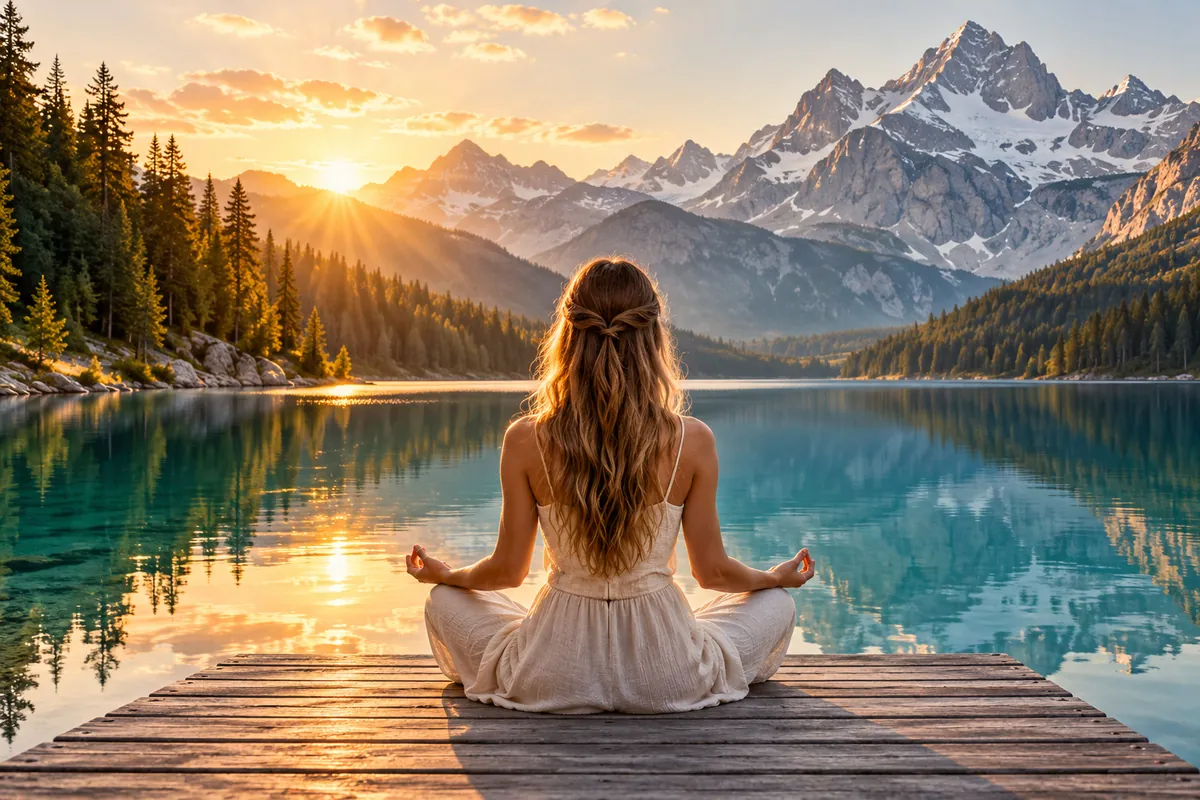
Learn how meditation before sleep can become your key to better relaxation. Discover simple techniques that will help you unwind before the night.
Why is meditation before sleep so popular?
Meditation before sleep is very popular because it allows for a conscious end to the day and calms the nervous system. Many people treat this time as a transition moment, where daily duties are symbolically set aside, opening up space for deeper regeneration.
Evening meditation practices are often based on the tradition of mindfulness, which suggests that our ability to relax depends on the skill of consciously being in the present moment. Instead of analyzing the past or planning the future, we learn to accept our current state, which for many is a form of deep mental cleansing.
If you want to start your journey toward relaxation, check out our available meditations, which will help you take your first steps. It is also worth remembering that every moment spent pausing is a valuable step toward inner balance.
How to prepare your space for evening meditation?
Proper preparation of the environment is crucial so that meditation before sleep becomes a pleasant ritual rather than a burdensome chore. It is worth ensuring dimmed light, comfortable clothing, and a room temperature that promotes physical relaxation.
Tradition suggests that creating a permanent place for practice helps the mind enter a state of calm faster by associating a specific space with rest. You can use guided meditations to make it easier to focus on the process instead of searching for the right breathing rhythm on your own.
It is also worth reading the article Meditation for beginners – a 7-day plan to understand how to gradually introduce mindfulness into your evening routine. Remember that the key is kindness toward yourself – you don't have to meditate for an hour right away to feel the positive effects.
What is mindfulness in evening meditation?
Mindfulness in an evening context is the process of observing your thoughts and bodily sensations without judging them as good or bad. This approach allows for the release of muscle tension that we often accumulate throughout the day, unconsciously holding it in the shoulders or jaw area.
Many people practice conscious body scanning, which in traditional schools is considered an excellent way to synchronize the mind with the physical shell. If you want to explore the topic of mindfulness in daily life, I recommend reading Mindfulness in daily life: how to practice effectively, which shows how meditation intertwines with our ordinary activities.
However, remember that if a person has strong anxiety or hypervigilance, focusing on the body may initially seem difficult. In such situations, it is worth choosing gentler forms of practice that do not require deep insight into difficult emotions, but only focus on calm, rhythmic breathing.
Which breathing techniques support relaxation?
Breathing techniques are the simplest tool that allows for a quick calming of the heart rate and puts the body in a state of readiness for sleep. Focusing on an extended exhale is a classic method that, according to many traditions, supports the body's natural regenerative processes.
To learn more about practical solutions, read the text 4-7-8 Breathing: how to perform the technique for calm. This specific exercise can become a permanent element of your evening preparation for sleep, helping you disconnect from external stimuli.
Remember that every breath is an opportunity to return to yourself. Do not rush and allow your body its natural pace, which will become increasingly calm and steady over time. This practice does not require specialized equipment, only your presence and a desire for a moment of respite.
Is meditation before sleep the only path to peace?
Meditation before sleep is just one of many tools that can help build harmony, but it does not have to be the only choice. There are many meditation techniques for calming down that can be used at any time of the day to reduce tension levels before the evening.
You will find more inspiration in the article Meditation techniques for calming: How to find harmony in everyday life. Often, it is regularity throughout the day that makes falling asleep easier, because we do not accumulate excess stress that would need to be released right before going to bed.
🎴 This content serves entertainment and personal reflection purposes. It is not supported by scientific evidence. In case of sleep difficulties, it is always worth consulting a doctor or therapist to rule out medical causes.
FAQ
Will meditation before sleep help with insomnia?
Meditation can support the calming of the body, which often makes falling asleep easier, but it is not a cure for insomnia. If you have chronic problems with sleep quality, consult a specialist to rule out medical causes.
Do I have to sit in the lotus position to meditate?
Absolutely not. Before sleep, the most comfortable position is often lying flat on your back or in the fetal position. The most important thing is that the body feels safe and can fully rest.
Can you meditate with music?
Yes, gentle relaxation music or nature sounds can be helpful for people who find it difficult to calm down in total silence. It is important that the sounds are monotonous and do not contain sudden changes in tempo.
How to start meditating when I have a racing mind?
Start with very short sessions (even 2-3 minutes) and instead of fighting your thoughts, simply name them in your mind (e.g., "thought about work"). This simple exercise allows you to distance yourself from the content that occupies your mind before sleep.
Sources
- Esoteric tradition — symbolism of tarot, runes, and numerology passed down in European culture.
- Cultural symbolism — interpretations of archetypes and signs in a comparative approach.