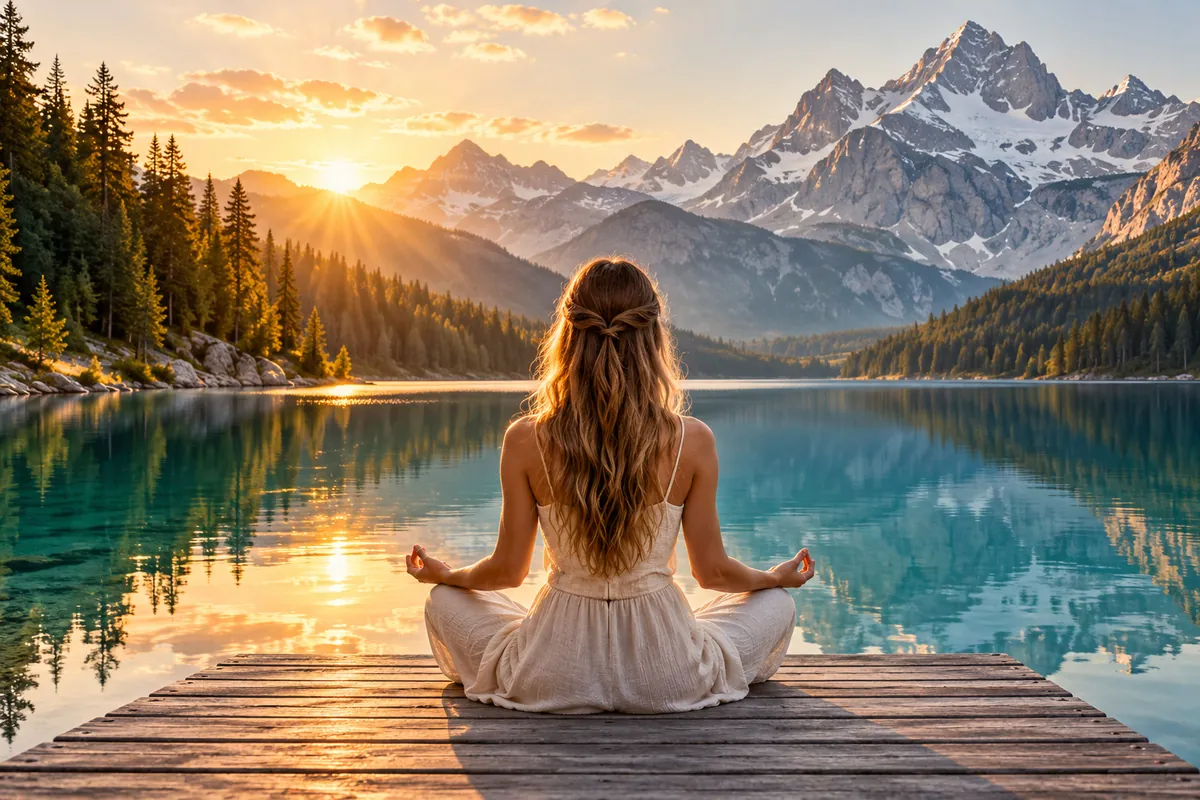
Transcendental meditation involves silently repeating a personal mantra, leading to deep relaxation and calm. This practical guide explains how to prepare for the first session and what effects you can expect from regular practice.
What is transcendental meditation?
Transcendental meditation is a technique involving the silent repetition of a chosen mantra, allowing the mind to enter a state of deep calm.
Also try our tool: Online Dream Dictionary.
Tradition holds that a mantra is an individual sound or syllable received from a teacher or chosen independently, kept private. Repeated in silence, the mantra has no semantic meaning – its purpose is to focus attention beyond thoughts. The practice does not require any special postures; the most important thing is that the body is comfortable and the breath is natural.
Many people believe that regular sessions bring inner balance and reduce everyday stress. 🎴 This content is for entertainment and personal reflection purposes only. It is not supported by scientific evidence.
What are the basic principles of transcendental meditation practice?
The basic principles are silence, a comfortable position, regularity, and repeating the mantra without forcing it.
Tradition emphasizes that meditation should take place in a calm environment, free from distractions – preferably in a quiet room or with the natural sound of water. It is important to sit in a comfortable, upright position, which promotes a free flow of breath. The mantra is repeated mentally, not aloud, and attention is not directed to its meaning but to its vibration.
In practice, two sessions per day are recommended, usually morning and evening, each lasting 10‑20 minutes. If you feel discomfort, shorten the time and gradually extend it. 🎴 This content is for entertainment and personal reflection purposes only. It is not supported by scientific evidence.
How to prepare for the first session?
Preparation includes choosing a quiet place, comfortable seating, and silencing the surroundings.
First, find a spot where no one will disturb you – it could be a corner of a room, a garden, or a quiet space in the office. Turn off your phone, mute notifications, and arrange pleasant lighting, e.g., a soft lamp glow. Sit on a cushion, chair, or floor, keeping a straight spine so the breath can flow freely.
If you are just starting, it is worth checking out Meditation for Beginners – 7-Day Plan, where you will find a simple schedule and additional tips. After settling, close your eyes and take a few deep breaths to calm the body. 🎴 This content is for entertainment and personal reflection purposes only. It is not supported by scientific evidence.
How to choose and repeat a mantra?
A mantra should be short, neutral, and easy to repeat mentally.
Tradition suggests that mantras are assigned by an experienced teacher who matches them to the individual student's profile. If you do not have this option, you can choose a simple syllable, e.g., “Om”, “So‑Ham”, or your own combination of sounds that have no specific meaning in everyday language. It is important that the mantra does not trigger associations or become too complicated.
During meditation, repeat the mantra in your mind, without forcing it, allowing it to arise naturally. If you notice the mind wandering, gently bring your attention back to the mantra, without judging yourself. 🎴 This content is for entertainment and personal reflection purposes only. It is not supported by scientific evidence.
How often and how long to meditate?
Two sessions per day of 10‑20 minutes are recommended, but you can adjust the frequency to your own needs.
Tradition stresses that regularity is key – daily practice allows the mind to become accustomed to a state of calm. If you are just beginning, start with 5‑10 minutes, gradually increasing the time as you feel comfortable. There is no need to extend sessions beyond 30 minutes, as the goal is a smooth transition into a state of peace, not fatigue.
It is useful to keep a simple practice journal to observe changes in well‑being and possibly adjust the schedule. For additional support you can use our meditations or a timer app to maintain a steady rhythm. 🎴 This content is for entertainment and personal reflection purposes only. It is not supported by scientific evidence.
What sensations and effects may arise from regular practice?
Regular practice may bring a feeling of deep relaxation, increased mental clarity, and better ability to cope with stress.
Many practitioners describe that after a session they feel a “loosening” in the body, slower breathing, and lightness of thought. Over time they may notice improved concentration, greater creativity, and better sleep quality. Some also describe a subtle shift in life perspective, leading to greater acceptance of daily challenges.
However, effects are individual and do not guarantee specific results – everyone experiences meditation differently. 🎴 This content is for entertainment and personal reflection purposes only. It is not supported by scientific evidence.
Are there pitfalls and how to avoid them?
Typical pitfalls include excessive control of thoughts, frustration due to “lack of progress”, and unsuitable environmental conditions.
Tradition advises not to judge your thoughts as “good” or “bad”. Meditation is not about forcibly silencing the mind, but gently returning attention to the mantra. If you feel physical discomfort, change your position or shorten the session. Avoid practicing in noisy surroundings that can distract attention.
If in doubt, it is worthwhile to consult an experienced teacher or seek support in a practitioner group. 🎴 This content is for entertainment and personal reflection purposes only. It is not supported by scientific evidence.
See also
FAQ
Does transcendental meditation require a special teacher?
Traditionally it is recommended to start under the guidance of a certified instructor, but many practitioners begin on their own using available descriptions and tools.
How long does one need to meditate to notice the first effects?
Many people feel a reduction in tension and greater calm already after a few days of regular practice, although deeper changes may take several weeks.
Can I meditate while sitting on a chair?
Yes, the most important thing is to keep the spine upright and be comfortable – a chair, cushion, or floor are acceptable.
Is transcendental meditation suitable for children?
Children can use simplified versions, but shorter sessions and simpler mantras are recommended, always under adult supervision.
Sources
- Tradycja ezoteryczna — tarot, rune, and numerology symbolism transmitted in European culture.
- Cultural Symbolism — interpretations of archetypes and signs in a comparative perspective.