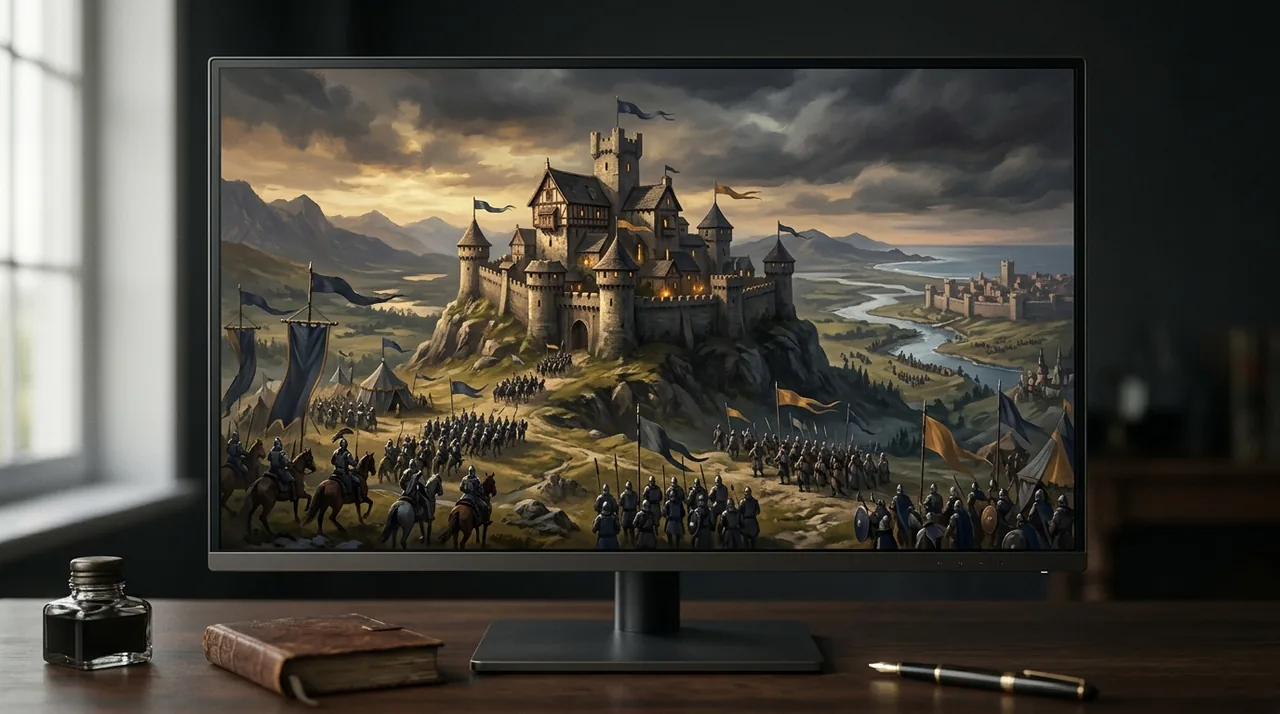
A good strategy begins with numbers, priorities, and discipline. Discover how to manage resources in a strategy game to accelerate your growth, plan quests more effectively, and avoid costly mistakes.
How to Manage Resources in a Strategy Game
In any good strategy game, it's not just the player who clicks the fastest that wins, but primarily the one who plans the best. This holds true for both classic turn-based games and modern online titles, such as browser games, MMOs, or systems focused on kingdom development, quests, and cooperation. If you play Ezostylia Kingdoms, explore other titles from the Games section, or develop your unique playstyle through the game panel, effective resource management is the cornerstone of your success.
Resources in a strategy game can encompass raw materials, gold, energy, construction time, movement points, units, production slots, and even the player's attention. This last element is often forgotten. According to the American Psychological Association, a 2006 study on attention-switching costs shows that multitasking reduces performance, as each task switch incurs a cognitive cost. For players, this means one simple thing: if you try to develop everything at once, you often lose momentum. In strategy games, prioritizing focus is essential.
This guide will demonstrate how to manage resources like a practiced strategist. Not through chaos, but through planning, numbers, and consistent decision-making. This approach will benefit you in browser games, solo modes, quest systems, and when collaborating in alliances to compete for ranking positions.
1. First, identify which resources truly drive progress
The first mistake many players make is treating all resources equally. In reality, in most strategy games, some resources are vital at the beginning, some during the middle phase, and some only in the closing stages of the game. Therefore, before you spend any resources, ask yourself three questions:
- Which resource most frequently hinders my progress?
- Which resource provides a real advantage the quickest?
- Which resource can I recover easily, and which one is challenging to regain?
In practice, this means that not every expense carries the same weight. If you're playing an MMO and lack the resource needed to upgrade your base, investing in decorative or secondary features might be a mistake. Conversely, if your main limitation is time, it’s wise to expedite actions that unlock new production levels, quests, or access to alliance collaboration.
This way of thinking mirrors prioritization techniques found in project work. The University of Waterloo, in its material on the Eisenhower Matrix, explains that efficiency increases when you differentiate between urgent and important matters. The same applies to strategy games. Urgent does not always mean advantageous. What matters is what enhances your future production, security, or expansion rate.
2. Build your economy before launching an offensive
Many players feel the urge to attack right away, earn points, and tackle difficult quests. This is natural, as quick actions bring immediate excitement. However, in the long run, the player who first stabilizes their economy tends to emerge stronger. In browser games and systems like Ezostylia Kingdoms, this typically involves developing production sources, storage, logistics, infrastructure, or mechanics that reduce waiting times.
If your base produces insufficient resources, every subsequent move becomes more costly, both mentally and tactically. You start making choices based on what you can currently afford, rather than what is optimal. This sharply limits your strategic options.
A good practice is the 60-30-10 rule:
- Allocate 60 percent of your investment to stable production growth.
- Allocate 30 percent to defense, utility, or unlocking new features.
- Reserve 10 percent for experimentation, events, special quests, or quick opportunities.
This isn’t rigid math applicable to every game, but a practical starting point. The MIT Sloan Management Review noted in 2015 that simple operational guidelines help teams perform more effectively. In gaming, the same principle holds true. When you have your own set of straightforward rules, you tend to make better decisions under pressure.
3. Avoid the trap of spending everything at once
One of the most frequent mistakes is depleting your storage completely following every large resource payout. At first glance, this seems logical, as it keeps resources from sitting idle. The issue is that having no reserve strips away your flexibility. When a limited-time quest, a time-sensitive opportunity, an alliance bonus, or a new development path arises, you have nothing available to respond with.
NIST, in its risk management approach, emphasizes the importance of preparation and safeguarding key assets. Though the document pertains to organizational systems, the principle itself is universal. A well-managed system does not function with zero safety margin. In a strategy game, reserves serve as that safety margin.
Therefore, you should maintain a buffer. Even a basic one, such as:
- 20 percent of essential resources kept untouched without a valid reason,
- a separate pool for daily quests,
- a separate pool for long-term development,
- a minimum reserve for defense or recovery after a loss.
Such a structured spending approach provides peace of mind and minimizes impulsive decisions. In strategy, maintaining composure is a significant advantage.
4. Plan your daily cycle, as time is also a resource
Many players view resources merely as numbers displayed on the screen. In reality, login time and gameplay rhythm are just as critical. If production finishes when you can't access the game, a portion of potential is lost. If you queue short tasks before going to sleep, you waste the night. If you commence a long build at the start of an active session, you limit other available options.
Harvard Business Review discussed in 2007 the importance of managing energy instead of merely time. In gaming terms, this can be interpreted as a more effective player aligning their activities with their rhythms and focus. When you have 10 minutes, gather resources and set production. When you have 30 minutes, review quests and the upgrade queue. When you have an extended session, strategize development, trading, alliance tactics, and plan several steps ahead.
You can use a simple breakdown:
- Short session: gather production, refresh tasks, make quick decisions.
- Medium session: quests, base management, cost review.
- Long session: strategic planning, alliance coordination, more challenging goals.
This is particularly important in browser games, as their strength lies in accessibility. You can log in for just a moment, but it's essential to make every moment count.
5. Calculate your return on investment, even if the game doesn't show it directly.
A good player doesn't merely ask, 'Can I afford this?' They also ask, 'When will it pay off?' If an upgrade is expensive but only slightly increases production, there may be a better path. If quests yield minimal resources but unlock significant features, their value might be greater than it first seems.
In practice, analyze three elements:
- entry cost,
- payback time,
- additional value, such as access to a new map, unit, or bonus.
This is how mature strategy is formed. You don't rely solely on emotion, but on the relationship between cost and effect. In Ezostylia Kingdoms and similar systems, this way of thinking not only helps you grow faster, but also aids in choosing which quests to complete immediately and which to postpone.
If you enjoy testing your play style, a good complement may also be a quiz discussion about tactics or decisions. While this format cannot replace experience, it helps you identify your patterns and mistakes.
6. Alliance cooperation alters the value of resources.
Solo play and team play often operate within two distinct economies. In an alliance, certain resources gain greater importance because they support a collective goal. Suddenly, it's not just about how much you have, but also when you can assist and what the group requires. That's why, in cooperative mode, it's beneficial to think on two levels: your personal development and your contribution to the team.
This is especially crucial in MMO games, where communication, specialization, and synchronization create an advantage. One player may focus on production, another on defense, and another on expansion or completing specific quests. The scaling effect means that a well-coordinated alliance grows faster than a group of solo players.
In practice, establish simple rules:
- what the shared goals are for the week,
- who develops which areas,
- how you respond to threats,
- which quests are a priority for the entire group.
Then review the results. If you enjoy competition, also keep an eye on the leaderboard.. A ranking position doesn't always tell the entire story, but it clearly indicates whether your development model is yielding real results.
7. Don't let side activities divert your attention.
In modern games, it’s easy to succumb to the temptation of trying to do everything at once. Events, side quests, cosmetic upgrades, additional quizzes, mini activities, collections, point systems—everything looks enticing, but not all of it is beneficial at a given moment.
The APA reminds us that frequent task switching diminishes efficiency. In a game, this translates to slower growth. So, before you engage in a side activity, ask yourself: Does this bring me closer to my current strategic goal? If not, postpone it for later.
This doesn't mean you have to play in a rigid manner. Entertainment is important too. After all, the Games section in Ezostylia combines fun and learning through action. The key is balance. The best players can utilize different modes without losing sight of the main objective.
If you want a break from traditional economy management while still honing your tactical thinking, you might also want to try Magic Chess. A different gameplay format often cultivates the same decision-making habits but in a more concentrated form.
8. Create your own progress tracking system.
Even the best strategy won't work for long without regular reviews of results. Every few days, assess whether your plan is actually resulting in growth. Don't judge the game solely based on the emotions of a single session; evaluate it by the overall trend.
A simple checklist can be useful:
- Is the production of basic resources increasing week by week?
- Does the number of completed quests lead to lasting benefits?
- Do you have a reserve for unexpected expenses?
- Is the alliance supporting your development, or merely demanding your attention?
- Is the upgrade queue aligned with your goals?
This review takes just a few minutes, but it helps you identify mistakes early. Sometimes, you'll realize you're investing too much in defense. At other times, you might find that you're being overly aggressive and neglecting the economy. And occasionally, you may discover that your quests are flashy but not very rewarding.
This is where strategy truly matures. It's not about a one-time great move, but about a system of sound decisions repeated over an extended period.
The most important rules in brief.
If you want to manage resources effectively in a strategy game, keep a few simple rules in mind. First, identify the critical resource. Then, strengthen the economy before embarking on costly aggression. Always maintain a reserve. Treat time as a resource. Assess the profitability of investments. In an alliance, focus on the shared results, not just your own score. And regularly check whether your plan is functioning.
This approach applies both to browser games and more advanced MMO-style models. If you play consistently, you’ll see the difference sooner than you think. Less chaos, more control, better quests, and a more purposeful strategy. And that is precisely what distinguishes random clicking from genuine player development.
This article is intended for educational and entertainment purposes. It does not constitute financial, legal, or professional advice; it's merely a practical guide to better planning in games.
FAQ
Which resources are most crucial at the onset of a strategy game?
Typically, the most essential ones are those that drive further development, meaning basic resources, building time, and mechanics that unlock new features. In the initial stages, it’s wise to invest primarily in your economy and stability.
Is it better to spend everything immediately, or to keep a reserve?
It's better to maintain a reserve. This way, you can respond to new quests, events, and opportunities. A lack of a buffer often leads to stagnation or forces poor decisions.
How should you plan quests in an MMO game?
First, select quests that offer lasting benefits, such as unlocking new options, increasing production, or enhancing your position within the alliance. Only then should you tackle side tasks or objectives focused solely on points.
Is being part of an alliance always beneficial?
Not necessarily, but in many games, it can provide a significant advantage. A strong alliance accelerates development, makes quests easier to complete, and enhances coordination. Conversely, a weak alliance may consume your time and distract you.
Sources
- NIST, Risk Management Framework, 2018, https://www.nist.gov
- American Psychological Association, Multitasking: Switching Costs, 2006, https://www.apa.org/topics/research/multitasking
- Harvard Business Review, Manage Your Energy, Not Your Time, 2007, https://hbr.org/2007/10/manage-your-energy-not-your-time
- University of Waterloo, What is the Eisenhower Matrix?, 2024, https://uwaterloo.ca
- MIT Sloan Management Review, Why Simple Operational Rules Help Teams Execute, 2015, https://sloanreview.mit.edu