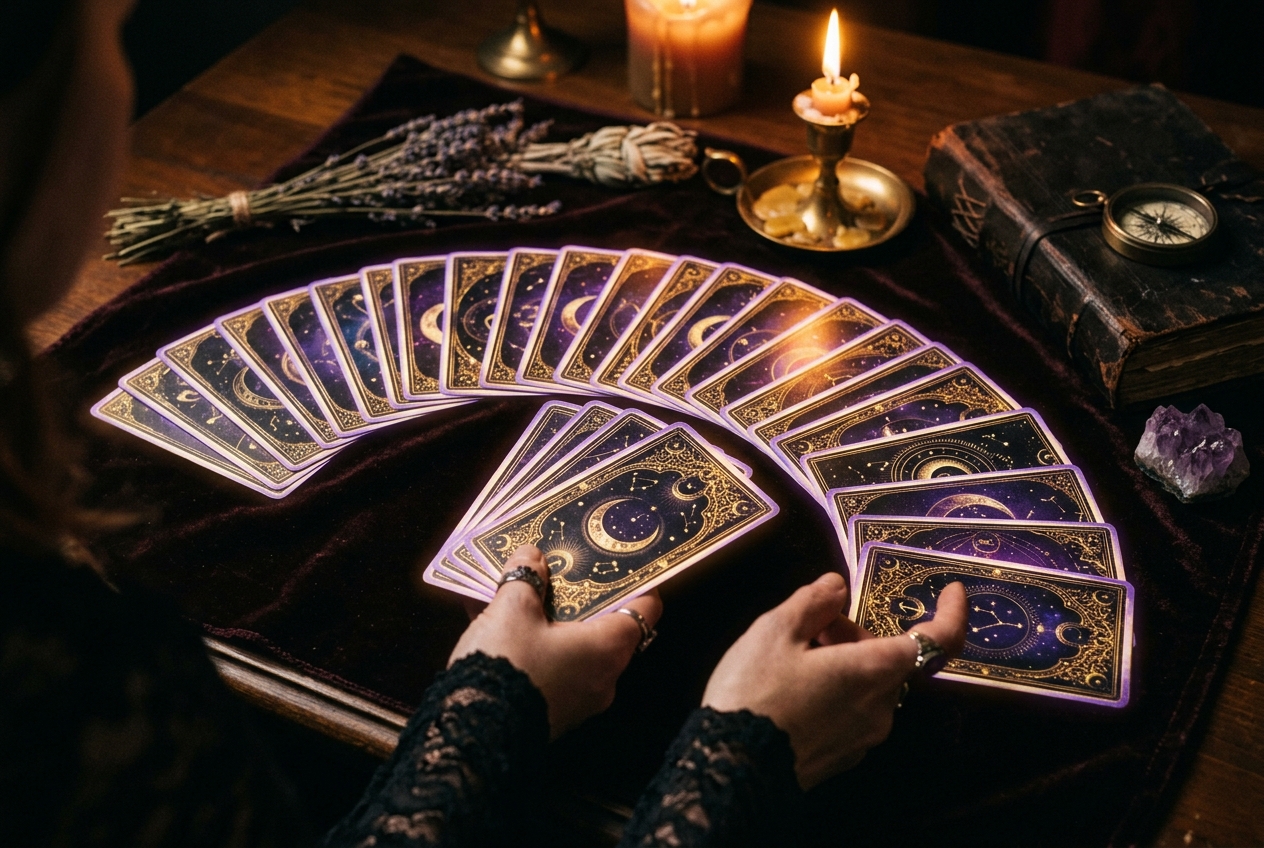
The daily tarot card is a simple way for daily reflection. Learn how to choose and interpret that one card to enrich your everyday experiences.
What is a daily tarot card?
The daily tarot card is a single card chosen for a specific day, whose symbolism is meant to support personal reflection.
Tarot tradition describes it as a brief message from the unconscious, expressed through images and archetypes. The symbolism suggests that the card can hint at what to focus on at a given moment, but does not provide predictions.
In practice, the daily card is used as a development tool, not as an oracle. 🎴 This content is for entertainment and personal reflection purposes. It is not supported by scientific evidence.
How to choose the daily card?
The selection of the daily card is usually random, emphasizing its personal nature.
You can shuffle the entire deck and pull one card, or choose a card intuitively, guided by your first impression. Some practitioners use special spreads, but the simplest method—random drawing—is most often recommended for beginners.
It is important to quiet yourself before drawing, focus on your breath, and formulate a short question or intention about the day. This makes the process more conscious.
- Prepare a clean surface and a 78‑card deck.
- Focus on the intention “What is important today?”
- Randomly draw one card and set aside the rest.
Learn more about practical use of the daily card in our daily card tool and in the section meaning of the 78 tarot cards.
How to interpret the symbolism of the chosen card?
Interpretation involves connecting the card’s traditional meaning with the current context of your life.
Tradition says each tarot image carries a specific archetypal message—for example, the Tower card suggests sudden change, and The Moon—hidden emotions. The symbolism suggests you should examine your own feelings and situation to read what the card wants to convey.
In practice, it helps to jot down a brief note: what you see on the card, what emotions it evokes, and how those elements relate to your experiences today. Such a record helps solidify insights and observe their usefulness in subsequent days.
What are the most common card meanings in a daily context?
Some cards appear more often and carry characteristic, brief messages.
For example:
- The Fool – an invitation to openness and taking a new step without fear.
- The Magician – a reminder of your own resources and the ability to create reality.
- Justice – a hint that it is worth striving for balance and honesty in your actions.
Of course, each card has many shades, so it is important not to rigidly adhere to one meaning but to adapt it to your own situation.
How to use the daily card in daily reflection?
The daily card can become a starting point for a brief meditation or journal entry.
After reading the card, spend a few minutes reflecting on the emotions and thoughts that arise in connection with its image. Write them down in a notebook, then set one small intention for the day that stems from this reflection.
Regularly practicing such a ritual can increase self‑awareness and help you manage emotions better. It is also worthwhile to compare notes from previous days to spot any patterns.
Are there ethical guidelines for using the daily card?
Yes, tradition emphasizes respect for the cards and your own intuition.
Cards should not be used as a tool for manipulation or as the sole source of decisions in important life matters. The symbolism suggests that cards are support, not an oracle.
It is important to remain open and not cling rigidly to a single reading. If a card evokes strong emotions, it is wise to consult a trusted therapist or specialist, especially in the context of difficult experiences.
Where to find additional materials and tools?
Ezostylia offers a range of tools that can enrich the daily card practice.
Besides the daily card tool, it is worth checking out the article on the birth card in tarot, which explains how to combine the daily card with long‑term development. Other useful resources include Life Map – how it was created and what it is for and Best online tarot sites, which allow quick card draws.
It is also worth trying free online tarot to see different interpretations and compare them with your own intuition.
FAQ
Can the daily card predict the future?
Tarot tradition emphasizes that the daily card is not a forecasting tool, but a prompt for reflecting on current challenges.
How often should you draw the daily card?
Many people choose a card every morning to start the day with a clear intention, but you can also do it at any time when you feel the need for support.
Can I use any tarot deck?
Yes, any traditional 78‑card deck contains the same archetypes, so the choice depends on personal preference and aesthetics.
How to show respect for the cards during daily readings?
It is worth treating the cards with care, for example storing them in a clean place, not using them in a dismissive manner, and approaching the reading with an open heart.
Sources
- Esoteric tradition — tarot symbolism, runes, and numerology transmitted in European culture.
- Cross‑cultural symbolism — interpretations of archetypes and signs in a comparative framework.