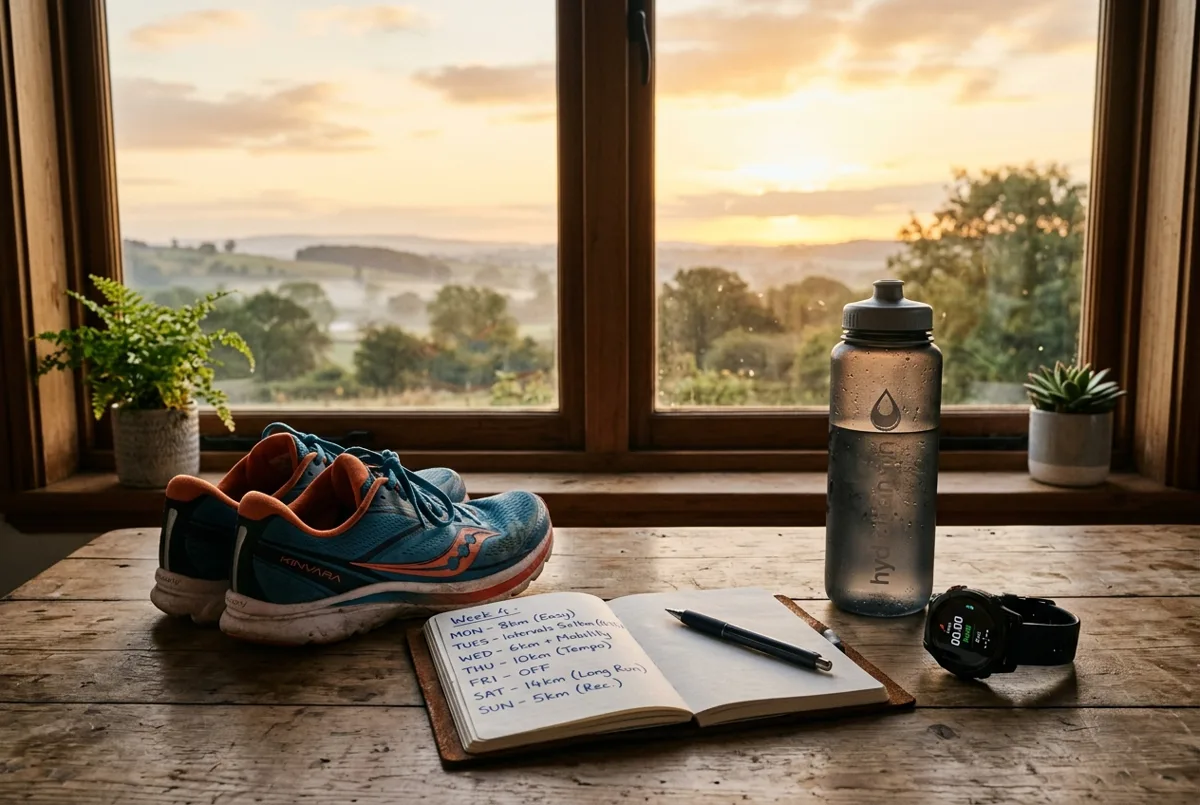
From couch to 5 kilometers in eight weeks — without breathlessness and without injury. A plan based on the run-walk method that works for thousands of beginners.
Running is the simplest sport in the world: all you need are shoes and a door. Yet, most people who start in January end up stopping by February. The reason is almost always the same — too fast, too much, too soon. This plan does the opposite: it starts slower than you think you need, and because of that, it helps you reach your first 5 kilometers.
Also, try our tool: AI Fortune Teller.
A principle that protects against injury
The World Health Organization recommends 150–300 minutes of moderate activity per week for adults. Running fits easily into this goal, but tendons and joints adapt more slowly than the heart and lungs. Hence, the 10 percent rule: do not increase your weekly distance or time by more than one-tenth. Breathlessness will fade after weeks, shin pain after months — it’s better not to invite it.
8-week plan (3 workouts per week)
- Week 1: 5 minutes of walking, then 8 × (1 minute of jogging + 2 minutes of walking), 5 minutes of walking.
- Week 2: 8 × (1.5 minutes of jogging + 2 minutes of walking).
- Week 3: 6 × (2 minutes of jogging + 1.5 minutes of walking).
- Week 4: 5 × (3 minutes of jogging + 1.5 minutes of walking).
- Week 5: 4 × (5 minutes of jogging + 2 minutes of walking).
- Week 6: 3 × (8 minutes of jogging + 2 minutes of walking).
- Week 7: 2 × (12 minutes of jogging + 2 minutes of walking).
- Week 8: 25–30 minutes of continuous jogging — this is your first 5 km.
Leave at least one day of rest between workouts. If the week was tough, repeat it instead of moving on. This plan is not a race.
Pace: speaking test
Jogging should allow you to speak in full sentences. If you're only panting — slow down. If you can sing — you can slightly speed up. Most training sessions in a runner's life, even for professionals, happen in this 'conversational' zone; it's what builds endurance.
Warm-up and cool-down
Five minutes of walking before running raises muscle temperature, and a few dynamic movements (leg swings, hip circles, high knees) prepare the joints. After your run, walk another five minutes and stretch your calves, hamstrings, and hip flexors — gently, without bouncing, for 30 seconds on each side.
Shoes and gear
You don’t need to buy expensive models, but it’s worth choosing running shoes rather than lifestyle sneakers. In a good store, ask for a foot analysis — proper cushioning really reduces stress on the knees. Seamless socks, a breathable shirt, and a watch or app to track time are all you need to get started.
Recovery is also training
7–9 hours of sleep, protein in every meal, and water throughout the day do more than any supplement. If you feel sharp, pinpoint pain or pain that worsens with each step — take a break and consult a physical therapist. Ordinary 'soreness' fades in 48 hours; injuries do not.
What after 5 km?
Maintain three runs a week for a month before adding distance. After that, you can sign up for a local parkrun (5 km, every Saturday, free) — running in a group is simply more enjoyable. And when 5 km becomes routine, 10 km is just a matter of applying the same principles patiently.