What is Grimoire — the Book of the Power of Spells and how does it work?
Grimoire is not just a book. It is a collection of recipes gathered over centuries for influencing reality: spells, symbols, rituals, prayers. Passed down from generation to generation as a key to invisible doors. It conceals not only instructions but also spiritual ethics — warning that every power comes with a price.
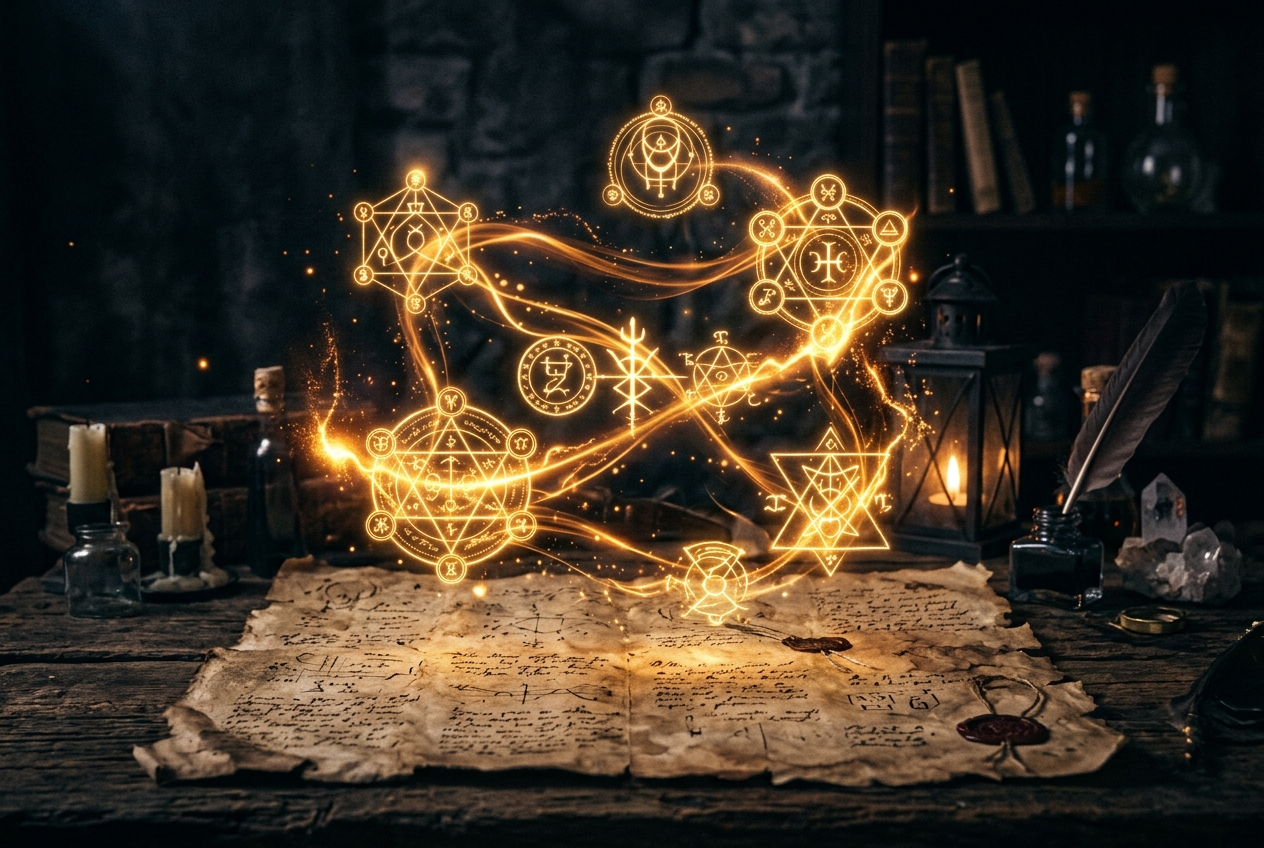
Most grimoires were handwritten, often encrypted to protect the knowledge from the unworthy. There you will find spells for summoning, protection, and transformation. Grimoire is also a map of your own psyche — a tool for working with the shadow and daily rituals.
Today's Books of Power draw inspiration from mythology, runes (/runy), tarot (/tarot), and esotericism. They become a collection of personal meanings: quotes, dreams, flashes of intuition. You write yourself into it.
Magic begins when you read it at night, by the faint flicker of light.
- Contains traditional spells and rituals
- Combines runes, tarot, and symbols from various traditions
- Creates a bridge between the material and spiritual realms
What were grimoires used for?
In the past, a grimoire was a tool for protection, healing, and influencing people, weather, and relationships. Practitioners recorded their experiences and successful rituals, passing them down. It wasn't just about power — the responsibility and maintaining balance were equally important, as every action carried its consequence.
Can you create your own grimoire today?
Yes — in fact, you should. Your own Book of Power is a daily journal of dreams, observations, notes from rituals, runes, or cards. When you keep spiritual notes, you create a contemporary grimoire. Your experiences, discoveries, and symbols gain power through intention and reflection.
What riches do Grimoires hold? Slavic and Celtic deities in the book of spells
Grimoire is not just a list of spells — it is the map of spiritual heritage. The Slavs had Perun, Mokosh, Veles. The Celtic world honored Dagda, Morrigan, Cernunnos. The book of spells connected requests, rituals, and prayers to these forces, seeking support or understanding of the life cycle.
Old grimoires were written in secrecy, sometimes using symbols or disguised under Christianity. Their strength lay not only in content but in the connections to archetypes common across cultures. Both Slavic and Celtic gods served as the strongest reference points for working with energy and intention.
Today, we discover the wealth of these figures through new sources and spiritual tools like /runy, /tarot, and /magia. Your own grimoire can be a place where you connect pagan deities with your own spirituality.
It is not just history — it is still a living fire.
- Perun — strength and protection (Slavs)
- Morrigan — warrior and transformative power (Celts)
- Cernunnos — deity of nature and wildness
How do deities appear in grimoires?
Their names were inscribed in protective, healing, and summoning spells. Their symbols often illustrated rites of passage, harvest, or battles against evil forces. Frequently hidden in metaphors or drawings, they allowed the reader to connect with ancient power.
Can you call upon these deities today?
You can — with respect and awareness. Contemporary magic utilizes archetypal energies, engaging in dialogue with ancient gods during rituals, visualizations, or meditations. The Book of Power thus becomes a bridge between worlds — the past and the present.
Ask the AI guide
AI · personal answer
What does daily practice with a grimoire look like? A blog of spiritual inspirations and self-analysis
Grimoire is not a dead book on a shelf. It is a journal, a guide, and sometimes a lazy whisper rustling in the middle of the night. Daily entries help reveal that magic lies in the details — in the repetition of small rituals. You craft spells, record dreams, jot down signs. You mix fear with hope, doubt with ecstasy.
By writing a spiritual blog, you engage in the ritual of presence, consciously looking within. It is a space for confronting your shadow, archetypes, and fears. Every page of your Book of Power becomes a living map: you repeat, cut, cross out. And you start anew.
You can draw inspiration from daily rituals by using /daily-rune or /meditate, utilizing the tools of modern spirituality. Your grimoire doesn't have to be pretty. It must be genuine.
Write even when your hands tremble.
- Everyday life: dreams, rituals, notes from cards and runes
- Transform your blog into a personal Book of Power
- Self-analysis through archetypes and daily events
How to start a spiritual blog or journal?
Write daily, even just in bullet points. Note the date, your mood, events, and symbols. Become your own observer: record recurring dreams, repeated thoughts, connections to cards or runes. By writing regularly, you create your own spells of transformation.
Why is it valuable to document your rituals?
Because memory is fallible. Recorded experiences help you notice patterns, repetitions, and even warning signs or indicators of progress. On difficult days, the grimoire reveals how far you've come. On good days, it gives you wings.
Archetypes and mythology: How did Jung and Campbell influence the meaning of the grimoire?
A grimoire is a metaphor—a journey into your inner self. Jung discovered that spells and rituals are codes of archetypes, deep patterns written in the collective unconscious. Campbell referred to it as the hero's journey, where each spell is a trial, and the power gained is transformation.
Modern books of power blend ancient myths with personal psychology. One writes their own tales into the grimoire: monsters, saviors, tests, rewards. You don’t need to be a magician; you only need to be honest with yourself.
In the Tarot’s Major Arcana (/tarot/mag, /tarot/jester) and the symbolism of runes (/rune/algiz), archetypes also dwell: the magician, the shadow, the guardian, the warrior. Reading them in your grimoire is the first step toward changing your life—regardless of what “magic” means to you.
A thousand old tales. One truth: magic has always been a way to cope with fear.
- The hero archetype: each book describes a journey
- The shadow—working through your own traumas and desires
- The symbolism of cards and runes provides ready tools for analysis
What is an archetype in spirituality?
Archetypes are primal, universal models of behaviors, desires, and fears. They manifest in dreams, symbols, stories (and grimoires). Working with archetypes allows you to understand which part of you dominates in a given situation—and how to consciously change it.
How to use mythology in your grimoire?
Rewrite your own mythology by identifying with characters, symbols, and stories. Write in your own hero (or antagonist), find the motif of the journey, discover spells for returning to yourself. Myth helps to name what cannot be expressed in ordinary language.
Spiritual Dictionary A-Z: Key concepts and symbols in the book of power of spells
The grimoire is filled with mysterious terms. Each one conceals a symbol, an intention, an archetype. Here is your tool for understanding the grimoire—a spiritual dictionary A-Z. You can quickly break down each spell, each sign.
Familiarity with these concepts makes your practice more effective and safer. "Bindrune," "Sigil," "Oracle," "Divine Shadow," "Intention," "Exorcism," "Transformation"—these set the direction of your work. If you don’t know what they mean, your practice may turn into aimless wandering.
A good grimoire, even a modern one, contains an index of symbols, cards, runes, and archetypes. Encountering a problem? Just return to the basics. Check /knowledge and /magic for further expanding your dictionary.
- Every symbol has a specific meaning and application
- The dictionary is essential for both beginners and advanced practitioners
- It helps interpret runes, tarot, and rituals
How to use the spiritual dictionary in your daily practice?
Browse the entries while creating or reading your own notes. The meaning of a word can sometimes differ depending on the tradition. If you get stuck—return to the dictionary. Independent study helps avoid misinterpretation and the risk of a dangerous ritual.
What are the most interesting concepts to know?
Sigil—a drawn symbol of intention;
Egregore—a collective force of thought energy;
Incantation—spoken aloud spell;
Runes—symbols from the Elder Futhark;
Destiny Matrix—a web of karmic and spiritual influences.
Mastering these terms opens new pathways.
How to start your own book of power and where to seek inspiration?
The hardest part is the first step. Are you afraid of making mistakes? They are part of the ritual. Your own grimoire doesn’t require knowledge of Latin or a leather cover. All you need is a notebook and a pen, sometimes a blog or /ai-spiritual.
Find inspiration in mythological texts, dreams, your own reflections, tarot cards (/tarot), runes (/runes), and hidden signs in everyday life. Write everything down—even the strangest thoughts. Over time, you’ll see that you are building a sacred code of your own life.
In the book, include: lists of dreams, your spells, quotes from favorite authors, notes from tarot sessions or horoscopes (/horoscope). This is your tool—you set the boundaries.
- Start with an ordinary notebook or an online file
- Connect dreams, intuition, rituals, and everyday life
- Draw inspiration from tools like /runes, /tarot, /horoscope
What should inspire you when creating a grimoire?
Slavic and Celtic mythology, your favorite tarot card, your favorite quote, or a dream. Don’t hesitate to draw from things that may seem mundane. Myths and spells also live in an ordinary breakfast, in a dream journal, in conversation. Every day is a ciphered spell.
How to maintain regular writing?
Set a minimum for yourself: one sentence a day. You can use inspiration from /game or ready spiritual challenges. Honesty is important, not volume. Over time, you’ll notice the first small changes—and you’ll be more eager to reach for your own book.