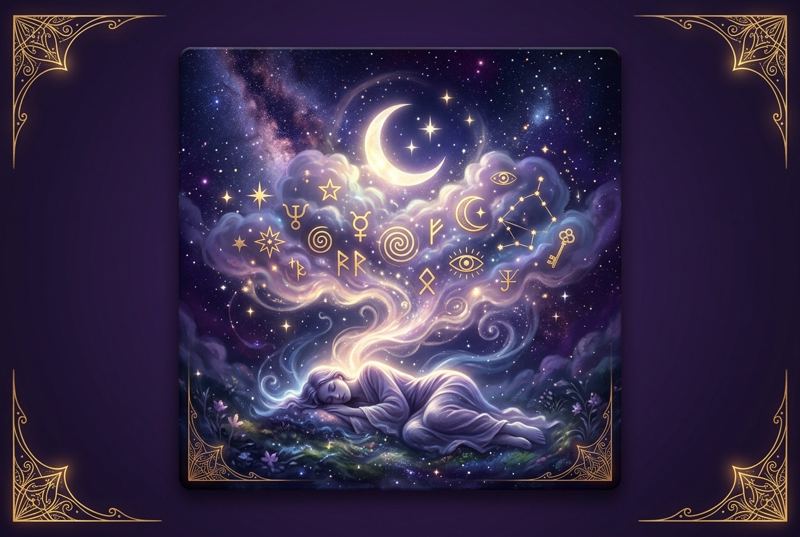
Science increasingly reveals what takes place in the brain during sleep. However, the symbolic significance of dreams lies beyond the scope of technology. Discover where certainty concludes and genuine interpretation begins.
What science says
Modern sleep neurobiology identifies two primary stages that cycle throughout the night. NREM (non-rapid eye movement) sleep is divided into three stages and is characterized by a gradual decrease in brain activity, the dominance of delta waves during deep sleep, and the absence of vivid dreaming. REM (rapid eye movement) sleep is the stage that has captivated researchers for decades: the eyes move rapidly, the body is nearly paralyzed, and the brain exhibits electrical activity akin to wakefulness. It is during REM that most of the dreams we remember come to life.
A significant breakthrough in understanding what transpires during dreaming was the activation-synthesis hypothesis formulated by Hobson and McCarley (1977). According to this theory, dreams arise from the chaotic activation of signals from the midbrain, which the cortex attempts to organize into a coherent narrative. In other words, the brain receives random noise and transforms it into a story. This concept was revolutionary, as it mechanistically demystified sleep, although it did not explain why the narratives developed by the brain are so intimately personal.
Equally important are the findings regarding the role of REM sleep in memory processing. Walker and Stickgold (2004) demonstrated that REM sleep plays a crucial role in consolidating emotional and procedural memory, indicating that dreams play an active role in processing experiences from the previous day. This is not a passive archiving process; during sleep, the brain actively reinterprets, synthesizes, and prioritizes memories. Stickgold, Hobson, Fosse, and Fosse (2001) advanced this further, confirming that during sleep, the brain reconfigures fragments of memories into new associations, which may form the neurobiological basis for the symbolic and metaphorical connections found in dreams. This sentence merits a second reading: science itself offers a mechanism explaining why dreams communicate through images and metaphors rather than in logical sequences.
An alternative line of research is the evolutionary perspective on the function of dreams. Revonsuo (2000) proposed the threat simulation theory, asserting that dreams evolved to practice responses to potential dangers. Consequently, fearful dream content is adaptive rather than pathological. This is an important distinction: if you dream of fleeing, being chased, or facing an exam for which you are unprepared, your brain is not signaling dysfunction; it is engaged in training.
Of particular importance for understanding the unique nature of dream experiences are the findings of Nir and Tononi (2010), who revealed in a review that during REM sleep, the deactivation of the dorsolateral prefrontal cortex reduces critical thinking and voluntary awareness in dreams. This explains why, in dreams, you do not find it strange that you are flying, that your grandmother is alive, or that the house has sixty floors. The part of the brain responsible for rational evaluation is largely inactive. What remains active are the visual cortex, the amygdala responsible for emotions, and memory structures. Thus, you dream in an emotional, visual, and associative manner—exactly how symbolic images operate.
An especially intriguing separate thread relates to lucid dreams. Dresler and colleagues (2012) demonstrated that in lucid dreams, there is a reactivation of the dorsolateral prefrontal cortex, confirming that metacognition during sleep is both neurophysiologically possible and measurable. You can be aware that you are dreaming, and that awareness leaves a trace in the fMRI scanner. The boundary between sleep and wakefulness is therefore not absolute but rather gradual.
Finally, it is worth noting Domhoff’s extensive research (2003), which showed in a comprehensive monograph that dream content largely reflects a continuity of concerns and relationships from waking life. You dream about what preoccupies you, unsettles you, and emotionally engages you. This challenges the notion of dreams as purely random occurrences and the perception of sleep as a portal to a reality radically different from everyday life. Dreams are anchored in your life, even if they express it in the language of metaphor.
From books
Scientific discoveries from recent decades gain deeper context when paired with both popular science and classical humanistic literature.
“REM sleep is like overnight emotional therapy: it processes painful memories, stripping them of their fear while preserving their essence. You wake up with a clearer perspective not because you have forgotten, but because your brain has rewritten the emotional significance of the experience.”
Matthew Walker, “Why We Sleep: Unlocking the Power of Sleep and Dreams” (2017)
Walker, a neuroscientist from Berkeley, presents decades of research on the function of REM sleep in a way that is accessible to all. His concept of overnight emotional therapy aligns well with the experiences practitioners have when working with clients: bringing a dream image into a therapy session and vocalizing it can be a therapeutic act in itself. This is not because the dream serves as a prophecy, but rather because the brain processes what it couldn't during the waking hours.
Carl Gustav Jung, in his work 'Über die Psychologie des Unbewussten' (1917), introduced concepts that still underpin psychological work with dream symbolism: the collective unconscious and archetypes. For Jung, dreams are not merely distorted wish fulfillment (as proposed by Freud), but rather the spontaneous expression of the unconscious, which communicates in symbols recognizable to all of humanity. Water, fire, mother, shadow, tower, road. These images appear in dreams irrespective of culture, era, or personal history. Jung did not assert that dreams predict the future; instead, he posited that they compensate for imbalanced conscious attitudes, highlighting what has been ignored or suppressed.
Sigmund Freud, in 'Die Traumdeutung' (1899), was the first to offer a systematic psychological interpretation of dreams, referring to them as the 'royal road to the unconscious.' Although many of Freud’s detailed assertions have been contested by science (most notably the idea that dreams fulfill suppressed sexual desires), his method of free association remains a proven therapeutic tool. The inquiry should not be: 'What does water signify in a dream dictionary?' but rather: 'What associations does this water hold for you personally?'
G. William Domhoff, in 'Finding Meaning in Dreams' (1996), proposed an empirical methodology for dream analysis that relies on quantitative content analysis of thousands of reports. His research indicates that patterns in dream content correlate with personality traits, relationships, and the dreamer's present concerns. This balance between subjective interpretation and empirical evidence is a bridge worth exploring.
Kelly Bulkeley, in 'Dreaming in the World’s Religions' (2008), illustrated through a comparative study that symbolic dream interpretation is a culturally universal practice, evident in Greek, Egyptian, Mesopotamian, Hindu, Tibetan, Islamic, and Christian traditions. Regardless of location or timeframe, people have imbued dreams with meaning and regarded them as messages. While this does not scientifically validate dream dictionaries, it grants them an anthropological significance that is impossible to overlook.
From practitioners’ experience
Academic and clinical insights converge in therapy offices, meditation halls, and card-reading spaces. Here is what those who engage with dream content daily have to say.
An integrative psychotherapist utilizing the Jungian approach asks clients to maintain a dream journal for at least four weeks prior to their first session. She notes that recurring images (such as house, water, unknown figure) often reflect the client's current emotional dilemmas. She doesn't interpret these images as prophecies, but as material for projection and inner dialogue. She emphasizes an essential point: even if we adopt a neurobiological perspective of dreams as processes of information integration, the very act of attributing meaning to those images holds therapeutic value. It is not the dream that brings healing, but the relationship formed with its content.
A mindfulness meditation teacher trained in the Tibetan tradition introduces the practice of 'dream yoga' as an extension of everyday awareness. She reports that among advanced practitioners, the capacity for lucid dreaming increases, which aligns with research by Dresler et al. (2012) on reactivation of the prefrontal cortex. However, the objective is not to control the dream, but to observe its content without attachment. What appears esoteric has identifiable neurobiological connections.
A tarot reader adopting a psychological approach that merges card reading with dream analysis identifies clear parallels between the symbolism of the cards and her clients’ dream images. The same archetypes—water, tower, guiding figure—surface in both dreams and drawn spreads. She explains to clients that cards and dreams function on the same symbolic level: the language of image and metaphor. Neither tool predicts the future; both illuminate ongoing psychological tensions, fostering a space for reflection. If you wish to delve into the symbolic language of the cards with this mindset, it is worthwhile to visit the card interpretation section in the Ezostylia app.
An herbalist and holistic therapist working with adaptogenic herbs notes that clients using valerian root or ashwagandha often report more vivid dreams and improved dream recall. She does not attribute this phenomenon to magic, but rather to an enhancement in deep sleep quality (consistent with pharmacological data). She views altered dream activity as an opportunity to discuss the client's mental state. Dreams serve as a mirror, not an oracle.
The history of dream dictionaries and their cultural significance in interpretation
Long before the advent of neurobiology, people have sought to comprehend dreams for millennia. Egyptian papyri from the Middle Kingdom, including the renowned Chester Beatty Papyrus from around 1279 BCE, feature enumerations of dream symbols with assigned meanings: good omen or bad omen, contingent upon the context. Mesopotamian cuneiform tablets, Greek oracle traditions linked to dream incubation (dreaming in sacred spaces while awaiting divine insight), Talmudic commentaries on dreams, Islamic interpretative texts, and Indian tantric traditions of dream work all premise that dreams convey information worth decoding.
Bulkeley (2008) reveals that regardless of the theology or cosmology adopted by a tradition, the interpretative mechanism is remarkably similar: the dream image is compared with a symbolic dictionary of that culture and contextualized within the dreamer’s life. This isn't magical thinking; it is a quest for language to articulate what the unconscious reveals when our rational mind is quieted.
Depth psychology versus neurobiology: alliance or contradiction?
A common misconception is to position Jung and Freud against modern neuroscience, as if they were addressing entirely different phenomena. In reality, they explore the same essence but at different levels. Neurobiology examines structures, neurotransmitters, and brain waves, while depth psychology focuses on meaning, psychic processes, and the connection between imagery and an individual’s life. These are not conflicting theories; they represent different dimensions of the same framework.
The activation of the visual cortex during REM sleep explains the vivid visual nature of dreams. However, it doesn't clarify why your mind conjures the image of a sinking ship on a night following a disagreement with your partner. Similarly, while the activation of the amygdala accounts for the emotional intensity of dreams, it does not elucidate why the emotion of fear manifests as a particular persecutor figure, which may vary between individuals yet serves the same symbolic role.
Jung would assert that it speaks in archetypes. A neuroscientist would counter that your associative cortex merges fragments of memory into narrative frameworks aligned with the most potent emotional patterns. Both perspectives are valid, but neither captures the full picture.
The skepticism of science towards dream dictionaries: where evidence holds strong and where it falls short.
An honest examination of the topic necessitates a clear distinction between what science validates and what it does not.
- Science verifies that REM and NREM sleep serve active biological and psychological functions.
- Science confirms that dream content is associated with the emotional experiences and relationships we encounter in waking life (Domhoff, 2003).
- Science establishes that lucid dreams exhibit measurable neurobiological correlates (Dresler et al., 2012).
- Science confirms that sleep aids in memory consolidation and emotional processing (Walker and Stickgold, 2004).
- Science does not affirm that a specific dream symbol holds a single fixed meaning that is independent of the dreamer.
- Science does not support the notion that dreams can predict the future.
- Science neither validates nor refutes Jung’s concept of the collective unconscious, as it extends beyond the current capabilities of empirical methods.
This differentiation is important. Dream dictionaries, as collections of symbol meanings (such as what water signifies, what fire represents), lack empirical verification in the sense of stating “if you dream of water, it means X.” However, they possess heuristic value: they provide potential associations that the dreamer may choose to accept or dismiss based on their personal context. This is not fortune-telling; it is a structured form of introspection.
How to implement this in practice
Knowledge of dream neurobiology and the tradition of symbolic interpretation can coexist harmoniously. You can embrace both perspectives while maintaining an awareness of what each layer contributes.
- Keep a dream journal. Record your dreams immediately upon waking, before your prefrontal cortex has a chance to rationalize or erase them from memory. A few sentences will suffice. Over time, you'll begin to recognize recurring images, figures, and places—this comprises your personal symbolic dictionary.
- Ask yourself what it means to you. When images like water, a house, or a stranger appear, instead of immediately consulting a dream dictionary, ask yourself: what does this word or image evoke in me? What memory, emotion, or association arises? Freud’s free association technique is both simple and effective.
- Use a dream dictionary as a suggestion, not an absolute. The Ezostylia dream dictionary, It offers symbolic interpretations that you can compare with your own associations. If a proposed meaning resonates, take it as a springboard for reflection. If it does not resonate, let it go.
- Compare dreams with cards. If you engage with tarot or oracle cards, try pulling a card while asking: “What message does this dream convey?” Treat it as an additional image for contemplation—not as the definitive answer, but as another mirror. A detailed exploration of Ezostylia card symbolism can be found in the cards section.
- Prioritize the quality of your sleep. Neurobiology makes it clear: without sufficient REM sleep, emotional processing is hampered. If you wish to remember your dreams and gain insights from them, maintain a consistent circadian rhythm, avoid alcohol (which inhibits REM sleep), and create an environment conducive to deep sleep. Support this process with herbs like valerian or ashwagandha, which practitioners report may alleviate sleep challenges and enhance sleep depth.
- Consider establishing a meditation practice. Regular mindfulness meditation, offered in the meditation section of Ezostylia, enhances your ability to observe your own mental states, which translates into improved dream recall and understanding.
Dreams, Tarot cards, and oracle cards: the symbolic language of imagery as a tool for reflection.
Ezostylia tarot and oracle cards, energized by this deck and interpreted by the Cards' Author, operate on the same level as dreams: they represent a language of imagery that speaks to the same part of the psyche responsible for generating dreams. Visual cortex, amygdala, associative memory networks. When you draw a card and focus on its imagery, you activate mechanisms analogous to those that shape a dream narrative.
This is no coincidence. Just like dreams, cards work as projections: your psyche assigns meaning to the images based on what is currently alive within you. The Tower card does not indicate that something will fall apart. Instead, it urges you to examine what in your life is shaking at its foundations. The Water card does not predict that you will drown. It prompts you to reflect on what flows within you and what remains beyond your control. This is the same mechanism that transforms a dream of a flood into an image of overwhelming emotion for one person, a symbol of purification for another, and a reminder of a specific past fear for yet another.
The tarot reader whose insights we reference in this article puts it beautifully: cards and dreams are two different entrances to the same cellar. You can enter from the realm of night or from the realm of imagery. In both cases, you will uncover what is waiting for your awareness.
An integrative model: neurobiology as a map, symbolism as a compass.
In conclusion, it’s worth proposing a way of thinking that connects both perspectives without downplaying either one.
Neurobiology serves as a map: it outlines the landscape, detailing the mechanisms that generate dreams, their stages, neural correlates, and biological functions. A map is invaluable. Without it, you would wander in the dark, attributing a literal prophecy or pathology to your dreams. Thanks to the map, you understand that a nightmare is not a verdict, that fear in a dream has an evolutionary basis, and that REM sleep processes emotions rather than producing mystical revelations on command.
Symbolism acts as a compass: it does not describe the landscape, but it indicates the direction. A compass does not inform you that there is a forest beyond the hill; it simply says: go north. A dream dictionary, a tarot card, or Jungian amplification of a symbol: none of these tools can definitively tell you what your dream ‘means.’ They can only guide you toward which direction is worth pursuing. And that is sufficient.
A map without a compass provides information without direction. A compass without a map offers direction without context. Together, they enable you to navigate through a fascinating, complex, and still uncharted terrain: the landscape of your own psyche.
If you wish to deepen your journey with symbolism and intuition, it's also beneficial to visit the other articles on the Ezostylia blog, where you will discover texts about numerology, runes, the destiny matrix, and other tools of symbolic reflection.
FAQ
Do dream dictionaries have a scientific basis?
Dream dictionaries, as glossaries of symbols, lack empirical confirmation in the sense that 'this symbol always means the same thing.' However, science does confirm that dream content is linked to the dreamer's emotions and relationships (Domhoff, 2003), and that the process of assigning meaning to dream images is of psychological importance. It is best to view a dream dictionary as a collection of potential associations rather than a predetermined key to translation.
Why don’t I remember my dreams?
Dream recall is influenced by several factors: the quality of REM sleep, cortisol levels upon waking, and above all, the moment you wake up. We tend to remember dreams best when REM sleep is interrupted, meaning when the alarm goes off in the midst of a dream. Keeping a dream journal and writing down your dreams immediately after waking (before you get up and engage in other activities) significantly enhances dream memory.
Can dreams predict the future?
Science provides no evidence for dream precognition. What is occasionally interpreted as prophecy can often be explained by retrospective confirmation (we remember dreams that 'came true' and forget those that didn't), by the fact that we tend to dream about issues already on our minds and likely to come to pass regardless, or by the way our actions after a 'prophetic' dream truly alter the situation. If a dream motivates you to reflect and change, its value is genuine. Not because of prophecy, but because of the self-awareness it fosters.
Can working with Tarot cards help in understanding dreams?
Yes, in several ways. Cards, like dreams, operate in the language of imagery and metaphor, weaving through the same associative networks. Drawing a card after reading a dream from your journal can offer a new perspective: not as an answer, but as an additional question. According to the interpretation of the Author of the Cards in Ezostylia, this method of work is a means of reflection, not prophecy. If you're interested in trying this, you can begin with the card section available in the app.
Can herbs affect dream quality?
Certain herbs, such as valerian root and ashwagandha, are traditionally associated in herbalism and preliminary pharmacological studies with alleviating sleep difficulties and enhancing sleep quality. Some users report experiencing more vivid dreams and improved dream recall. These effects likely stem from enhanced deep sleep quality rather than directly 'generating' dreams. Herbs can support sleep, but they do not substitute for good sleep hygiene or professional help in cases of more serious disorders.
Sources
- Hobson, J.A., McCarley, R.W. (1977). The brain as a dream state generator: an activation-synthesis hypothesis of the dream process. American Journal of Psychiatry.
- Walker, M.P., Stickgold, R. (2004). Sleep-dependent learning and memory consolidation. Neuron.
- Revonsuo, A. (2000). The reinterpretation of dreams: an evolutionary hypothesis of the function of dreaming. Behavioral and Brain Sciences.
- Nir, Y., Tononi, G. (2010). Dreaming and the brain: from phenomenology to neurophysiology. Trends in Cognitive Sciences.
- Stickgold, R., Hobson, J.A., Fosse, R., Fosse, M. (2001). Sleep, learning, and dreams: off-line memory reprocessing. Science.
- Domhoff, G.W. (2003). The scientific study of dreams: neural networks, cognitive development, and content analysis.American Psychological Association.
- Dresler, M. et al. (2012). Neural correlates of dream lucidity obtained from contrasting lucid versus non-lucid REM sleep: a combined EEG/fMRI case study. Sleep.
- Walker, M. (2017). Why We Sleep: Unlocking the Power of Sleep and Dreams.Scribner.
- Jung, C.G. (1917). On the Psychology of the Unconscious.Rascher Verlag.
- Freud, S. (1899). The Interpretation of Dreams.Franz Deuticke.
- Domhoff, G.W. (1996). Finding Meaning in Dreams: A Quantitative Approach. Plenum Press.
- Bulkeley, K. (2008). Dreaming in the World’s Religions. New York University Press.