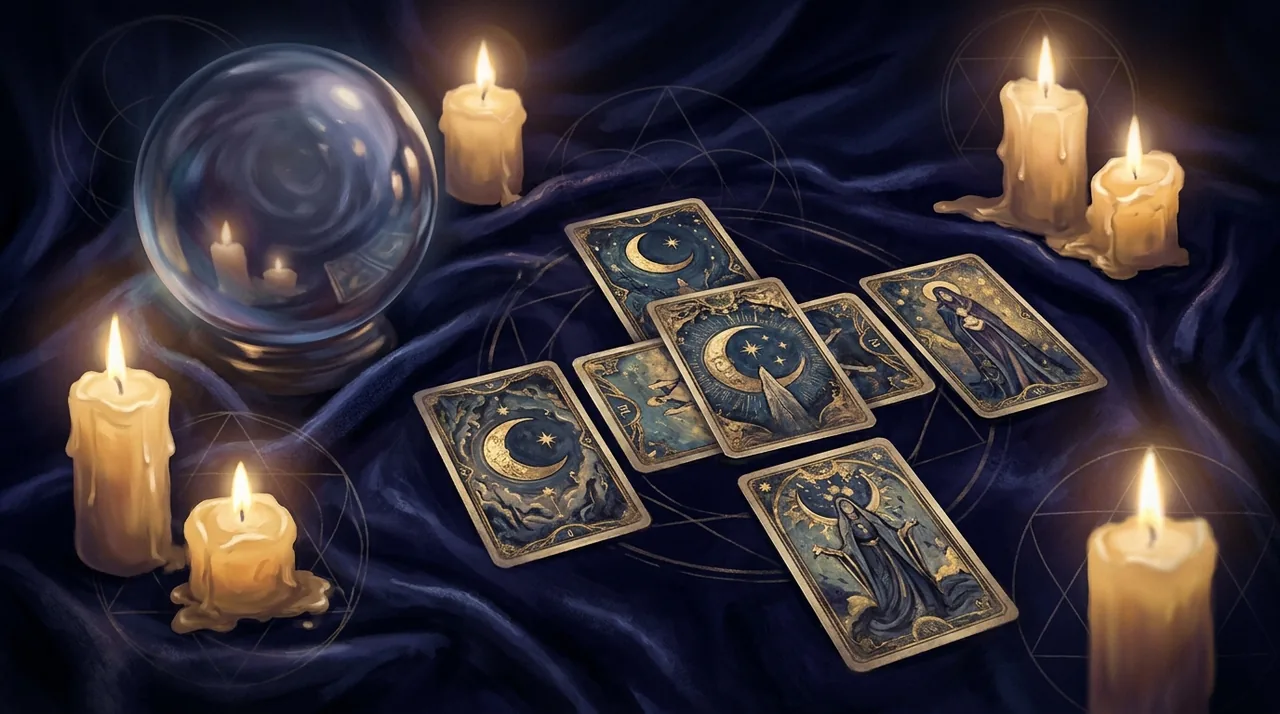
This article discusses the meaning of the phrase 'tarot yes or no' and teaches how to interpret card answers. Learn how to trust your intuition while reading tarot.
Tarot Yes or No - What It Means and How to Read Card Answers
What is 'tarot yes or no'?
'Tarot yes or no' is a practice of asking the cards a very specific question when you need a quick reading of the direction of a situation. Unlike a broad reading, you’re not looking for a full story here, but for a clear signal: is the energy conducive to action, or does it rather suggest stopping, slowing down, or changing plans? This is why the phrase tarot yes or no appears so often in everyday, relational, and professional decisions. It is about the simplicity of the question and the clarity of the answer, but without flattening the meaning of the cards to a dry 'yes' or 'no'.
In this method, precise questioning is essential. Instead of asking generally 'will this work out', it’s better to ask 'is this step beneficial for me right now' or 'will this conversation lead to progress in the right direction'. This approach to working with the cards shows not only the outcome but also the quality of the energy: openness, blockage, maturity, haste, tension. This is what is unique in the 'yes or no' reading - it does not judge the person nor close the matter, but helps to see if the moment is supportive. If you feel that you need a more structured perspective, this form can be a good starting point for further interpretation in the tarot section.
It’s also worth remembering that tarot yes or no does not work like a judgment vending machine. The cards may indicate agreement, warning, or a conditional response like 'yes, but with reservations'. Therefore, most sense emerges when you treat this reading as a support for decision-making, not a replacement for common sense. It is a method for quick discernment that organizes emotions and facilitates seeing what was previously vague.
How to Read Card Answers?
When reading answers in tarot, the most important things are not only the symbol of the card itself but also its position, the energy of the entire question, and your first impression. One card may suggest 'yes' if it carries movement, agreement, growth, and lightness, but it can also mean 'no' when it shows blockage, chaos, or the need to stop. Therefore, it’s not worthwhile to look solely at a single sign. What matters is what the card is doing in response to a specific question and how it fits into the whole situation.
In reading card answers, details also count: color scheme, the direction of figures, presence of obstacles, recurring symbols, and whether the card supports action or rather warns against haste. A good reading does not consist of forcefully looking for a positive outcome but rather reading the energy honestly. If the question concerns a decision, it’s worth checking if the answer leaves space for action now, or rather indicates a need for preparation, conversation, or waiting. This is often more important than a simple 'yes' or 'no'.
It also helps to maintain consistency between intuition and logic. When a card gives a signal, take a moment to pause and check if the answer matches what you already know about the situation. Tarot is not meant to replace common sense but to complement it. Therefore, it is best to read the answer in a simple, calm way: what the card supports, what it complicates, and what direction it gives. This method is clear, practical, and respects both the symbolism of the cards and the real life of the querent.
Trust Your Intuition
In the question of tarot yes or no, intuition is one of the most important pillars of interpretation. The cards do not function like a rigid machine with a simple answer button, but rather like a language of symbols, emotions, and associations. Two people may draw the same set of cards and interpret them differently, if their context, inner state, and intention of the question are different. Therefore, it’s worthwhile to first pause for a moment, breathe, and see what the given card awakens in you before reaching for a ready-made rule.
Intuition develops through practice, not pressure. Observing the first impression after revealing a card and recording associations helps, as well as checking how these feelings relate to your life situation. If the card evokes calm, lightness, or a sense of openness, it may be guiding toward a positive answer. If heaviness, tension, or ambiguity arises, it sometimes indicates a blockage, but not always means a firm 'no'. This is why intuition is so valuable in reading tarot.
In practice, it’s best to combine intuition with knowledge of symbolism. It’s not about guessing, but about consciously listening to yourself and observing the cards in relation to the question. As you learn this process, tarot becomes more precise and personal. If you want to deepen this way of working, other materials on tarot may also be helpful, where it’s easier to see how the meanings of the cards change depending on the layout and intention.
Which Cards Indicate 'Yes'?
In the question of tarot yes or no, a positive answer typically counts on the energy of movement, openness, and agreement. Cards that often support 'yes' include The Fool, The Star, The Sun, The World, Ace of Wands, and Ace of Cups. Their message is usually straightforward: something has the
space to begin, develop, or bring relief. However, this is not a guarantee without effort. It’s more a sign that the situation has a natural momentum in a good direction and it’s worth not blocking it.
In practice, a positive card speaks not only about the outcome but also about the quality of the answer. The Sun shows clarity, transparency, and a sense that things are starting to come together. The Star brings hope and rebuilding after a time of tension. Aces open new potential, so they often signal the beginning of something important, not yet fully formed, but already with a clear impulse. In relationships, the Two of Cups also works well as it indicates mutuality, understanding, and readiness for contact.
If a positive card appears, but obstacles are visible in the layout, the answer may be more conditional. Then the meaning rather sounds: yes, if you act consciously or yes, if you give the matter time. This is why it’s worth asking specific questions grounded in reality. Instead of testing fate, it’s better to examine readiness, timing, and direction. Tarot then responds more clearly and without unnecessary confusion.
Which Cards Indicate 'No'?
In the question of tarot yes or no, a negative answer most often arises from cards of stopping, overwhelm, disappointment, or warning. Such signals include, among others, Ten of Swords, The Tower, The Devil, Five of Cups, Five of Swords, and Eight of Swords. Their message does not boil down
to a simple 'bad'. Instead, they show that the situation is tense, unprepared, too risky, or based on something that needs to be honestly named. Tarot in this configuration does not frighten but reveals where the energy does not flow freely.
A 'no' card does not have to mean a permanent refusal. Sometimes it says: not now, because the moment is weak. Other times: no, because the question was poorly posed or is based on hope rather than real foundations. The Tower can indicate a sudden breakthrough and the necessity of completely rebuilding the situation, while the Eight of Swords shows limitations that may be stronger in thought than in the external world. Therefore, a single card should not be read in isolation from the context. The entire layout matters and what happens between the cards.
In practice, a negative answer is often an invitation to correct. Instead of asking 'will it work out', it’s better to ask 'what is blocking this process' or 'what needs to change to move forward'. This form provides more agency and helps use tarot as a tool for reflection rather than a simple pass or fail test. Then the answer becomes useful, leading to better choices rather than just a quick verdict.
Sample Questions for Tarot
A good question in tarot should be specific, calm, and open to a meaningful answer. In the topic of tarot yes or no, questions about direction, possibility, or conditions work best, rather than forcing a simple verdict. Instead of asking 'will he return?', it’s better to ask: 'what energy stands between us?' or 'does this relationship have potential for development in the near future?'. This way, the cards reveal the process, not just the outcome.
Questions concerning your role are also helpful. You may ask: 'what supports me in this matter?', 'what blocks this plan?' or 'how can I best approach this decision?'. This format allows the tarot to respond more precisely and practically. If the question is too broad, the answer often becomes murky, leading to easy misinterpretation. The better you pose the question, the clearer the answer will be from the cards.
It’s important to remember that tarot works best when you seek understanding, not just confirmation of your own hope. Questions can pertain to relationships, work, plans, or emotions, but it’s always good to leave room for nuance. You can ask: 'is this direction beneficial for me?', 'is this a good moment to take action?' or 'what are the chances if I take this step?'. This form supports an honest and clear interpretation.
FAQ
Does tarot really answer only 'yes' or 'no'?
No. In practice, the 'yes or no' reading is just a simplified form of working with the cards. It helps quickly see the direction, but usually reveals the background: emotions, tensions, conditions, and what lies behind the decision. If the card is strong and clear, it can give a signal. If it is more complex, the answer may be closer to 'yes, but cautiously' or 'not now'. Therefore, it's best to use this method for preliminary discernment and then refine the question.
How do I know if a card means 'yes' or 'no'?
It helps to combine three things: the symbolism of the card, its energy, and your first impression. If the card is open, clear, and moving, it usually supports a positive answer. If it shows blockage, collapse, chaos, or closure, it more often signals refusal or obstacle. A practical example: The Sun when asking about a new project usually gives a 'yes' signal, but the Eight of Swords with the same question may indicate that something is holding you back. That context makes a difference.
Is intuition more important than the meanings of the cards?
The best reading occurs when both elements work together. Intuition helps sense the tone of the answer, while knowledge of the cards organizes what you feel. If you have a strong first impression after drawing a card, check it thoroughly: what in this card attracts attention, and what brings resistance. For example, a positive card may give inner discomfort if the situation requires more time. That signal is worth taking seriously, as intuition often picks up details that the mind has not yet organized.
Sources
- Esoteric tradition — the symbolism of tarot, runes and numerology handed down in European culture.
- Cultural symbolism — comparative interpretations of archetypes and signs.