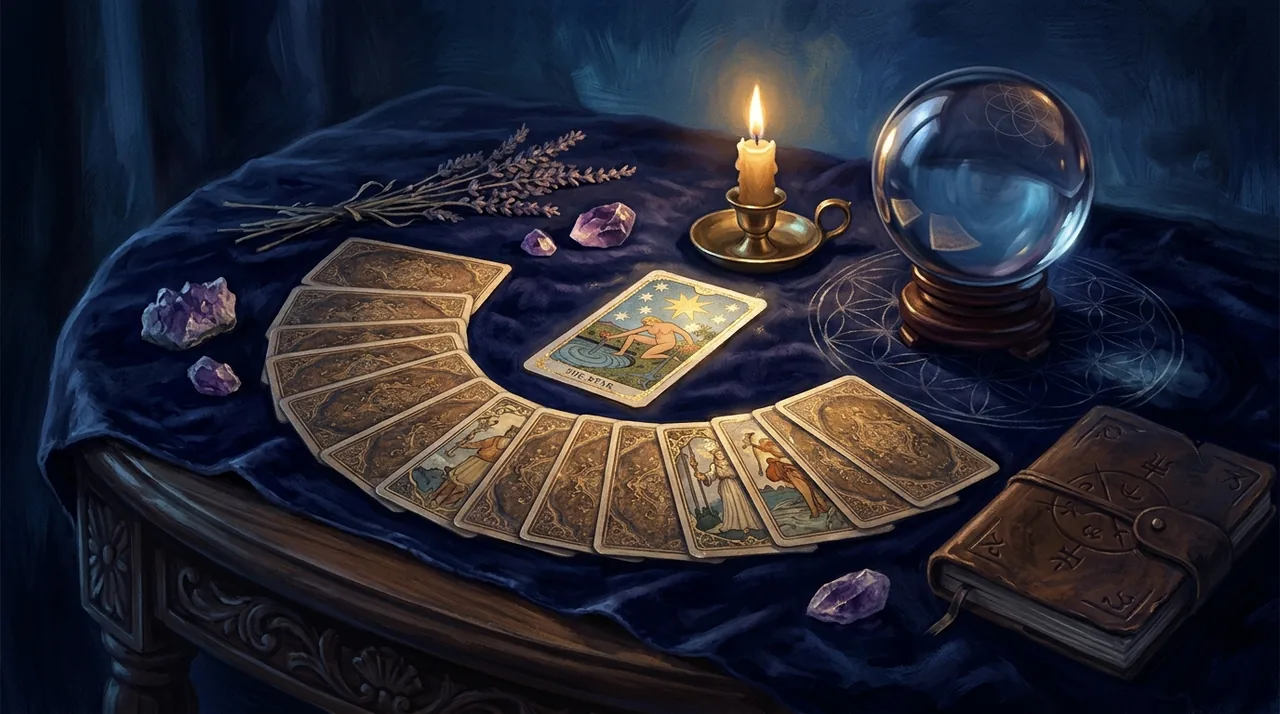
Learn how to utilize the free daily tarot by selecting a single card. Uncover reading and interpretation techniques, and invite the energy of tarot into your daily life.
Daily Tarot Free One Card – How to Read and Interpret It
What is daily tarot?
Daily tarot is a simple, everyday practice of pausing with one card and approaching the day with heightened awareness. This reading isn't meant to confine the future to a single answer, but to capture a theme, mood, or task that requires your attention today. One card chosen in the morning
or at a significant moment of the day can serve as a clear signal: where to direct your energy, what not to overlook, and what to base your decisions on.
In practice, daily tarot is most effective when approached calmly and without pressure. It’s not a test of intuition or an attempt to prove anything. Instead, it's a quiet dialogue with a symbol that organizes your thoughts and helps identify what already lies beneath the surface. This is why the term 'daily tarot free one card' resonates with those seeking a simple and accessible way to connect with the cards each day.
No elaborate ritual or special preparation is needed. Just a moment of focus, one specific intention repeatedly, and a willingness to accept the answer without trying to fit it into a comfortable narrative. If you want to deepen this practice, the tarot section may also be beneficial, where you'll discover a broader context for working with cards and daily symbolism.
How to choose a free tarot card?
The simplest approach is to select one card from your own deck, but you can also utilize an online tool if you desire quick and convenient access. What truly matters is not the location of the draw, but the intention behind it. Take a moment, mentally name the theme for the day, and allow
the selection to be a conscious act aimed at seeking an answer, rather than an impulsive gesture.
If you're physically drawing a card, shuffle the deck slowly and without rush. When using a digital version, treat clicking as equivalent to the same gesture. In both cases, it's about mindfulness, not perfection in ritual. This is why the free daily tarot one card is so practical: it doesn't require many steps, yet can provide a valuable reference point for the entire day and help organize your thoughts.
After drawing, avoid rushing into interpretation. First, observe the image, colors, figures, movements, and overall mood of the card. Only then connect this with your question. This sequence allows for a deeper, more personal reading of the card. If you'd like, jot down your responses for several days, as regularity often reveals how daily tarot unfolds within the rhythm of your life and which patterns tend to recur.
Interpreting the chosen card
In a daily tarot free one card reading, the most crucial aspect is to calmly reflect on what the symbol presents. It's not about forcefully matching a meaning but rather about attentively noticing which theme emerges today. Pay attention to the figure, colors, gestures, and the emotions evoked by the card. Sometimes, your first instinct can convey far more than a standard definition.
Understanding the card's meaning becomes richer when you relate the image to your own experiences. Ask yourself a simple question: where in my life is this energy most apparent today? It may pertain to relationships, work, decisions, or inner tension. It's important to interpret the card as a suggestion, not a judgment. Its message is intended to help you see your situation more clearly, rather than diminish your agency.
A useful technique is to write down the first thought that arises after drawing the card. Then, compare it with your daily experiences. This practice helps you recognize subtle connections and builds trust in your intuition. At that moment, one card transforms from merely an image into a clear signal that you can calmly relate to your everyday life.
The meaning of the card in the context of daily life
One card holds its greatest value when you immediately connect it with a real situation. If it signifies a slowdown, you might not want to push for a conversation that requires time. If it indicates movement, check whether you’ve been postponing calls, messages, or decisions that are ready to be made. The daily tarot free one card reaches its fullest potential when it serves as a practical reference point rather than a detached remark.
In daily life, the card can highlight something very specific: a need for a pause before an important meeting, the necessity to set a boundary in a conversation, or a reminder not to act out of haste. Its meaning doesn’t have to be grand or dramatic. Sometimes a small adjustment in approach is all that’s needed for the day to unfold more calmly and consciously. It’s crucial to ask not just about the symbol's meaning but also how it influences your choices today.
In the evening, it’s worthwhile to revisit the drawn card and see where its message played out in practice. Was there a moment when you needed to slow down, maintain distance, or trust yourself? Such simple observations help cultivate mindfulness without overwhelming theory. Over time, one card becomes less of a prediction and more of a clear guide for the day.
Common mistakes in reading tarot cards
The most common mistake is extracting just one word from the card and considering it the only truth. For instance, a card depicting stagnation doesn't automatically signify failure, just as a card of movement doesn’t necessarily demand immediate action. Without considering the context, it’s easy to lose the intended meaning and assign the symbol a significance it doesn't possess.
The second mistake is interpreting the card through a lens of fear. When someone is tense, a neutral image may be misconstrued as a warning, while in reality, it could simply be a reminder to slow down or stay calm. Rather than wondering what negative might happen, it's more beneficial to ask what deserves greater attention today. Such a shift promptly clarifies the reading.
It's also wise to refrain from mechanically comparing each card to rigid definitions. The same card may convey a different meaning depending on the question and the context. If you're using the Ezostylia original deck, stay attuned to the energy of this deck and the interpretations of the Author of the Cards, as these provide coherence and character to the reading.
Why is it worthwhile to practice daily tarot?
Regular daily tarot fosters mindfulness. It's a simple pause where you reflect on what's important to you today and what may need your calm attention. This practice doesn't have to be lengthy or complex. One card is sufficient to organize your thoughts and enter the day with enhanced awareness. Over time,
you'll begin to notice your emotions more quickly and respond to them with greater gentleness.
Practicing with one card also strengthens your intuition. Not because it provides ready answers to everything, but because it hones your ability to notice signals. The more often you return to the cards, the easier it becomes to recognize when a message pertains to relationships or inner work. It is in such daily simplicity that trust in your own feelings and the rhythm of the day is cultivated.
It’s also valuable to practice daily tarot as it creates a space for reflection without pressure. It’s a moment when you don’t have to prove anything. You can observe how the card reflects your attitude, plans, or tensions. If you wish to delve deeper into this tool, exploring tarot can be a great complementary practice. One card often serves as the best starting point for a conscious journey.
FAQ – Frequently Asked Questions
How often should you use daily tarot?
Ideally, once a day at a consistent time, so that the practice remains calm and clear. One card is sufficient if you want to cultivate mindfulness and observe how its message relates to the day’s events. More frequent draws typically introduce chaos and make it harder to discern meaning. Regularity and a genuine willingness to reflect on oneself are more important than the number of questions.
Can you draw multiple cards for one day?
You can, but with daily tarot, it’s generally better to embrace simplicity. One card helps focus on the essence and does not overwhelm you with excessive information. If the question is more complex, a spread with more cards will usually make more sense. In daily practice, one card most clearly demonstrates how intuition functions and how to interpret a symbol without confusion.
Is tarot for everyone?
Tarot can be for those who approach it with openness and respect. You don’t need extensive experience to begin with one card and explore how its message connects to your daily life. What matters most is to treat tarot as a tool for reflection, not a replacement for your own thinking. If you're looking for a serene way to connect with your intuition, daily tarot can be a great starting point.
Sources
- Esoteric Tradition — the symbolism of tarot, runes, and numerology passed down through European culture.
- Cultural Symbolism — comparative interpretations of archetypes and signs.