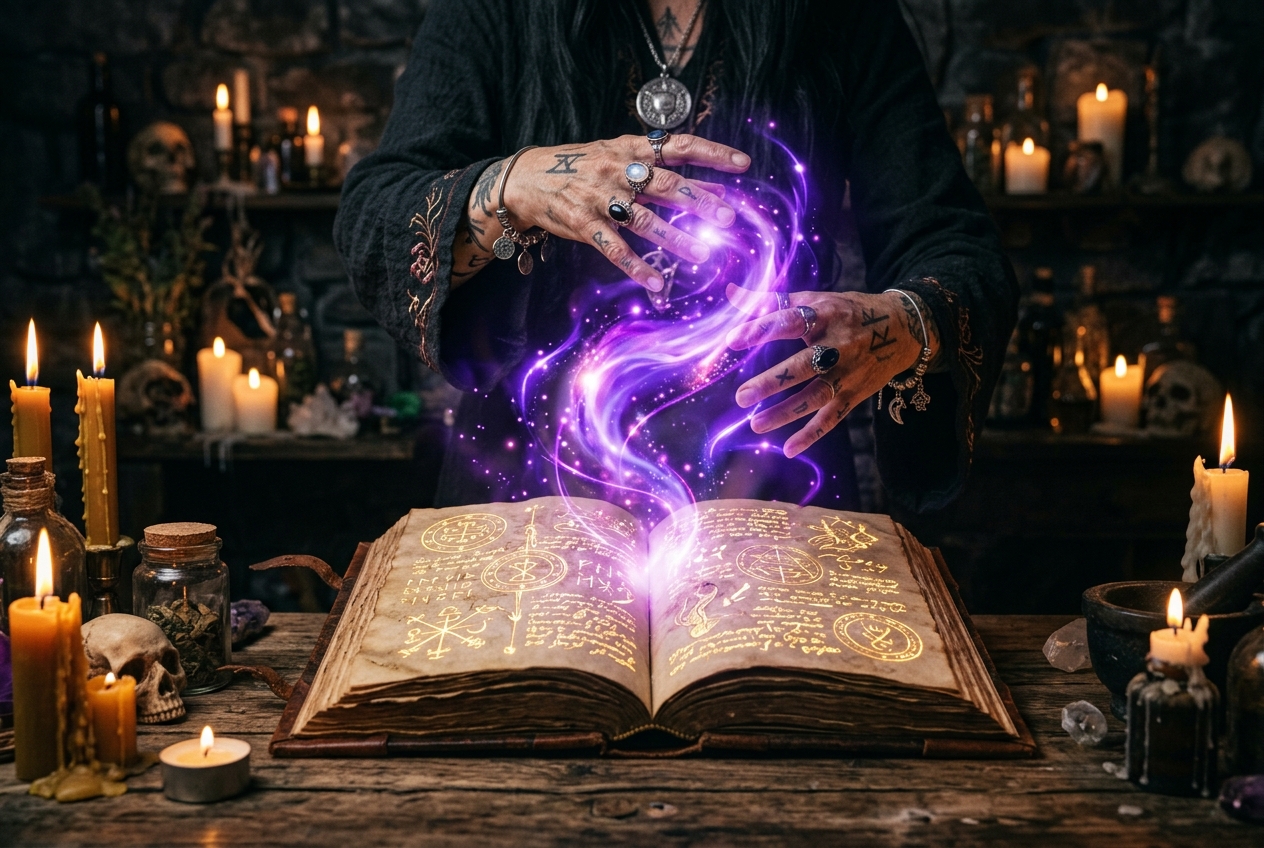
Every day we rediscover the magic of Polish charms and spirits. Be inspired by the quote of the day and learn about the richness of spell excerpts and their meaning.
Quote of the Day — Polish Charms and Spirits and Spell Excerpts
Quote of the Day — The Essence of Charms and Spirits
In Polish tradition, charms and spirits were not abstract concepts but integral to daily understanding of the world. Charms encompassed anything that acted through word, gesture, sign, or object: whispering over water, tying a red thread, smudging with herbs, placing a bowl of salt under the bed, or interpreting dreams as guidance. The spirit, on the other hand, was a liminal figure, usually associated with the forest, crossroads, mill, or places where one felt less secure. In folk tales, it served as a reminder that not everything can be controlled and that not every temptation leads to good.
Such motifs played an important cultural role. They explained things that could not be easily clarified while also ordering fears related to illness, infertility, sudden misfortune, or conflict at home. In practice, charms could be protective, for instance when garlic was placed at the threshold, a sign of the cross was drawn over a child, or herbs were hidden under the pillow to protect sleep. Spirits, in turn, appeared in warnings: meant to caution against pride, greed, and easily succumbing to what glitters but does not bring peace. Thus, their presence in culture was not only frightening but also educational.
In Polish folklore, we find many examples of such images. There are sabbats on mountain meadows, charms over milk, cattle invocation, whisperers lifting curses, as well as spirits sitting by stones, wells, and bridges. In some regions, it was believed that a properly spoken formula could protect a home from the “evil eye,” and herbs gathered on a specific day could strengthen domestic order. That is why charms and spirits are so important in the collective memory: they show how ancient people combined fear, hope, and life practices. If you wish to explore the meanings hidden in such images, the tarot can also be helpful, as it similarly organizes symbols and emotions.
Spell Excerpts in Tradition
Spell excerpts are ancient records that linked words with protective, divinatory, or ritual practices. They could take the form of a short formula written on a piece of paper, a notebook note, a prescription passed down orally, or sometimes a fragment of text glued into a household book. Historical sources reveal, among other things, apotropaic records, which were meant to ward off misfortune, as well as texts mixing prayers, spells, and recommendations regarding herbs. In old homes, they were carefully preserved because they were believed to hold power derived not only from their content but also from the act of writing itself.
The historical context of such excerpts is very interesting, as it showcases the meeting of many orders: religious, folk, and practical. In Polish tradition, there were records from prayer books, household notebooks, herbals, and notes from those involved in herbal healing or whispering. Often, old protective formulas appeared alongside crosses, for example over water, fire, or bread. There were also instructions regarding gathering plants at a specific time of day, keeping salt at the threshold, or speaking words over a sick animal. For people, this was not chaos but a coherent way of caring for the safety of family and homestead.
Today, spell excerpts are a valuable source of knowledge about the mentality of past eras. They show that words were treated as tools that could organize reality, support memory, and strengthen intention. Some texts were passed down from generation to generation, others circulated locally and changed with the needs of the community. Their value also lies in revealing the everyday concerns of ordinary people: their worries about home, health, weather, relationships, and crops. Thus, spell excerpts are not just curiosities but important traces of cultural history.
Famous Polish Charms
In Polish tradition, the word “charms” encompassed many different practices, from simple protective measures to rituals connected to significant moments in life. Some of the most well-known included spells cast over water, whispering over a child, tying a red ribbon, smudging the house with juniper or mugwort, and placing a bowl of salt in a corner of the room. In some regions, it was also believed that warm ash from the stove, bread placed at the threshold, or water used to wash the face could “take away” negative influence and restore peace. These practices were not flashy, yet they held significance as they were woven into the rhythm of everyday life.
An important role was played by charms related to home and family. When bringing new fire into the home, words of blessing were spoken to ensure harmony and abundance. Red threads, herbs under pillows, or symbolic gestures by the cradle were used for the protection of children. Young ladies and women relied on rituals involving water, mirrors, or wreaths, as they were believed to help with matters of the heart and interpreting the future. Farmers, on the other hand, attended to rituals involving animals, wells, and fields, believing that the right word could enhance yield and livestock health.
Thus, famous Polish charms had a very local, practical character. Some were associated with fertility and bounty, others with protection against the “evil eye,” and still others aimed at calming fears after illness, arguments, or failed harvests. Many were based on simple items: threads, salt, bread, water, herbs, and fire. It was this closeness to everyday life that allowed charms to remain so enduring in culture. They did not separate people from reality but provided a symbolic form of care that could be enacted with their own hands.
Spirits — Their Place in Polish Mythology
Spirits are figures rooted in folk imagination, associated with chaos, deception, and untamed forces. In Polish folklore, they had many faces: sometimes mischievous, sometimes amusing, and at times menacing. Their origins intertwine with ancient perceptions of forest, wilderness, and swamp spirits, as well as later religious influences that bestowed a more distinct demonic tier. The spirit was not merely a monster but a figure straddling the boundary between order and temptation.
In legends, spirits appeared as opponents of clever peasants, monks, or wanderers who managed to escape peril through wit, prayer, or humor. In this way, the spirit became an important element of moral tales: it taught vigilance, illustrated the price of pride, and reminded that not all that glitters is good. In Polish mythology, it thus played a role not only as a frightener but also as a sample of folk philosophy of life, where wisdom triumphed over chaos.
Examples of well-known spirits appear in tales about Boruta, Rokita, or other beings straddling hell and the forest. Boruta was often depicted as a noble spirit, cunning and tied to a specific place, while Rokita was associated with swamps and the treacherous nature of wetland areas. Such characters are not merely folkloric decoration. They construct a language of symbols through which people interpreted their own fears, desires, and weaknesses, passing them down through generations.
Quotes about Charms and Magic
Polish literature often shows that magic begins where a person tries to name what overwhelms them. In Juliusz Słowacki's “Balladyna,” the world of charms intertwines with guilt, temptation, and the consequences of choices, while in Adam Mickiewicz's “Dziady,” ritual and word become ways to connect with the invisible. These examples well illustrate that charms in culture are not mere embellishments of a plot but tools for telling stories about conscience, memory, and transformation. A quote about magic can thus concern not only wonder but also responsibility for one's own decisions.
In Polish poetry and prose, the thought that words have causal power often recurs. One only needs to recall the images from Cyprian Norwid's works, where meaning arises from attention, or the folk tone of records in which a single sentence uttered at the right moment organizes chaos. Often, the most important aspect is not the “spell” itself but the direction of thought. This is why quotes about charms resonate so well with reflections on intention: they teach that meaning does not come from an excess of effects but from internal clarity.
In folk and literary tradition, we also find many short formulas that act like small rituals of language. Proverbs, prayers, spells, and even ordinary well-wishes could organize emotions and tame uncertainty. In this sense, the quote of the day does not have to be a grand manifesto. It can be a simple sentence that captures attention and reminds us of the power of words. It is this quality that connects ancient stories about charms with modern, symbolic readings of the world.
Practical Magic — What Can Be Conjured?
Practical magic, in a daily sense, can mean very specific, calm actions that help regain order and mindfulness. In folk tradition, such activities included smudging the home with herbs, washing hands with water added with a sprig, placing bread at the threshold, sprinkling ash over a quarrel's aftermath, or tying a thread around the wrist as a sign of protection. Today, similar meanings can be found in simple rituals: lighting a candle during a moment of silence, writing down one intention on paper, tidying the table before work, or closing the day with a short meditation. It is about the gesture that directs attention.
In magical practice, seasonal and domestic rituals are also important. Many people use them when changing seasons, cleaning before holidays, starting a new month, or when needing a symbolic “reset.” It takes just one mindful action: airing out the room, changing water in the vase, writing down a dream upon awakening, or burning a piece of paper with what no longer serves. Such actions do not need to be complicated to be meaningful. Their strength lies in their repetition, focus, and the feeling that one is participating in organizing their own space.
A safe practice always respects boundaries and does not create tension. It is not about invoking fear or promising miraculous results but supporting inner order. Therefore, rituals associated with gratitude, sleep, breath, writing intentions, and peacefully closing the day work well. One can also engage in symbolic work with cards, observe images, and note associations that arise during reflection. In this context, magic becomes a simple tool of self-care rather than something that detaches one from reality.
FAQ
What do charms mean in Polish tradition?
In Polish tradition, charms referred to practices based on words, gestures, signs, or objects, meant to protect homes, people, and animals or to organize daily experiences. They fell within the realm of folk beliefs, as they helped explain what was disturbing, such as illness, infertility, a child’s fear, or tension within the family. Charms were thus part of practical culture, not just a whimsical curiosity.
Who was the spirit in ancient tales?
The spirit was a liminal figure associated with temptation, chaos, and places distant from everyday order. In ancient tales, it could be clever, ironic, sometimes menacing, but often also playfully ironic. It appeared at crossroads, bridges, forests, and old mills, where one felt a proximity to the unknown. This way, it functioned both as a warning and as a colorful figure of folklore.
What was the purpose of spell excerpts?
Spell excerpts served to record protective formulas, ritual recommendations, prayers, herbal prescriptions, and short texts linked to magical practices. People preserved them to enhance their sense of security, organize family memory, and support household rituals. Sometimes they were transcribed from books, and sometimes they were orally passed down and only later recorded. Their function was both practical and symbolic.
Did spell excerpts relate to religion?
Yes, many excerpts combined Christian prayers, signs, and invocations with folk protective practices. This combination demonstrates that ancient people did not sharply separate faith, ritual, and the everyday need for security in life. In a single record, a blessing, a plea for protection, and an old folk formula could coexist. Thus, these excerpts are now an important testament to border culture.
Did charms in folk tradition have only negative implications?
No. Many charms had protective, organizing, or supportive functions. They concerned home, health, sleep, yield, and relationships, thus were not solely associated with danger. This is important, as it reveals a more complex picture of ancient imagination.
How to understand these motifs today?
Today, they can be read as a language of symbols, memory, and care for inner order. It is not about taking ancient beliefs literally but understanding how people tried to cope with uncertainty. This perspective aids in better interpreting culture and its hidden meanings.