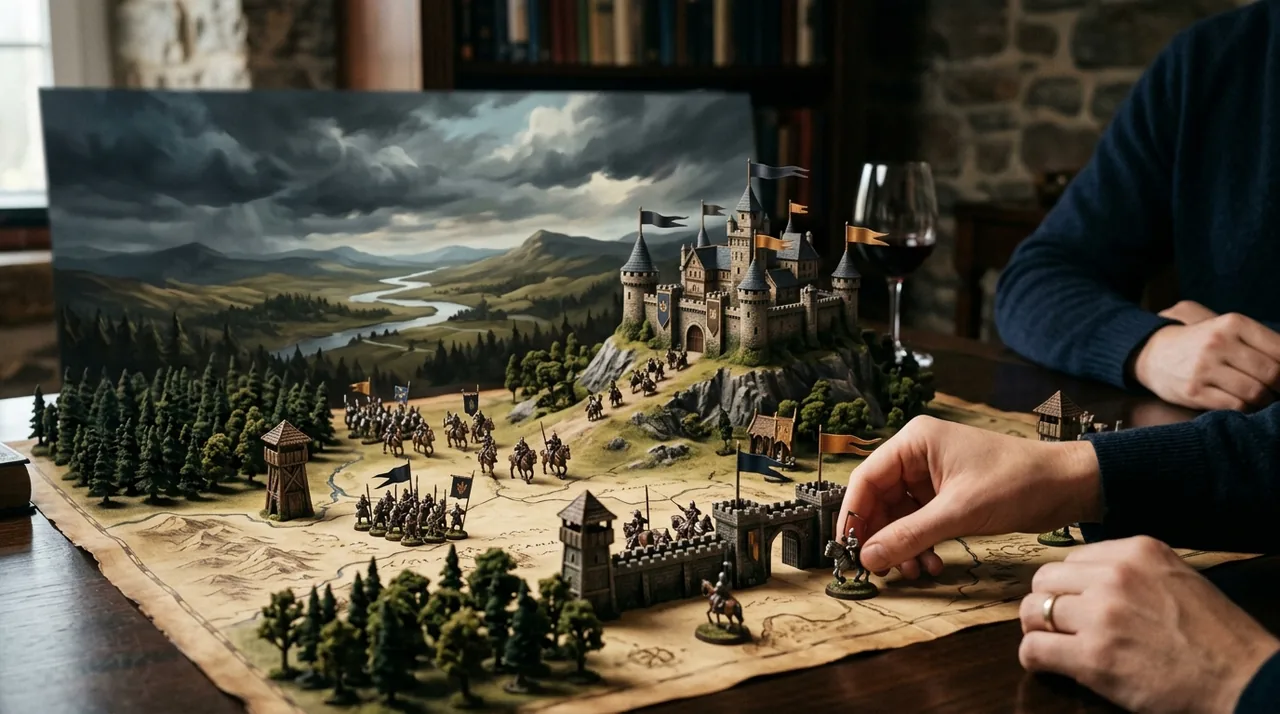
Ezostylia Kingdoms is a browser strategy game that combines empire building with quizzes and alliances. This guide walks you through your first steps, development priorities, and the most important mechanics — while also showing how the game becomes a tool for conscious thinking and building relationships.
What Ezostylia Kingdoms is and who it is for
Ezostylia Kingdoms is a browser strategy game in the “build and conquer” style, set in a fantasy kingdom. Players manage their own realm: they develop infrastructure, gather resources, complete missions, and interact with other participants. The game runs directly in your web browser, with no need to install additional software.
What sets Ezostylia Kingdoms apart from many similar titles is its built-in quiz system, which weaves player knowledge into strategic power. Answer correctly, and your kingdom gains bonuses that would in classic games require long hours of grinding. This one mechanic changes the entire feel of the game: knowledge stops being abstract and becomes a resource as real as wood or gold.
The game is aimed at a wide audience: fans of browser strategies, casual players who have time for one or two logins a day, and those who want to be part of an active community. There are no requirements for prior experience. What is needed, however, is a willingness to learn — and that is what makes Ezostylia Kingdoms a genuinely growth-oriented experience.
First steps: registration, interface, and getting oriented in the player panel
Registration in Ezostylia Kingdoms takes just a few minutes. After creating an account on ezostylia.com, you choose your kingdom name, starting faction, and position on the world map. Each faction offers slightly different starting bonuses. It is worth taking a moment to read their descriptions before choosing. Economy-focused factions are usually a better choice for new players than military factions — and this observation has a deeper dimension than tactics alone: it teaches that lasting strength grows from foundations, not from momentum.
After logging in, the player panel is divided into several main sections. In the top bar, you will find information about your current resources: wood, stone, gold, and knowledge points gained through quizzes. On the left side are tabs for the different aspects of the game: the kingdom map, mission center, alliance panel, diplomacy log, and upgrade shop. The center of the screen shows your kingdom, where clicking individual buildings lets you upgrade them, assign tasks, or check their current production level.
At the very beginning, the game will guide you through a short tutorial. Give it your full attention — even if you are an experienced strategy player. Ezostylia Kingdoms has several less obvious mechanics that set it apart from standard games in the genre. A mindful approach at this stage sets the tone for the entire experience.
Building your kingdom: development priorities and the logic of long-term thinking
One of the most common mistakes new players make is wanting to build military units right away and attack neighbors. That impulse is understandable: action gives the illusion of control. But without a solid economic base, a kingdom cannot sustain an army, rebuild losses, or grow at a pace that allows it to compete with players who have chosen balanced development.
This pattern — that lasting strength requires patience and solid foundations before offense begins — is one the game illustrates especially clearly. Your building priorities in the first sessions should look like this:
- Sawmill and quarry: basic production buildings that generate the resources needed for all future investments. Upgrade them to level three before moving on to the next steps.
- Treasury: increases the maximum storage limit for resources and protects part of them from plunder. It is essential for players who log in once a day.
- Knowledge Center: a building directly tied to the quiz system. The higher its level, the more knowledge points you can gain in one session and the stronger the bonuses you can activate.
- Market: allows you to exchange resources with other players. It is especially helpful when one of your production buildings is being upgraded.
- Barracks: the military building you can begin developing once the economy is stable. Start with small, inexpensive units intended for defense.
Each building takes time to upgrade. Plan your build queue in advance so that when you log in, you can always collect a finished building and immediately start the next investment. It is a small habit that, over the course of weeks, makes a huge difference in the pace of development.
The mission system: narrative, goals, and rewards as a structure for conscious action
The mission system in Ezostylia Kingdoms is the backbone of the entire progression. Missions fall into three categories: main missions that advance the story and unlock new mechanics, side missions that reward exploration and specialization, and daily missions available every day for regular bonuses and experience points.
When reading a mission brief, pay attention to a few elements. First, check the list of prerequisites — some missions only become available after reaching a certain building level or completing the previous mission in the chain. Read the objective carefully, because missions often include clues about the optimal strategy. Also check the rewards before accepting the mission and decide whether it is worth taking on now or better saved for a more favorable moment.
Mission rewards may include resources, experience points, special items, unlocking new buildings or unique units, and sometimes access to exclusive areas of the map. Collect rewards regularly. The limit of active missions in the center is restricted, so completed but unclaimed tasks block access to new ones.
There is something worth reflecting on here: missions in Ezostylia Kingdoms teach you how to give structure to action. Instead of reacting on the fly, you plan sequences of steps with future effects in mind. That is a skill whose transfer beyond the game screen brings real benefits.
Quizzes as a mechanic and as a metaphor: knowledge as a resource
Quizzes in Ezostylia Kingdoms are not decoration or a pause between construction — they are a full-fledged mechanic that can determine a player’s position on the map. Knowledge points earned from quizzes are used to activate special abilities and upgrades unavailable to players who ignore this part of the game: they speed up construction time, increase the production of a specific resource, make the kingdom more resistant to attacks, or strengthen diplomatic relations with neighbors.
Quizzes appear in several modes. Main quizzes are tied to the mission storyline and require answers to thematic questions. Quick quizzes are short sessions available from the Knowledge Center panel, and you can launch them several times a day. Guild quizzes are tasks completed together with alliance members, where the total score of the whole group translates into bonuses for all participants.
This mechanic is more than just a way to earn resources. It introduces into the game an idea that many wisdom traditions express directly: knowledge has practical power. It is not an abstraction stored on a shelf, but a tool that changes reality. Players who understand this connection and treat quizzes as an investment rather than an obligation consistently outpace rivals who ignore this mechanic.
Alliances and guilds: belonging as strength, not weakness
Ezostylia Kingdoms offers an extensive alliance and guild system that is more than a mechanical add-on to the game. An alliance is a community of players sharing resources, knowledge, and strategies. A guild is a narrower circle of close collaborators, often centered around a specific playstyle or area of the map.
Joining an active alliance in your first week gives several concrete benefits. First, mentorship from experienced players shortens the learning curve and helps you avoid costly mistakes. Second, diplomatic protection: kingdoms belonging to strong alliances are less often targeted by attacks. Third, access to the alliance treasury, from which you can borrow resources in times of crisis. Fourth, participation in guild quizzes and alliance events that accelerate the growth of every member.
There is something in this structure that resonates with a broader truth about human nature: isolation rarely leads to lasting strength. Research on social dynamics in multiplayer games shows that cooperation in groups generates a stronger sense of belonging and makes players less likely to quit than those who play solo (Ducheneaut et al., 2006). In the context of Ezostylia Kingdoms, this means that an alliance is not a convenience — it is one of the pillars of the game.
When choosing an alliance, check how long it has existed, how many active members it has, and whether it maintains internal communication through chat or a forum. Avoid groups whose last activity dates back several weeks. Look for communities with clear goals and regularly organized shared missions.
Diplomacy and conflict: when to fight, when to negotiate, when to retreat
In Ezostylia Kingdoms, conflict is an inevitable part of the game, but it does not have to define your style of play. Diplomacy is just as powerful a tool as an army — and sometimes more effective. Understanding when to reach for each one is one of the deepest lessons the game can offer.
Attack only when you can predict the outcome with a high probability of victory and when the potential gains outweigh the cost of rebuilding losses. Before every attack, check your intelligence: how many units the target has, what its defenses look like, whether it belongs to an alliance, and whether your attack might provoke a response from its guild.
Negotiate when you encounter a player or alliance stronger than you, but at the same time see a possibility of mutual benefit. Non-aggression pacts, trade agreements, and defensive alliances available through the diplomacy panel can significantly change your safety balance. A well-built diplomatic network protects you more effectively than any army in the early stages of the game.
Retreat whenever conflict escalation threatens buildings or resources that would take days to rebuild. Tactical restraint and preserving resources is often a wiser move than fighting on in a lost war. This principle — that strength also means knowing how to step back — is one the game illustrates especially clearly.
Beginner mistakes: traps worth recognizing before you fall into them
Every new player makes mistakes. What matters is learning from them as quickly as possible. Below is a list of the most common traps players fall into at the beginning of their Ezostylia Kingdoms journey:
- Neglecting the economy in favor of the army. Without stable resource production, you will not be able to maintain even a small army for long. Military aggression without an economic foundation inevitably leads to stagnation.
- Ignoring quizzes. Players who skip this mechanic give up free bonuses and slow down their progression while missing one of the game’s most engaging dimensions.
- Attacking strong neighbors too early. Expansion makes sense only when your kingdom is stable enough to survive a possible response.
- Not using the market. Many new players stockpile one type of resource instead of exchanging surpluses for what they lack. That is wasted trade potential.
- Having no plan for each login. You enter the game without a goal, click randomly, and after leaving you feel like you achieved nothing. Planning your session fundamentally changes that dynamic.
- Joining the first alliance you encounter without checking its activity and values.
- Failing to secure resources in the treasury before long breaks from the game, leaving them open to plunder.
Each of these mistakes has a simple solution: planning, patience, and a willingness to learn from more experienced players. The Ezostylia Kingdoms community is generally helpful toward new participants.
Long-term progression: first-week goals and planning with perspective
Ezostylia Kingdoms reveals its full depth only after several weeks of regular play. To avoid getting lost in the abundance of options, it is worth setting concrete goals for each stage.
In the first week, focus only on the economy and safety. Upgrade production buildings to level three or four, build a solid treasury, complete all main missions available at this stage, and join an active alliance. Do not get involved in conflicts. This week is for building foundations — both in the game and in your understanding of its mechanics.
In the second week, begin to diversify your development. Invest in the Knowledge Center and complete quizzes regularly. Build your first line of defense: walls, towers, and small defensive units. Take part in your first guild event and engage in alliance communication. Start exploring the map and identifying potential trade partners.
In the third and fourth weeks, you can start thinking about offense and diplomacy on a broader scale. Your economy should be stable enough to finance military campaigns without risking a collapse in resources. Aim for roles with greater responsibility in the alliance — they bring additional bonuses and build your reputation in the community.
Why strategy games engage us so deeply — what science says and what it means for the player
The question of why games like Ezostylia Kingdoms can pull us in for hours, sometimes weeks, is a question about the nature of human motivation and learning. Scientific research from the last two decades sheds interesting light on this topic — and it is worth citing, because it helps us play more consciously.
Przybylski, Rigby, and Ryan showed that games engage players most strongly when they satisfy three fundamental psychological needs: autonomy, meaning the feeling that we are making our own decisions; competence, meaning the experience of growing skill and mastery; and relatedness, meaning the sense of being part of something larger than oneself (Przybylski et al., 2010). The researchers applied this framework to video games in general as a category — and while they did not study the specific ezostylia.com platform, their model offers a useful lens for understanding why certain game mechanics engage players more deeply than others. In Ezostylia Kingdoms, each of these needs has its reflection: freedom to choose a playstyle answers autonomy, the mission and quiz system builds competence, and alliances and guilds satisfy relatedness.
Hamari and colleagues studied the link between cognitive challenges in games and the flow state — the experience of total immersion in a task, where time dissolves and action becomes naturally rewarding (Hamari et al., 2016). Their results — obtained in studies of educational games as a category, not the specific platform — show that cognitive challenge matched to the player’s skill level is a necessary condition for flow to occur. Quizzes in Ezostylia Kingdoms, scaled to the player’s progress, create exactly that condition: they are difficult enough to engage and accessible enough not to frustrate.
Domínguez and colleagues analyzed the effectiveness of gamification elements — such as missions, rewards, and points — in educational contexts. Their study, carried out in academic environments, showed that quiz and mission structures increase participant activity and improve knowledge retention (Domínguez et al., 2013). Although the study did not concern Ezostylia Kingdoms, its findings help explain why the Knowledge Center mechanic can support deeper memorization — provided the player approaches quizzes with genuine engagement rather than as a box-ticking exercise.
Ducheneaut and colleagues examined the social dynamics of multiplayer games and showed that cooperation in groups — guild effort, shared missions, mutual help — creates stronger bonds and higher satisfaction than solo play (Ducheneaut et al., 2006). This is not a surprising result, but it is worth keeping in mind: when we feel part of a group, the game stops being just a game. It becomes a place of relationships.
All of these studies concern games and gamification as broader phenomena, not a specific platform. Still, they say something important about why certain mechanics — such as quizzes, missions, alliances, and the gradual unlocking of competence — have the potential to engage more deeply than simple clicking. A game that wants to be more than entertainment must satisfy those deeper needs. Ezostylia Kingdoms seems designed with that understanding.
Wisdom from books: game design and the deeper nature of play
For years, game designers have asked a question that sounds simple but turns out to be surprisingly deep: what makes rules become an experience? Katie Salen and Eric Zimmerman, in their foundational work Rules of Play: Game Design Fundamentals (2003), show that the best-designed games reveal their rules gradually and reward mastery of them. A player who understands the system experiences growing agency — not as an illusion, but as genuine mastery. The tutorial in Ezostylia Kingdoms, the missions that unlock new mechanics, and the quizzes that deepen understanding of the game world are exactly this philosophy in practice.
Jane McGonigal, in Reality Is Broken (2011), goes a step further and argues that strategy and cooperative games develop real-world skills: the ability to manage complex systems, to plan with a long-term perspective, to cooperate under pressure, and to recover from failure. McGonigal does not idealize games — rather, she points out that their potential depends on how the player approaches them. A game can be an escape from reality or a laboratory of skills. The choice belongs to the player.
Jesper Juul, in Half-Real (2005), draws attention to the special nature of failure in games. In the real world, failure can be costly and hard to reverse. In a game, failure is built into the structure of the experience as feedback — it tells you what did not work and gives you a chance to try again. Ruined economic plans, a lost battle, an unsuccessful diplomatic mission in Ezostylia Kingdoms are not the end, but a lesson. A player who can read failure that way takes away from the game something no tactical guide can give them.
The Ezostylia Kingdoms community: forum, events, tournaments, and resources for new players
Ezostylia Kingdoms lives through its community. Beyond the game itself, the platform offers several spaces where players exchange knowledge, strategies, and experiences. The game forum is where you will find detailed guides written by veterans, discussions about current events, and recruitment threads from alliances looking for new members.
Events take place regularly and reward activity within a specific time window: races to collect the most knowledge points, diplomacy tournaments that test negotiation skills, or shared missions for the entire community, where the sum of all players’ achievements determines the rewards for every participant. Keeping track of the event calendar and planning your gameplay around it is one of the most effective ways to accelerate progression.
Tournaments are a more formal form of competition, in which players or entire alliances compete according to specific criteria — the number of completed missions, quiz scores, or the value of the kingdom they have built. Participating in tournaments is an excellent test of skill and a source of unique rewards unavailable in standard play.
As a new player, you will especially benefit from the guide section on the forum and from the possibility of asking direct questions in your alliance chat. There are no stupid questions. Every answer from a more experienced player can save you hours of trial and error — and reminds you that learning from others is one form of wisdom, not weakness.
How to play consciously: practical daily habits
Research insights and the experience of practitioners translate into a few concrete habits worth adopting from your first day in Ezostylia Kingdoms. These are not tactical tips — rather, they are principles of a mindful approach to the game that change its character.
Before every login, set two or three goals for the upcoming session. These might be: completing a specific mission, upgrading a chosen building, and taking part in a quiz at the Knowledge Center. A goal gives your actions direction, and the time you spend in the game produces real progress. Research by Przybylski and colleagues indicates that players who experience competence — measurable progress — return to the game with stronger intrinsic motivation (Przybylski et al., 2010). Planning your session is the simplest way to ensure that experience.
Make quizzes your first action after logging in. Collect knowledge points at the start, activate bonuses, and only then move on to building and missions. Changing the order of actions also changes your mindset: you begin with an investment in yourself, not by reacting to whatever was left from the previous session.
Be an active participant in your alliance, not just a passive recipient of protection. Help others, answer questions, and take part in guild events. Players who contribute something to the community receive more from it in return. This is a pattern that goes far beyond game mechanics.
Keep a simple gameplay journal or notes. Record which strategies worked and why, what surprised you, what fell short of your expectations. This speeds up learning and makes each subsequent week of play more effective than the last. Reflection on experience — not experience alone — is what turns gameplay into learning.
Questions and answers: what new players ask most often
Is Ezostylia Kingdoms free?
Yes, the game is available free of charge to all registered users of ezostylia.com. Access to the basic mechanics, missions, alliances, and quizzes does not require any payment. The platform may offer optional purchases that speed up development, but the game is designed so that regular, engaged players can achieve strong progression without spending money. This means your position depends on the quality of your decisions, not the thickness of your wallet.
How long does one game session last, and how often should you log in?
Ezostylia Kingdoms is designed for players who have from twenty minutes to an hour a day. One or two logins per day are enough for effective growth, as long as each session is planned and focused on specific goals. Players who log in less often than once a day can catch up by actively participating in alliance events and regularly taking quizzes. The game’s rhythm is fairly gentle — it does not require constant presence, only consistency and awareness.
Can you play solo without joining an alliance?
Technically yes, but it significantly limits your possibilities. Guild quizzes, shared missions, and alliance protection are available only to group members. Solo players often become targets for organized alliances and have more limited access to resources from the guild treasury. As Ducheneaut and colleagues (2006) showed, cooperation in groups supports higher satisfaction with the game. If you value independence, look for an alliance with a loose structure that does not impose duties but still offers basic protection and access to resources.
What should I do if a stronger player attacks me?
Your first reaction should not be an immediate military response — especially at the beginning of the game. Secure your resources in the treasury, contact your alliance, and ask for diplomatic or military support. Check whether the attacker belongs to an alliance with which your guild has good relations, because in that case the alliance leader may intervene directly. If the attack was a one-off and had no clear economic logic for the attacker, it is often enough to wait it out and strengthen your defenses. The ability to stay calm under pressure is valued in this game just as much as military skill.
How do quizzes affect my standing compared with other players?
Quizzes translate into knowledge points, which you can spend on bonuses unavailable through other mechanics: faster building, temporary production boosts, protection from attack, or an experience point bonus. Players who use quizzes every day have access to these upgrades much more often than rivals who ignore them, and over the course of weeks this creates a noticeable difference in the pace and quality of kingdom development. More importantly: this mechanic rewards curiosity and a willingness to learn — qualities that are valuable whether we are talking about a game or anything else.
How do I know whether my decisions in the game are going in the right direction?
The best measure is the long-term trend, not the result of one session. If your economy grows steadily from week to week, missions are completed regularly, and your alliance values your participation — that is the right direction. Failures and course corrections are part of the process, not proof of a mistake. Juul (2005) wrote that games teach us to handle failure as feedback. Adopt that way of seeing things, and every setback becomes a starting point for a better strategy.
Sources
- Hamari, J., Shernoff, D. J., Rowe, E., Coller, B., Asbell-Clarke, J., Edwards, T. (2016). Challenging games help students learn: An empirical study on engagement, flow and immersion in game-based learning. Computers in Human Behavior.
- Przybylski, A. K., Rigby, C. S., Ryan, R. M. (2010). A motivational model of video game engagement. Review of General Psychology.
- Ducheneaut, N., Yee, N., Nickell, E., Moore, R. J. (2006). “Alone together?” Exploring the social dynamics of massively multiplayer online games. Proceedings of the SIGCHI Conference on Human Factors in Computing Systems.
- Domínguez, A., Saenz-de-Navarrete, J., de-Marcos, L., Fernández-Sanz, L., Pagés, C., Martínez-Herráiz, J. J. (2013). Gamifying learning experiences: Practical implications and outcomes. Computers & Education.
- Salen, K., Zimmerman, E. (2003). Rules of Play: Game Design Fundamentals. MIT Press.
- McGonigal, J. (2011). Reality Is Broken: Why Games Make Us Better and How They Can Change the World. Penguin Press.
- Juul, J. (2005). Half-Real: Video Games between Real Rules and Fictional Worlds. MIT Press.