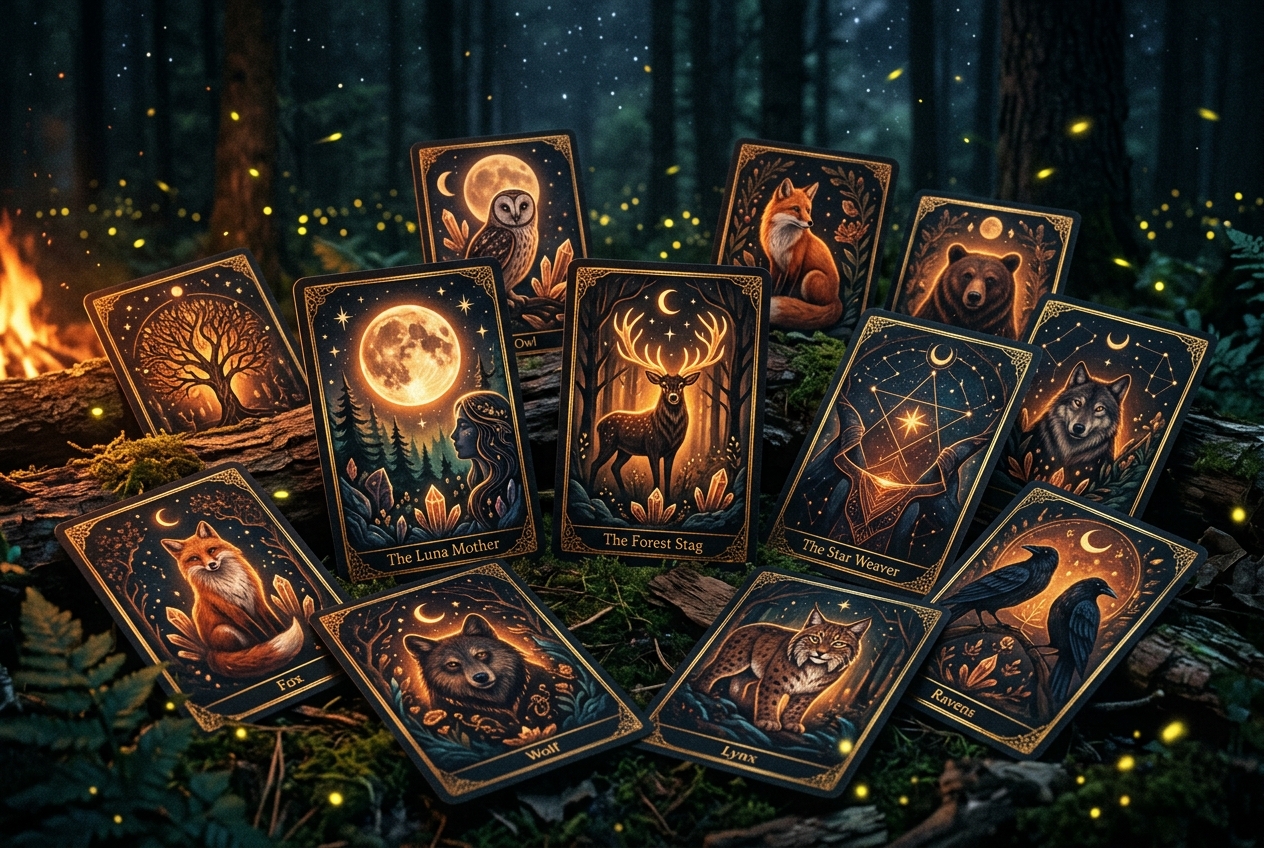
Tarot and Runes are popular esoteric tools, but each has its unique qualities. Explore their differences and similarities to find out which is better suited to your spiritual path.
The Difference Between Tarot and Runes – What to Choose?
Introduction to Tarot and Runes
The difference between Tarot and Runes begins with their structure, how they function, and the type of answers they typically provide. Tarot is based on a set of cards featuring images, symbols, and archetypes that weave together a broader narrative about the question, emotions, and processes. Runes, on the other hand, are a smaller system of symbols. Each symbol carries its own field of meaning and usually operates in a more pointed manner, indicating direction, tension, or need for action. They are not identical tools, although both serve the purpose of reflection and working with intuition.
In spiritual practice, Tarot often helps to track a situation step by step, recognize dependencies, and name what lies beneath the surface. Runes typically provide a more concise message, acting like a signal about what to pay attention to at this moment. For this reason, people seeking a comprehensive analysis of relationships, decisions, or inner processes tend to choose Tarot more often. In contrast, Runes are favored by those looking for a simpler, direct reading that can easily be translated into specific reflection or intention. If you want to explore the more extensive context of working with cards, also check out Tarot.
The choice between these tools should ideally be based on your own mindset and the question you bring. Tarot generally offers more layers of meaning and works better where narrative and analysis of dependencies are important. Runes are more compact and can be helpful when you need a quick evaluation of the energies in a situation or a clear message. In either case, intention, focus, and the willingness to read the message calmly, without imposing what is not included in the answer, are essential.
Structure and Components of Tarot
Tarot consists of 78 cards that form an organized system of meanings. In a deck, there are 22 Major Arcana cards and 56 Minor Arcana cards. The Major Arcana describes significant life phases, turning points, and lessons, while the Minor Arcana represents everyday life, emotions, actions, and specific situations. This structure allows Tarot to connect the big picture with the details of daily life, which for many people is its greatest strength in spiritual work.
In practice, interpreting Tarot cards involves more than just memorizing individual meanings. The position of the card in the layout, the question asked, the presence of nearby cards, and how the entire sequence fits into a coherent narrative all matter. The energy of this deck also includes symbols, colors, figures, and the dynamics of the images. Therefore, Tarot is a tool that often requires a moment of concentration but offers a very rich, multidimensional message, especially regarding questions of relationships, decisions, and the course of changes.
When comparing the difference between Tarot and Runes, the structure of Tarot reveals its more complex nature. Runes typically operate with a smaller number of symbols and often rely on brevity, while Tarot provides a complete map of archetypes and experiences. This means that card interpretations can be subtler but also more precise in analyzing situations. Tarot suits those who enjoy combining intuition with imagery, narrative, and working with cards in layouts tailored to the question.
Structure and Components of Runes
The difference between Tarot and Runes is already visible at the structural level. Tarot forms an intricate system of cards, while Runes consist of an alphabet of symbols. In the Elder Futhark, there are 24 characters, each with its own name, sound, and range of meanings. This makes Runes a tool that is sparing in form but symbolically rich. Their strength lies not in the number of elements but in the precision of the message and the context of the question.
In practice, Runes function like a key to thought, immediately directing attention to a specific area. For example, a Rune might indicate movement, protection, the need for patience, a change of plans, or the moment of laying foundations. When questions concern relationships, the Rune may highlight the need for trust or setting boundaries. In professional matters, it can suggest the pace of action, the quality of decisions, or the need to organize things. In daily reflection, Runes are particularly helpful when you require a single clear reference point rather than a long narrative.
Their interpretation requires attention to the meaning of the symbol, the question, and the situation of the person asking. The same Rune can be interpreted differently depending on whether the context is relationships, work, or inner growth, so it is not advisable to read it in isolation from the overall situation. Compared to Tarot, Runes are formally simpler but no less profound. This combination of brevity and symbolic density ensures that many people use them when they want to quickly grasp the core of the issue and see where the most significant direction for action lies.
Differences in Reading Methods
In tarot, the reading typically relies on the layout of the cards, where the position, the relationship between the cards, and the overall logic of the layout matter. This allows the answer to not only reveal the current state but also the background of the situation, possible developments, and elements that require attention. With runes, the method is often more direct. One can draw a rune, select several signs, or use a simple layout based on personal practice. In this sense, the difference between tarot and runes also lies in the fact that tarot often builds a more complete narrative, while runes usually indicate the key point of tension or direction.
In tarot, images, archetypes, and the interrelationships of the cards are very important. In runes, the focus is on the sign, the question, and the intention of the person using the tool. When the question is concrete, runes can provide a quick and clear signal, for example, regarding the need to pause, protect, act, or change the approach. When the question is more complex, tarot may better reveal the emotional layers, the relationships between people, and the process currently unfolding. Both systems are valuable, but they offer slightly different perspectives on the matter.
The choice of method is also influenced by personal preference. Someone who prefers analysis, a broader context, and multi-layered meanings will typically gravitate more naturally towards tarot and further exploration with it. TarotA person who values simplicity, the rhythm of shorter reflections, and quick messages is more likely to choose runes. In both cases, mindfulness, honesty towards the answer, and the willingness to read the message in alignment with the real situation — not with the expectation of a convenient affirmation of one's hopes — remain of utmost importance.
Similarities between tarot and runes
Despite the differences, both tools serve a similar purpose: they help pause and look deeper into one's own situation. Both tarot and runes support reflection, the ordering of thoughts, and the discovery of inner truths that can be easily overlooked in the rush of daily life. They do not necessarily need to predict everything in advance. More often, they act like a mirror, reflecting emotions, intentions, tensions, and possible patterns of action.
In both practices, symbolism is crucial. In tarot, one reads the images, archetypes, and the relationships between the cards. In runes, one works with individual signs, but also with their meanings in the context of the question. In both cases, meaning does not arise from a single word alone. It emerges from the connection of signs, intuition, experience, and the current situation of the person asking. This makes both systems tools for personal development and spiritual self-observation.
The similarity is also visible in everyday application. Tarot and runes can support morning insights, evening reflections on the day, intention work, or a moment of stillness before a significant decision. For many people, these are complementary practices, as one offers a broad narrative while the other delivers a concise sign. This allows them to be used in similar contexts, although each system does so in its own language and at a different pace.
How do I choose between tarot and runes?
The choice between these tools should be based on the type of answers you are truly seeking. If you need a broad picture of the situation, work with emotions, and a more comprehensive analysis, tarot may be the better starting point. However, if you value brevity, simplicity, and quickly grasping the main theme, runes might better suit your style. The difference between tarot and runes does not lie in superiority but in a different approach to communicating with intuition.
For beginners, it is also important how much time they are willing to spend on learning. Tarot requires familiarization with a larger number of cards, layouts, and their interdependencies, but it offers very rich material for practice. Runes are simpler in terms of the number of symbols, yet their interpretation still demands patience and a connection with one's own feelings. If someone enjoys learning through images and stories, tarot may feel more natural. If someone prefers minimalism, runes could be more convenient.
It’s best to start with the tool that sparks curiosity and does not impose pressure. In practice, it’s the regularity and trust in one's own process that yield the most benefits. There’s no need to know everything immediately to work meaningfully with the symbol. Many people choose tarot because it’s easier to find structures and layouts for it, while others opt for runes because they appreciate the simple, daily connection with a sign. The most important thing is that the tool supports and does not overwhelm.
FAQ
Can I combine tarot and runes in a practice?
Yes, you can combine them, provided that you do so consciously and without chaos. One practice can provide a broad picture through tarot, while the other can hone in on the theme through runes. However, it's wise to establish your own workflow to avoid mixing too many layers at once. It's best to treat both tools as complementary symbolic languages rather than as competitors. This way, the reading remains clear and calm.
Which tool is better for beginners?
It depends on how you learn best. Tarot can be more intuitive for those who respond well to images, scenes, and narratives. Runes may be easier to start with, as they have fewer symbols and a more straightforward working style. If you enjoy in-depth meanings, begin with Tarot. If you prefer brief, concrete symbols, choose Runes. The best tool is the one that you want to work with regularly.
How much do cards and runes cost?
The cost depends on the quality of the production, the edition, and the materials used. Tarot is typically purchased as a deck of cards, while runes are bought as sets of stones, wooden pieces, or other symbolic carriers. There are both simple, budget-friendly options and more refined collector's editions available in the market. It's advisable to start with a sturdy and comfortable version without spending too much on embellishments. The most important thing is that the tool is practical and serves you well in your daily work.