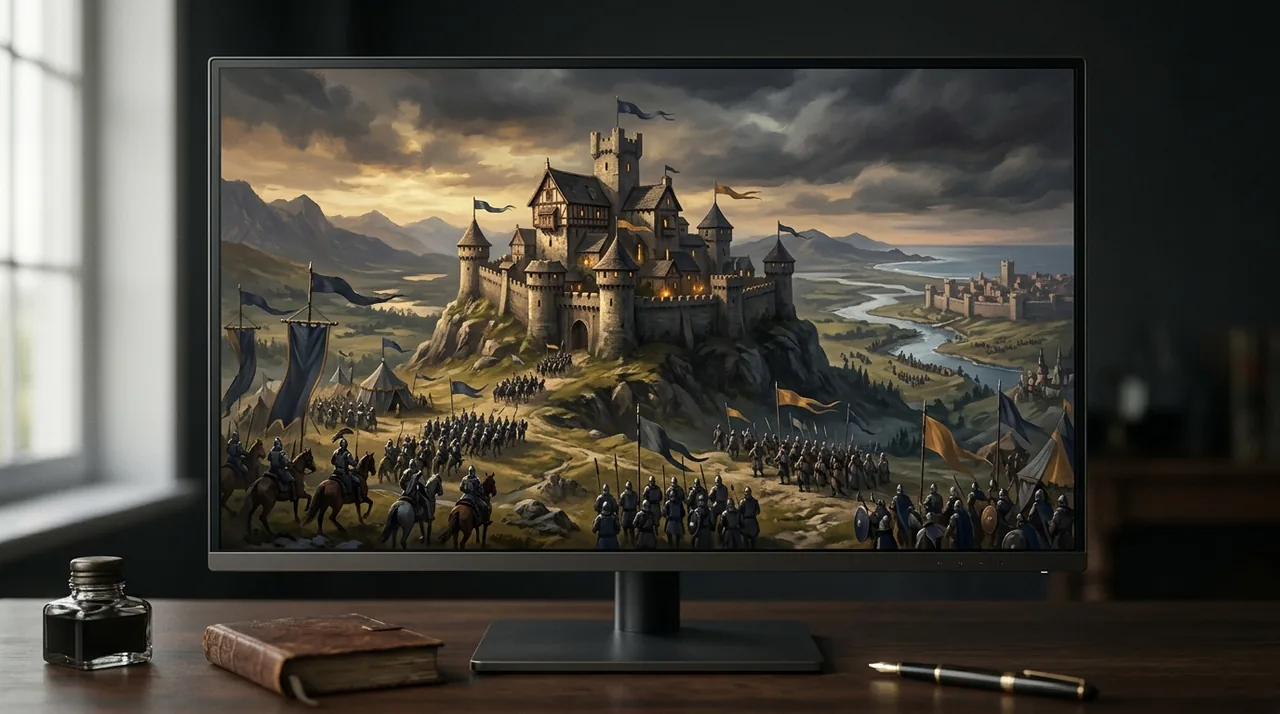
Good strategy starts with numbers, priorities, and discipline. Find out how to manage resources in a strategy game so you can grow faster, plan quests better, and avoid costly mistakes.
How to Manage Resources in a Strategy Game
In every good strategy game, it is not only the player who clicks faster who wins, but above all the one who plans better. This applies both to classic turn-based games and modern online titles, such as browser games, MMO games, or systems built around kingdom development, quests, and cooperation. If you play Ezostylia Kingdoms, test other titles from the Games section, or develop your own style of play through the game panel, then resource management is the foundation of your effectiveness.
Resources in a strategy game can mean raw materials, gold, energy, building time, movement points, units, production slots, and even the player’s attention. And it is this last element that is often overlooked. According to the American Psychological Association, material on attention-switching costs from 2006 shows that multitasking lowers performance because every switch between tasks carries a cognitive cost. In practice, for a player this means one simple thing: if you try to develop everything at once, you often lose momentum. In strategy, focus on priorities matters.
This guide will show you how to approach resources like a practitioner. Not through chaos, but through planning, numbers, and regular decisions. This approach will be useful in browser games, in solo modes, in quest systems, and also when you act in an alliance and compete for a ranking position.
1. First, identify which resources really drive progress
The first mistake many players make is treating all resources the same. Meanwhile, in most strategy games, some resources are crucial at the start, some in the middle phase, and some only at the end of the game. That is why, before you spend anything, ask yourself three questions:
- Which resource blocks my progress most often?
- Which resource turns into a real advantage the fastest?
- Which resource can I recover easily, and which one is hard to recover?
In practice, this means that not every expense is equally important. If in an MMO game you lack the resource needed to upgrade your base, then investing in decorative or secondary elements may be a mistake. If, on the other hand, the main limitation is time, it is worth speeding up the actions that unlock new production levels, new quests, or access to alliance cooperation.
This way of thinking is similar to prioritization known from project work. The University of Waterloo, in its material on the Eisenhower Matrix, explains that effectiveness grows when you distinguish urgent matters from important ones. In a strategy game, it works similarly. Urgent does not always mean profitable. What matters is what increases your future production, safety, or expansion pace.
2. Build your economy before you go on the offensive
Many people want to attack right away, earn points, and complete difficult quests. That is natural, because fast actions bring excitement. However, in the long run, the stronger player is the one who first stabilizes the economy. In browser games and in systems like Ezostylia Kingdoms, this usually means developing production sources, storage, logistics, infrastructure, or mechanics that shorten waiting time.
If your base produces too little, every next move becomes more expensive both mentally and tactically. You start choosing not what is best, but what you can currently afford. This severely limits strategy.
A good habit is the 60-30-10 rule:
- Allocate 60 percent of your investment to stable production growth.
- Allocate 30 percent to defense, utility, or unlocking new features.
- Keep 10 percent for experimentation, events, special quests, or quick opportunities.
This is not rigid math for every game, but a practical starting point. MIT Sloan Management Review noted in 2015 that simple operating rules help teams perform more effectively. In games, it works similarly. When you have your own set of simple rules, you make better decisions under pressure.
3. Avoid the trap of spending everything at once
One of the most common mistakes is emptying your storage completely after every larger resource payout. At first glance, it seems reasonable, because nothing is sitting idle. The problem is that having no reserve takes away your flexibility. When a limited quest, a time window, an alliance bonus, or a new development path appears, you have nothing with which to respond.
NIST, in its risk management approach, emphasizes the importance of preparation and protecting key assets. Although the document concerns organizational systems, the principle itself is universal. A well-managed system does not operate with zero safety margin. In a strategy game, reserve is exactly such a margin.
That is why you should keep a buffer. Even a simple one, for example:
- 20 percent of basic resources untouched without a valid reason,
- a separate pool for daily quests,
- a separate pool for long-term development,
- a minimum reserve for defense or recovery after a loss.
Such a spending structure gives you peace of mind and reduces impulsive decisions. And in strategy, calm is an advantage.
4. Plan your daily cycle, because time is also a resource
Many players think about resources only as numbers on the screen. Meanwhile, login time and the rhythm of play are just as important. If production finishes when you cannot enter the game, part of the potential is lost. If you queue short tasks before sleep, you lose the night. If you start a long build at the beginning of an active session, you block other options.
Harvard Business Review wrote in 2007 about managing energy rather than time alone. In gaming terms, this can be translated to the idea that a more effective player matches activity to their rhythm and focus. When you have 10 minutes, collect resources and set production. When you have 30 minutes, review quests and the upgrade queue. When you have a longer session, plan development, trading, alliance tactics, and moves several steps ahead.
You can use a simple division:
- Short session: collect production, refresh tasks, make quick decisions.
- Medium session: quests, base management, cost review.
- Long session: strategic plan, alliance coordination, harder goals.
This is especially important in browser games, because their strength is accessibility. You can log in for a moment, but it is worth making every moment purposeful.
5. Calculate return on investment, even if the game does not show it directly
A good player does not ask only: can I afford this? They also ask: when will it pay off? If an upgrade costs a lot but raises production only slightly, there may be a better path. If quests give little resources but unlock important features, their value may be greater than it first appears.
In practice, analyze three elements:
- entry cost,
- payback time,
- additional value, such as access to a new map, unit, or bonus.
This is how mature strategy is built. You do not rely solely on emotion, but on the relationship between cost and effect. In Ezostylia Kingdoms and similar systems, this way of thinking helps you not only grow faster, but also choose better which quests to complete immediately and which to postpone.
If you like testing your play style, a good complement may also be a quiz about tactics or decisions. Such a format will not replace experience, but it helps you notice your own patterns and mistakes.
6. Alliance cooperation changes the value of resources
Solo play and team play are often two different economies. In an alliance, some resources gain greater value because they support a shared goal. Suddenly, it is not only about how much you have, but also when you can help and what the group needs. That is why in cooperative mode it is worth thinking in two layers: your own development and your contribution to the team.
This is especially important in MMO games, where communication, specialization, and synchronization build an advantage. One player may focus more on production, another on defense, another on expansion or completing specific quests. The scale effect means that a well-coordinated alliance grows faster than a collection of lone players.
In practice, set simple rules:
- what the shared goals are for the week,
- who develops which areas,
- how you respond to threats,
- which quests are a priority for the whole group.
Then check the results. If you enjoy competition, also watch the leaderboard. A table position does not always say everything, but it clearly shows whether your development model produces real results.
7. Do not let side activities distract you
In modern games, it is easy to fall into the temptation of doing everything at once. An event, side quests, cosmetic upgrades, an extra quiz, a mini activity, a collection, a points system. Everything looks appealing, but not everything is profitable at a given moment.
The APA reminds us that frequent task switching reduces efficiency. In a game, this means slower development. So before you enter a side activity, ask yourself: does this bring me closer to my current strategic goal? If not, put it off for later.
This does not mean you have to play in a rigid way. Entertainment matters too. After all, the Games section in Ezostylia combines fun and learning through action. The point is proportions. The best players can use different modes without losing sight of the main plan.
If you want a break from classic economy management while still training tactical thinking, you can also visit Magic Chess. A different gameplay format often develops the same decision-making habits, only in a more condensed form.
8. Create your own progress tracking system
Even the best strategy does not work for long without reviewing results. Every few days, check whether your plan is actually bringing growth. Do not judge the game only by the emotions of a single session. Judge it by the trend.
A simple checklist can be helpful:
- Is the production of basic resources growing week by week?
- Does the number of completed quests translate into lasting benefits?
- Do you have a reserve for unexpected expenses?
- Does the alliance support your development, or only take your attention?
- Is the upgrade queue consistent with your goal?
This review takes only a few minutes, but it helps you detect mistakes early. Sometimes you will realize that you are investing too much in defense. Other times that you are being too aggressive and neglecting the economy. And sometimes that your quests are flashy but not very profitable.
This is exactly where strategy becomes mature. It is not about a one-time good move, but about a system of good decisions repeated over a longer period.
The most important rules in brief
If you want to manage resources effectively in a strategy game, remember a few simple rules. First, identify the critical resource. Then strengthen the economy before entering costly aggression. Always keep a reserve. Treat time as a resource. Calculate the profitability of investments. In an alliance, play for the shared result, not only your own score. And regularly check whether your plan is working.
This approach works both in browser games and in more advanced MMO-style models. If you play consistently, you will see the difference sooner than you think. Less chaos, more control, better quests, and a more conscious strategy. And that is exactly what separates random clicking from real player development.
This article is for educational and entertainment purposes. It does not constitute financial, legal, or professional advice, only a practical guide to better planning in games.
FAQ
Which resources are most important at the start of a strategy game?
Usually the most important are the ones that drive further development, meaning basic resources, building time, and mechanics that unlock new features. At the start, it is worth investing primarily in the economy and stability.
Is it better to spend everything right away, or keep a reserve?
It is better to keep a reserve. This way you can respond to new quests, events, and opportunities. A lack of buffer often leads to stagnation or forces poor decisions.
How should you plan quests in an MMO game?
First choose quests that provide a lasting benefit, such as unlocking new options, increasing production, or improving your position in the alliance. Only then complete side tasks or purely point-based objectives.
Is an alliance always worth it?
Not always, but in many games it gives a major advantage. A good alliance speeds up development, makes quests easier to complete, and improves coordination. A weak alliance, however, can take time and distract your attention.
Sources
- NIST, Risk Management Framework, 2018, https://www.nist.gov
- American Psychological Association, Multitasking: Switching costs, 2006, https://www.apa.org/topics/research/multitasking
- Harvard Business Review, Manage Your Energy, Not Your Time, 2007, https://hbr.org/2007/10/manage-your-energy-not-your-time
- University of Waterloo, What is the Eisenhower Matrix?, 2024, https://uwaterloo.ca
- MIT Sloan Management Review, Why Simple Operational Rules Help Teams Execute, 2015, https://sloanreview.mit.edu