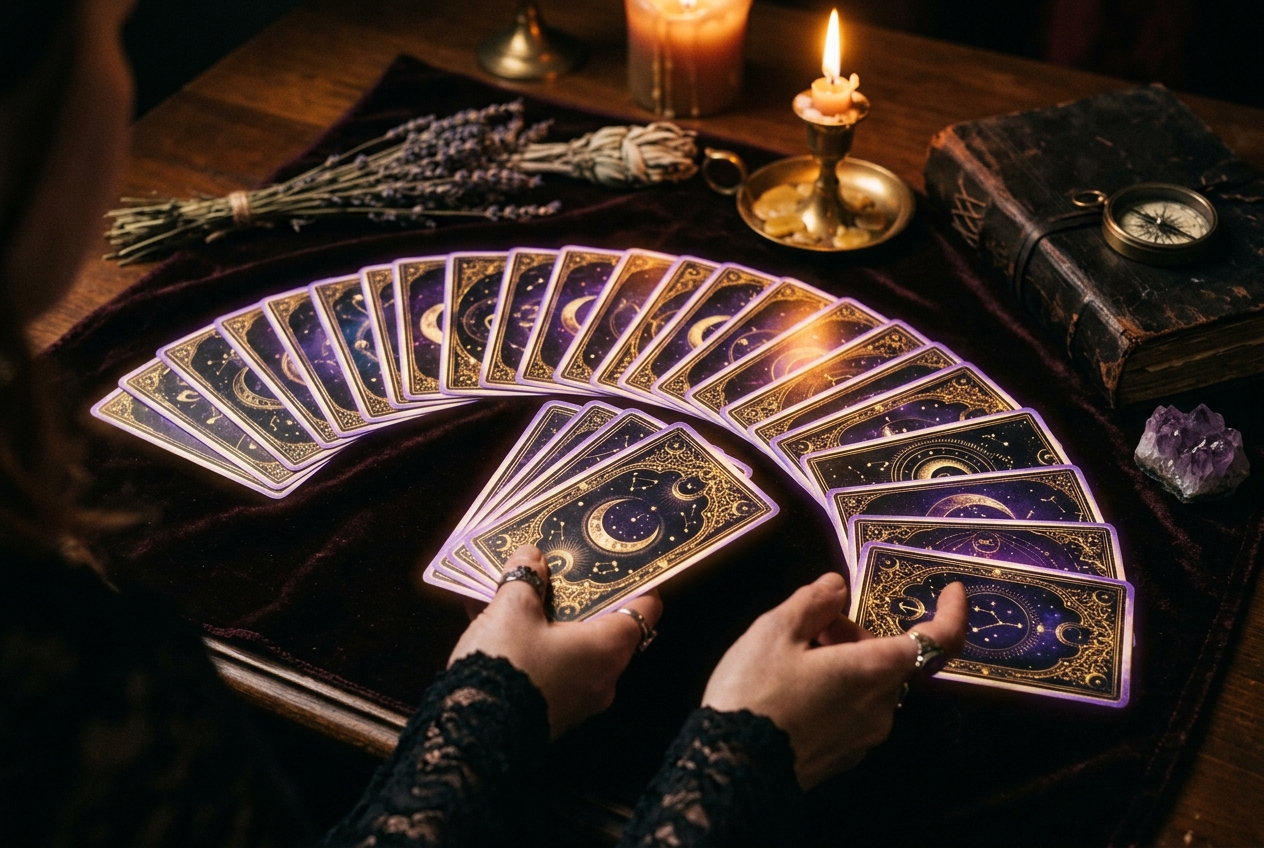
The Death Card in tarot evokes a range of emotions. Understanding this card allows you to uncover its positive meaning and the transformative impact it can have on your life.
The 'Death Card' in Tarot – What Does It Mean in Practice?
What does the Death card mean in tarot?
The Death card in tarot primarily symbolizes transformation rather than an end. According to the interpretation of the Author of the Cards, it signifies that a certain phase is naturally closing, and old forms are no longer necessary. This could relate to a relationship, a job, a mindset, or a habit that no longer supports your growth. With this card, it is essential to release what has outlived its energy to create space for something new.
Despite its strong name, the Death card often brings organization rather than fear. It reveals a process that cannot be halted by mere will. When it appears in a spread, it typically encourages an honest assessment of what has already ended, even if it's emotionally challenging to accept. It represents closure, purification, and distinguishing what is alive from what lingers out of habit.
Its meaning is best interpreted within the context of the question and the entire spread. It does not inherently signify tragedy, but rather a flow of energy leading to change. In practice, it can be one of the most liberating signals in tarot, reminding us that sometimes we must let go of something to reclaim our peace and step into a new phase without unnecessary burdens.
The meaning of the trend 'tarot death card'
The trend 'tarot death card' illustrates how this card powerfully captures the imagination and often serves as an entry point into tarot study. It draws attention because it combines mystery, a striking image, and the promise of understanding something that many find challenging. This is why it appears so frequently in searches. People want to know if the Death card truly indicates something negative, or if it speaks of a change they cannot yet define.
This trend also influences perceptions of tarot online and offline. On one hand, it familiarizes people with the topic of the cards; on the other, it can oversimplify the message if everything is reduced to one compelling slogan. Therefore, it's crucial to view the Death card not through the lens of fear but through the meaning it holds within the entire spread. On the tarot page, you'll see that each card has its own rhythm and does not exist in isolation from the question or the situation of the seeker.
The shift in interpretation over generations is quite evident. In the past, the Death card was often taken literally and elicited strong emotions. Today, thanks to greater access to knowledge, it is increasingly seen as a symbol of transition, closure, and renewal. Thus, the trend 'tarot death card' reflects not only interest in the card itself but also a more mature approach to tarot, signifying a movement from fear to understanding, from sensationalism to a deeper reading of the energy of change.
Examples of interpretations of the Death card
The Death card in tarot typically indicates a change that has already matured. According to the interpretation of the Author of the Cards, it does not pertain to a literal end, but rather stepping out of a phase that has ceased to function. This could pertain to relationships, work, decisions, or internal patterns. If something has long caused feelings of exhaustion, tension, or a sense of being trapped, this card suggests that clinging to an old form is becoming too costly.
In practice, this card is particularly clear when accompanied by a sense of relief despite uncertainty. It signifies that an ending does not have to mean failure. Sometimes it simply represents the natural closure of something that has already served its purpose. In this context, death signifies cleansing rather than loss. First, what is unnecessary fades away, and then space opens up for a more authentic direction.
A new beginning usually doesn't arrive immediately. First, you must acknowledge that a certain phase has genuinely ended. Only then can you move forward without looking back. If you want to gain a deeper understanding of such transitions in spreads, visit the tarot section, where it's easier to see how a single card influences the entire spread and its meanings.
The Death card and its relationship with other tarot cards
The meaning of the Death card clearly shifts depending on the cards surrounding it. By itself, it speaks of transformation, but the adjacent cards reveal whether it relates to ending a relationship, changing jobs, severing ties with an old pattern, or fostering an inner awakening. When movement, growth, or a new path appears alongside, Death functions as a gateway to the next phase. In that case, an ending is not final but rather a prerequisite for moving forward.
The situation differs when it's surrounded by cards representing blockage, fear, or stagnation. Here, the Death card may indicate resistance to change, an attachment to what no longer serves you, or a struggle to relinquish control. This does not yet signify an actual end but a moment of tension between the old and what requires space. In such a spread, it is crucial to identify where the energy is stagnant and what needs honest closure.
In interpretation, it's important to consider the whole rather than isolating a single symbol from the context. In the Ezostylia cards, as interpreted by the Author of the Cards, the energy of the spread matters; therefore, the Death card can carry different weight when paired with a card of rebuilding than when paired with a card of stagnation. This is not a card intended to frighten. Rather, it conveys a clear message that something is concluding to create room for the next movement that aligns more closely with the truth of the situation.
When does the Death card appear?
The Death card often appears when it's time to close an old chapter in life. It's essential to pay attention to it when the question revolves around relationships, career decisions, habits, attachment to the past, or situations that have stagnated for too long. Its presence suggests that clinging to the current situation won't bring relief. It's an invitation to honestly evaluate what no longer has life force and what requires a change in form.
Sometimes, this card emerges during crucial periods when a person intuitively feels that something is coming to an end, even if they can't yet articulate it. It may appear after a crisis, an important conversation, a loss of motivation, or when past goals lose their significance. During such moments, it’s no coincidence; rather, it signals that the psyche and reality are ready for a new phase. This is precisely when the card is most relevant, as it identifies what's been quietly ripening for a long time.
The cyclical nature of this card is significant, as its message often recurs until the lesson is embraced. If someone ignores the need for change, the card may show up repeatedly in spreads, in slightly different shades but with the same essence. This isn't about punishment; it’s more about a recurring theme that cannot be bypassed. Practically, this means it’s valuable to notice not only the card itself but also the repetitive patterns in questions, emotions, and decisions that lead to its appearance.
How is the perception of the Death card evolving?
The perception of the Death card has significantly transformed with culture and the language people use to describe spirituality. For many, the name alone once sparked fear, as it automatically invoked thoughts of biological endings. Over time, it has increasingly been recognized as a symbol of transformation, passage, and renewal. Today, the interpretation of this card is more conscious, though it still requires sensitivity. Its significance lies not in instilling fear but in demonstrating that life naturally cycles through phases of ending and rebirth.
The social influence on interpretations is evident, as culture dictates what to fear and what to overlook. Where the fear of loss looms larger, the Death card is often understood literally and weighs heavily. In environments where language around shadow work, acceptance, and psychological maturity flourishes, the same card becomes clearer. Thus, it’s not the card itself that changes, but rather the perspective with which it is approached. This is crucial because, in tarot, meaning resides in the relationship between the symbol and the seeker.
Shifts in esoteric consciousness are leading more individuals to view the Death card as a transitional moment rather than a final verdict. This translates to a greater willingness to embrace endings without struggle and without ascribing catastrophic meanings to them. Today, there’s often more discourse on cleansing, letting go, and inner rejuvenation than on a dramatic end. This mature outlook facilitates a calmer reading of tarot, fostering greater trust in the process and reducing the need to control every symbol.
FAQ
Does the Death card signify actual death?
No, in tarot interpretation, the Death card typically does not signify literal death. According to the interpretation by the Author of the Cards, it symbolizes the conclusion of a phase, transformation, and severing ties with what has outlived its purpose. In everyday life questions, it more frequently denotes a change in state, relationship, decision, or mindset. Its meaning is more psychological and symbolic than literal. Therefore, it’s best to interpret it calmly and always within the context of the entire spread.
What are the positive meanings of the card?
The positive meanings of this card primarily include cleansing, liberation, and the opportunity for a new beginning. The card may indicate the end of something burdensome that hindered growth or drained energy. It may also signify the courage to stop revisiting the past and to create space for something more aligned with one's inner truth. In practice, it represents maturation rather than failure. It illustrates that an ending can be essential for something healthier and more authentic to arise.
How to interpret the card in the context of questions about the future?
In queries about the future, the Death card usually indicates that the current direction cannot endure indefinitely. It should not be perceived as a negative sign but as information about an impending transition. If the question pertains to plans, relationships, or work, the card may suggest a need to change strategy, conclude a certain phase, or adopt a new perspective. It’s best to view it as a signal of movement and transformation rather than a straightforward yes or no answer.