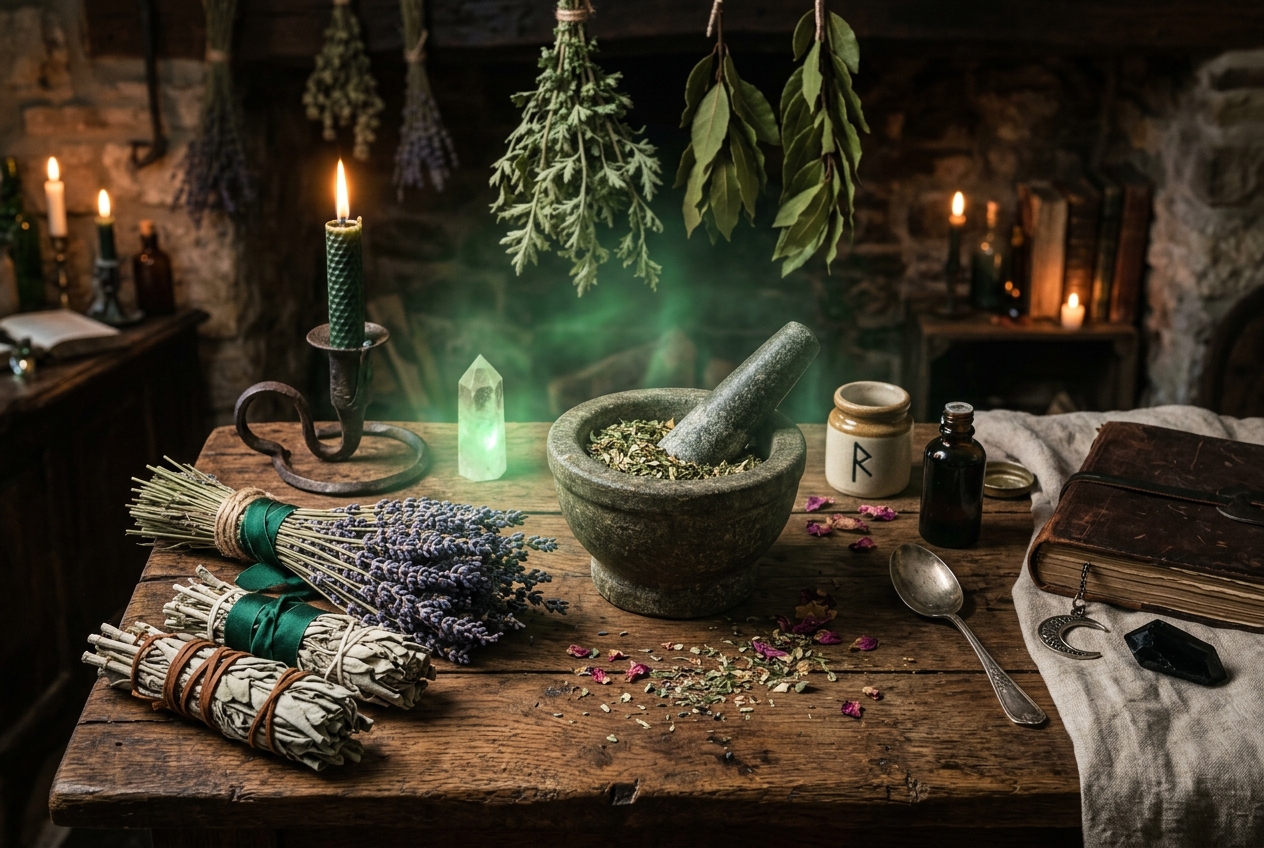
In Podlasie, around Hajnówka, Bielsk Podlaski, and Orla, the whispering women still live today — folk healers whose practice is rooted in Orthodox Christianity and centuries-old Slavic traditions. A whispering woman does not "cast spells"; she whispers a prayer over the sick, makes the sign of the cross, and uses simple gifts from nature. Her domain encompasses five ailments: fear, curse (the evil eye), the rose, wind (draft), and nervous tangle.
In the rituals of the whispering women, the most important elements are: beeswax (poured over the head into cold water to "cast off" fear), flax (burned over a cloth in the treatment of the rose), ash from the oven, sheep's wool, and blessed water, salt, and bread. Alongside them, however, has stood an entire pharmacy of fields and meadows for centuries — herbs that Slavic herbalists and whispering women knew like no other. Healing has always been regarded as a gift from God, not a service: gratitude was expressed with sweets, agricultural produce, or small offerings.
Herbal Compendium of the Whispering Women — 12 Sacred Plants
Here are the herbs that possessed the greatest power in Slavic folk tradition. The photos come from Wikimedia Commons, including the famous botanical atlas by Köhler from 1897.
Wormwood (Artemisia absinthium)

How it was used: The most "magical" herb of the Slavs. Bitter as sorrow, burned for fumigating homes while removing curses and driving away evil forces. Hung above the doors, it protected the house and yard.
Curiosity: On St. John's Eve, wreaths made of wormwood were worn on the head to protect against charms for the entire year.
Common St. John's Wort (Hypericum perforatum)

How it was used: "St. John's herb," collected on the eve of St. John. Folk tradition attributed to it the power to drive away demons, hence the old name fuga daemonum, meaning "flight of demons."
Curiosity: The red dye extracted from the flowers was called "the blood of St. John" and was considered a sign of his special power.
Common Yarrow (Achillea millefolium)

How it was used: An herb of warriors and herbalists. It staunched bleeding and, in folk magic, was used for love divination and protection against the "evil eye."
Curiosity: The Latin name comes from Achilles, who, according to legend, used it to heal the wounds of his soldiers during the Trojan War.
Common Chamomile (Matricaria chamomilla)

How it was used: A gentle guardian of children. Chamomile baths "washed away" fear and curses from infants, and the infusion calmed the nerves and stomach.
Curiosity: The Slavs regarded chamomile as a solar flower, dedicated to the deities of light — that’s why it was placed in the cradle.
Common Nettle (Urtica dioica)

How it was used: A green shield of protection. Thrown at the threshold and under windows during the solstice nights to prevent any evil forces from entering the house. It strengthened blood and vitality.
Curiosity: It was believed that nettle picked barehanded without burning was a sign of pure intentions of the gatherer.
Black Elder (Sambucus nigra)

How it was used: The holy shrub that borders the world of the living and the dead. It was prohibited to cut it down without asking for forgiveness — "Beneath the elder live the spirits of ancestors." The flower and fruit treated colds.
Curiosity: Before cutting the elder, the host would remove his hat and say: "Forgive me, elder" — otherwise, misfortune would befall the house.
Linden (Tilia cordata)

How it was used: The tree of the Blessed Virgin Mary and the Slavic goddess of love. Courts and prayers were held under linden trees, and an infusion of flowers was used to treat fevers and "sweat out" illness.
Curiosity: It was believed that lightning never strikes a linden tree — which is why people would take shelter under it during a storm and plant it next to their homes.
Common Mugwort (Artemisia vulgaris)

How it was used: An herb of the summer solstice. Bands made of mugwort were worn around the hips on the night of Kupala, and then burned in the bonfire, so that diseases and curses of the entire year would burn away with them.
Curiosity: Mugwort hung in the barn was believed to protect cows from witches who would steal their milk.
Peppermint (Mentha × piperita)

How it was used: An herb of purity and clear thinking. Placed in coffins and blessed bouquets, used to fumigate rooms after illness and arguments to "air out" bad energy.
Curiosity: In Podlasie, mint was woven into wreaths blessed for the octave of Corpus Christi — such a wreath protected the house for an entire year.
Broadleaf Plantain (Plantago lanceolata)

How it was used: First aid from the hay. The leaf was applied to wounds, bites, and "the rose." In blessings, it is noted as the herb "that takes away nine diseases."
Curiosity: In old herbals, plantain was referred to as "the mother of herbs" — the Anglo-Saxon Nine Herbs Charm mentions it right after mugwort.
Great Mullein (Verbascum densiflorum)

How it was used: The golden candle of herbalists. Dried stems dipped in wax served as torches in rituals, and the flower treated cough and hoarseness.
Curiosity: The name of the plant is associated with the Slavic goddess Dziewanna, lady of wild nature and hunting.
Burdock (Arctium lappa)

How it was used: Large leaves were placed on the forehead during fever and on joints for pain. In folk magic, burdock "attached" health just as its burrs cling to clothing.
Curiosity: The burrs of burdock inspired the inventor of Velcro — George de Mestral — in 1941.
Whispering Woman vs. Herbalist — What's the Difference?
A whispering woman primarily recites prayers and blessings — her word is her main tool, while wax, flax, and ash help "remove" illness. An herbalist heals through the body of the plant: infusions, poultices, and baths. In practice, the two traditions have intertwined for centuries in one village cottage, with knowledge being passed down from grandmother to granddaughter.
Curiosities You Might Not Know
- Whispering women do not set a price list — they believe that a gift that is priced loses its power.
- To find a good whispering woman, one must come "by thread": the address is passed from mouth to mouth, never through advertising.
- Prayers are whispered because when spoken aloud, they "escape" — hence the name whispering woman.
- Many whispering women refer patients to doctors first: they treat what the doctor cannot see.
Try the Wisdom of Herbs in Ezostylia
In the app, you will find the Book of Herbs with descriptions of properties, rituals, and applications — alongside runes, tarot, and a complete Map of Life. Remember: folk knowledge is a beautiful heritage and inspiration, but it does not replace consultation with a doctor.
Photo sources: Wikimedia Commons (public domain / CC), including Köhler's Medizinal-Pflanzen (1897). Ethnographic sources: studies of folk medicine in Podlasie (UMB, UwB), press and ethnographic accounts of whispering women from Orla and the surroundings of Hajnówka.