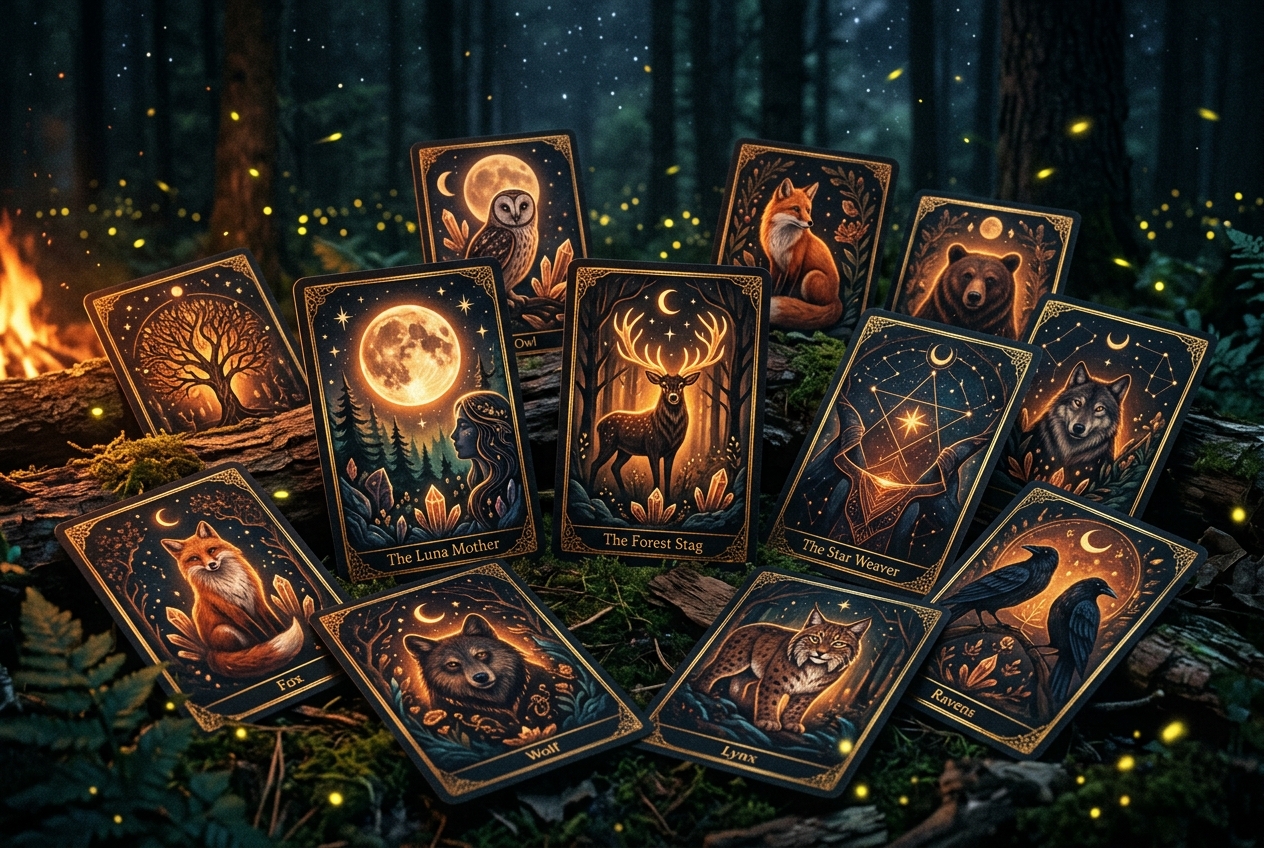
Tarot and runes are both beloved esoteric tools, yet each possesses distinctive qualities. Explore their differences and similarities to see which aligns better with your spiritual journey.
The Difference Between Tarot and Runes – Which to Choose?
Introduction to Tarot and Runes
The differences between tarot and runes begin with their structure, methods of operation, and the types of answers they typically provide. Tarot is based on a set of cards featuring images, symbols, and archetypes that weave together a broader narrative concerning the question, emotions, and processes at play. Runes, on the other hand, consist of a more concise system of signs. Each sign carries its own set of meanings and generally works more directly, indicating direction, tension, or a need for action. While they are not identical tools, both serve the purpose of reflection and intuitive exploration.
In spiritual practice, tarot often helps trace a situation step by step, revealing dependencies and naming what lies hidden beneath the surface. Runes typically convey messages more succinctly, functioning as signals for what to concentrate on in the present moment. This is why those seeking an in-depth analysis of relationships, decisions, or inner processes tend to prefer tarot. Conversely, runes are favored by individuals looking for a simpler, more direct reading that can easily translate into specific reflection or intent. If you want to understand the broader context of working with cards, check out tarot.
Choosing between these tools is best guided by your thinking style and the question you present. Tarot usually offers more layers of meaning and is better suited for scenarios where narrative and the analysis of dependencies are essential. Runes are more compact and can be helpful when you need a quick recognition of the energy surrounding a situation or a single, clear message. In both cases, intention, focus, and the willingness to calmly receive the message without adding personal interpretations are crucial.
Structure and Composition of Tarot
Tarot consists of 78 cards that create an organized system of meanings. The deck includes 22 Major Arcana cards and 56 Minor Arcana cards. The Major Arcana describes significant stages, breakthroughs, and life lessons, while the Minor Arcana reflects daily life, emotions, actions, and specific situations. This structure enables tarot to connect the broader picture of life's processes with the details of everyday existence, which is, for many, its greatest strength in spiritual practice.
In practice, interpreting tarot cards does not rely solely on memorizing individual meanings. The position of the card in a spread, the question being asked, the proximity of other cards, and how the entire sequence unfolds into a coherent story all matter. Within the energy of this deck, symbols, colors, figures, and the dynamics of images are also significant. Therefore, tarot is a tool that often requires a moment of focused contemplation but provides a very rich, multi-layered message, especially for questions regarding relationships, decisions, and the direction of change.
If you are looking to understand the difference between tarot and runes, the structure of tarot reveals its more complex nature. Runes typically work with a smaller set of symbols and emphasize brevity, while tarot offers a complete map of archetypes and experiences. This allows for interpretations of cards that can be subtler yet more precise when analyzing situations. Tarot effectively supports those who enjoy blending intuition with imagery, narrative, and working with cards in spreads tailored to the question.
Structure and Composition of Runes
The difference between tarot and runes is already apparent at the structural level. Tarot forms a complex system of cards, while runes represent an alphabet of symbols. The older futhark consists of 24 signs, each with its own name, sound, and field of meanings. This makes runes a tool that is economical in form but rich in symbolism. Their strength lies not in the sheer number of elements but in the precision of the message and the context of the question.
In practice, runes act as a shorthand that quickly directs attention to a specific area. For example, a rune may denote movement, protection, a need for patience, changes in plans, or a moment for establishing foundations. When the question involves relationships, a rune may underscore the importance of trust or setting boundaries. In professional matters, it may indicate the pace of action, the quality of decisions, or the necessity to organize affairs. In daily reflections, runes can be particularly helpful when you seek one clear point of reference, rather than an extensive narrative.
Their interpretation requires attention to the meaning of the sign, the question, and the circumstances of the inquirer. The same rune may resonate differently in various contexts, such as relationships, work, or personal development, so it’s important not to interpret it in isolation from the whole situation. Compared to tarot, runes are formally simpler but no less profound. It is precisely this combination of brevity and symbolic depth that draws many to them when they wish to quickly grasp the essence of a situation and identify the most important direction for action.
Differences in Reading Methods
In tarot, readings typically depend on the layout of the cards, where position, the relationships between cards, and the logic of the entire spread are all significant. This means that the answer can reveal not only the current state but also the background of the situation, possible developments, and elements that require attention. In contrast, rune methods tend to be more direct. You can draw one rune, several signs, or use a simple layout based on your practice. In this respect, the difference between tarot and runes also lies in the fact that tarot often constructs a fuller narrative, whereas runes generally highlight the most critical point of tension or direction.
In tarot, images, archetypes, and the connections between cards hold great significance. In runes, the focus shifts to the sign, the question at hand, and the intention of the user. When the question is specific, runes can offer swift and clear guidance, signaling needs such as stopping, protection, action, or adjusting one’s approach. For more complex inquiries, tarot might reveal deeper emotional layers, interpersonal dynamics, and the evolving process. Both systems are valuable, but they cater to slightly different perspectives on the matter.
Your choice of method is also influenced by your personal preferences. Someone who enjoys analysis, a broader context, and multi-layered meanings naturally gravitates towards tarot for further exploration. tarotConversely, those who appreciate simplicity, the rhythm of brief reflections, and swift messages often prefer runes. In both instances, self-awareness, honesty towards the answer, and a readiness to interpret the message in alignment with the actual situation—rather than seeking convenient validation of one’s hopes—are of utmost importance.
Similarities Between Tarot and Runes
Despite their differences, both tools serve a similar purpose: helping you pause and delve deeper into your situation. Both tarot and runes encourage reflection, organize thoughts, and uncover inner truths that might easily be overlooked amidst the hustle of everyday life. They aren't necessarily designed to predict everything in advance. More often, they act as a mirror, revealing emotions, intentions, tensions, and possible paths of action.
In both practices, symbolism is key. In tarot, images, archetypes, and relationships between cards are deciphered. In runes, individual signs are engaged with along with their meanings in relation to the query. In both cases, meaning doesn't stem solely from a single word. Instead, it arises from the interplay of the sign, intuition, experience, and the current circumstances of the seeker. This allows both systems to function effectively as tools for personal growth and spiritual self-reflection.
The similarity is also apparent in daily applications. Tarot and runes can assist with morning insights, evening reflections on the day, intention-setting, or moments of quiet before significant decisions. For many, these practices are complementary because one provides a broad narrative while the other delivers a succinct sign. This enables them to be utilized in similar contexts, though each system communicates in its own language and at a different pace.
How to Choose Between Tarot and Runes?
Your decision between these tools should hinge on the type of insights you are truly seeking. If you need a comprehensive overview of your situation, emotional exploration, and a more detailed analysis, tarot may be a more suitable starting point. In contrast, if you prioritize brevity, simplicity, and swiftly grasping the main theme, runes might align better with your style. The distinction between tarot and runes isn't one of superiority, but of differing ways to engage in dialogue with your intuition.
For beginners, the amount of time you wish to devote to learning is also important. Tarot entails familiarizing yourself with a larger number of cards, layouts, and their interrelations, but offers a wealth of material for practice. Runes are simpler in terms of the number of symbols, though their interpretation still demands patience and an attunement to one's own feelings. If someone delights in learning through imagery and narratives, tarot might feel more intuitive. If they lean towards minimalism, runes could prove more suitable.
The best approach is to begin with the tool that sparks your curiosity rather than creates pressure. In practice, consistency and trust in your own journey yield the best results. You don’t need to know everything right away to start engaging meaningfully with a symbol. Many people opt for tarot due to its ease of finding structures and spreads, while others choose runes for the simplicity and daily connection offered by a single sign. The key is that the tool supports you instead of overwhelming you.
FAQ
Can I combine tarot and runes in one practice?
Yes, you can blend them, provided you do so consciously and without chaos. One practice can paint a broad picture through tarot while the other can clarify specifics through runes. However, it's beneficial to establish your own order of operation to avoid mixing too many layers at once. It’s most effective to view both tools as complementary symbolic languages rather than competitors. This way, the reading remains clear and peaceful.
Which tool is better for beginners?
It depends on your learning style. Tarot may resonate more with those who connect well with images, scenes, and narratives. Runes might be easier to start with due to their fewer signs and more straightforward methodology. If you enjoy complex meanings, begin with tarot. If you favor brief, specific symbols, opt for runes. The best tool is one that you are excited to work with regularly.
What are the costs of purchasing cards and runes?
Costs vary based on quality, edition, and material. Tarot is typically acquired as a deck of cards, whereas runes are sold as sets of stones, wooden pieces, or other carriers of symbols. The market offers both simple, budget-friendly options and more elaborate collector sets. It’s advisable to start with a version that is robust and comfortable, without overspending on decorations. The crucial factor is that the tool is practical and serves well in your daily practice.