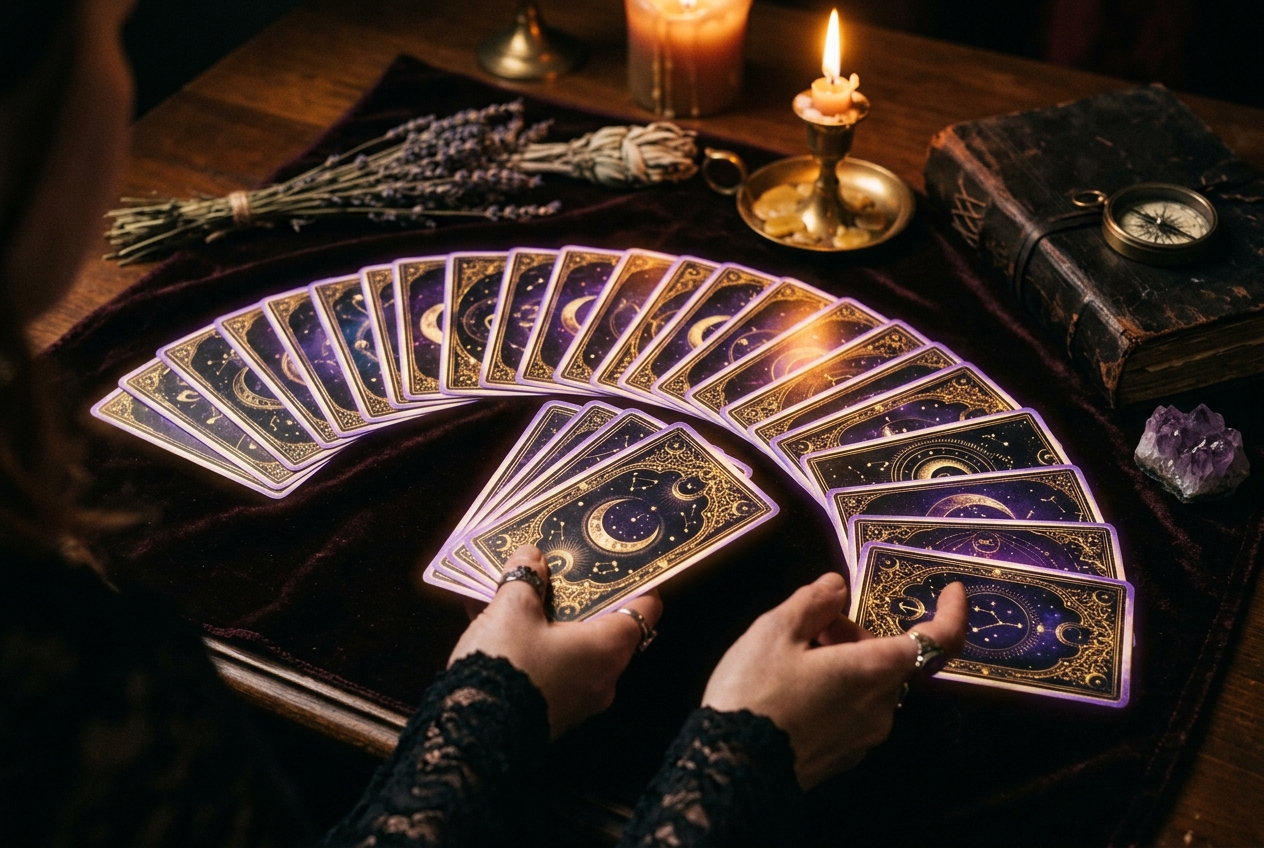
Explore the significance of the 22 Major Arcana in Tarot. Discover the insights each card offers and how they can enrich your spiritual journey and everyday life.
The Meaning of Tarot Cards — 22 Major Arcana and Their Messages
Introduction to the Major Arcana
The Major Arcana represents the most vital aspect of Tarot, as they illustrate life's stages, turning points, and unavoidable lessons. In practice, they serve as a roadmap for personal growth, highlighting moments of initiation, trials, loss of control, maturation, reflection, and the completion of a cycle. When the Fool appears in a reading, it often signifies a new beginning, a brave decision, or embarking on a journey without complete awareness. When the High Priestess emerges, the focus turns to intuition, stillness, and the unseen. Conversely, the Tower frequently represents a sudden upheaval that dismantles what was fragile or based on illusion.
Unlike the Minor Arcana, the Major Arcana transcends mere daily events; they delve into the deeper meanings behind life experiences. They may suggest a decision to change careers, but they can also signify an internal moment when one consciously chooses to break free from old patterns. They can indicate a breakup, yet also the process of reclaiming boundaries and expressing one’s voice. This is why they often evoke strong emotions during readings. Their messages can be direct, but not always comfortable, as they remind us of our responsibilities, the importance of trusting the process, and the necessity for change.
To fully grasp these insights, view Tarot as a visual language rather than a series of rigid predictions. This is how Tarot in Ezostylia functions, where each card unveils a unique layer of experience. The Major Arcana teaches that life has its rhythm, and each stage imparts its own lesson, even if at first you only perceive a fragment of the journey. Practically, this facilitates asking better questions: not merely 'what will happen?', but also 'what must I learn?', 'what needs to change?', and 'what should I be open to at this moment?'.
Symbolism of Individual Cards
Each of the 22 Major Arcana cards carries its own symbol and distinct message. The Fool represents new beginnings, openness, and the courage to embrace the unknown. The Magician embodies resourcefulness, focus, and the ability to harness one’s own potential. The High Priestess guides us toward intuition, while the Empress reminds us of abundance, nurture, and creative power. The Emperor brings structure, order, and a sense of responsibility for what endures.
In the following cards, themes of relationships, values, and inner challenges surface. The Hierophant signifies principles and teachings, the Lovers represent a heart-driven choice, and the Chariot symbolizes progress and determination. Strength imparts the lesson of gentle courage, the Hermit fosters reflection, while the Wheel of Fortune alerts us to the ever-changing nature of life. Justice emphasizes the importance of balance, and the Hanged Man suggests that we sometimes need to view things from a different perspective.
The later Arcana guide us through closure and rebirth. Death signifies the necessity of ending a cycle, the Devil reveals entanglements, and the Tower suggests a sudden upheaval that shakes false foundations. The Star offers hope, the Moon exposes fears and uncertainties, while the Sun brings clarity and simplicity. Judgment symbolizes awakening, and the World signifies the completion of a cycle. Within the energy of this deck, each meaning resonates with daily choices, emotions, and responses to change.
How to Interpret Cards in the Context of Life?
The true significance of tarot cards becomes evident when the question relates to a real-life situation rather than mere curiosity. A card does not render a definitive verdict but serves as a symbolic reflection of energy, tensions, and potential paths. If you ask about a relationship, observe whether the card indicates closeness, distance, honesty, or the need for boundaries. When inquiring about work, assess whether it suggests a beginning, chaos, stability, pressure, or a shift in rhythm. In decision-making inquiries, it’s essential to ask not just 'what should I choose', but also 'am I ready to face the consequences?' This transforms the reading into a practical and vibrant experience.
For instance: The Fool may signify a new beginning, but in a question about a stable job, it also serves as a reminder to be mindful of the details, deadlines, and regulations. Another example: the Lovers do not always denote romance; they may represent a choice between two paths, the necessity of aligning values, or a conversation that can no longer be delayed. A third example: the Tower in personal matters does not necessarily predict disaster, but rather a sudden shift in a situation that liberates you from instability. According to the Author of the Cards’ interpretation, not only does the name of the Arcana hold significance, but the entire context of the question, the arrangement of the cards, and the interplay between them all contribute to the reading.
The clearest readings arise when the question is straightforward and specific. Instead of asking 'what will my entire life be like?', it’s more effective to ask 'what is currently most important in this relationship?' or 'what should I focus on in this decision?'. Keeping notes after readings is also beneficial. A few days, weeks, or months later, you may notice how specific symbols reappear in similar situations. This cultivates personal experience with Tarot instead of solely relying on memorized definitions. The more precisely you frame your questions, the easier it becomes to interpret the cards in everyday contexts.
The Role of Intuition in Card Reading
Intuition is one of the most essential tools when working with Tarot, as it allows you to step outside the usual patterns and perceive the deeper meanings hidden within the imagery. While familiarity with the card meanings is important, mere memorization is insufficient if you desire to read a card in a more profound, personal manner. Sometimes, a single glance at a detail, color, or gesture of a character conveys more than a standard definition. This is why the reading should be conducted with attentiveness, calmness, and a grounding in the present moment.
You can cultivate your intuition in a simple way. Before laying out a spread, take a moment to pause, take a few deep breaths, and ask yourself what first captures your attention. Jot down your initial associations, even if they seem overly simplistic. Then, compare them with the content of your question and the neighboring cards. This kind of practice teaches you to trust subtle signals while guarding against the mechanical repetition of meanings without connecting with the true message.
In practice, intuition does not replace knowledge; rather, it complements it. If a card depicts energy of movement but your intuition suggests a stop, check if it indicates inner resistance or the need for reflection before taking action. In Tarot, it's crucial to blend symbolism, personal experience, and inner sensing. Therefore, it’s best to develop your readings step by step, revisiting your notes and trusting recurring themes in various spreads.
Contemporary Approach to Tarot
Today, Tarot encompasses much more than it did in the past. For some, it is a tool for spiritual contemplation; for others, a means of organizing emotions, and for many, a symbolic language for discussing life. The contemporary approach moves away from the rigid belief that a card has a singular, unchanging answer. Increasingly, the dialogue with the imagery, mindfulness, and the willingness to view one’s situation from a fresh perspective take precedence. This approach aligns more closely with everyday life.
In a fast-paced world, Tarot encourages us to pause, seek meaning, and cultivate a relationship with our inner selves. It doesn’t have to replace decision-making but can indeed support it when someone finds themselves at a crossroads. It’s important to remember that spirituality in these practices does not involve escaping reality but rather enhancing our understanding of it. This is why a contemporary reading of the cards can integrate symbolism, intuition, and straightforward, honest observation of what's happening in the here and now.
If you are interested in a broader context, Tarot in Practice and Interpretations of Ezostylia will be beneficial, as it makes it easier to connect the meanings of the cards with everyday experiences. This approach allows for working with Tarot without exaggeration or theatrics. What matters most is that the cards help elucidate the situation rather than induce artificial fear or unnecessary tension. When approached this way, Tarot becomes a calm, practical, and authentic tool.
Common Mistakes in Card Interpretation
One frequent mistake is treating each card literally without considering the question and the context. The same Arcana can convey entirely different messages in matters of love, career, and inner challenges. For example, the Emperor in a relationship may signify the need for boundaries and responsibility, whereas in work contexts, it may indicate strong organization. A moderate approach to inquiries about emotions may suggest patience, but in financial matters, it can serve as a reminder of the need for measured progress. Issues also arise when interpretations rely solely on initial associations without examining the connections between cards. Tarot operates more fully when you view it as a cohesive whole rather than a collection of isolated phrases.
The second pitfall is excessively categorizing cards as 'good' or 'bad.' Such a division simplifies the message, as even challenging Arcana can carry important lessons, while seemingly benign cards may caution against passivity or delusion. The Tower does not always signal a dramatic upheaval; sometimes it simply reveals the necessity to discontinue something that has been unsuccessful for a long time. The Moon does not always herald a problem; it may mean uncertainty, a lack of complete information, or a tendency to spin tales. In interpreting a card, it’s vital to ask: what role does this card play in this spread, where does it lead, and what does it reveal about your perspective?
Also, avoid jumping to conclusions too hastily. If a card doesn’t align with your initial interpretation, resist the temptation to impose a meaning onto it. It is often better to revisit the question, reassess your intention, and identify if a crucial element has been overlooked. A common error occurs when someone focuses solely on the main card and neglects surrounding Arcana that could alter the tone of the entire reading. For instance, the Sun beside the Five of Swords does not present a straightforward depiction of success; rather, it illustrates the tension between clarity and conflict. In Tarot, precision arises from practice, humility, and mindfulness, not from haste.
FAQ
What does the Fool mean in a simple reading?
The Fool in the energy of this deck represents a beginning, openness, and the courage to step into the unknown without excessive control. In a straightforward reading, it may signify a new phase, a spontaneous decision, or the need to break free from an old pattern. If the inquiry involves a relationship, it may indicate freshness and lightness. If it pertains to work, it serves as a reminder to begin without complete security. Its significance becomes clearest when you consider the entire spread rather than isolated cards.
How to read the Sun in a question about the future?
The Sun symbolizes brightness, simplicity, and a moment when clarity is achieved. In the context of a question about the future, it may indicate transparency, increasing certainty, and acting in alignment with one’s true self. However, it does not promise that everything will become effortless. Instead, it encourages a focus on honesty, consistency, and open communication. It is a card that supports conscious decision-making.
Does the Tower always mean a crisis?
Not always. The Tower often signifies a sudden revelation of truth, a breakdown of what was fragile, or the need for swift change. In a relationship, it may indicate a difficult conversation that ends the pretense. In a work context, it may signal that the old arrangement is no longer viable. Its meaning doesn’t boil down to fear, but rather to clearing away what no longer has support.
Why keep notes of your Tarot readings?
Notes help you to see how the cards align in recurring patterns. This makes it easier to notice, for instance, that the High Priestess often appears when it’s important to wait, while the Chariot shows up when movement and decision are needed. Recording your readings also fosters accountability for your own interpretations and allows you to revisit earlier questions without second-guessing. It’s a very practical tool for growth.
Can Tarot be combined with other practices?
Yes, Tarot can be combined with journaling, meditation, breathwork, or numerology, as long as it's done in moderation and with a clear purpose. It's beneficial when the additional practice organizes the reading rather than obscuring it. The most important thing is that Tarot remains a clear language of symbols. Mindfulness and consistency always yield better results than an overload of stimuli.
How to ask questions for a more specific answer?
It’s best to focus on one topic at a time and avoid overly broad questions. Instead of asking "what awaits me?", it is better to ask "what should I pay attention to in this relationship?" or "what is the most important step in this situation?" Such questions facilitate the reading and reduce the risk of chaos. Tarot responds more fully when the question is clear and sincere.