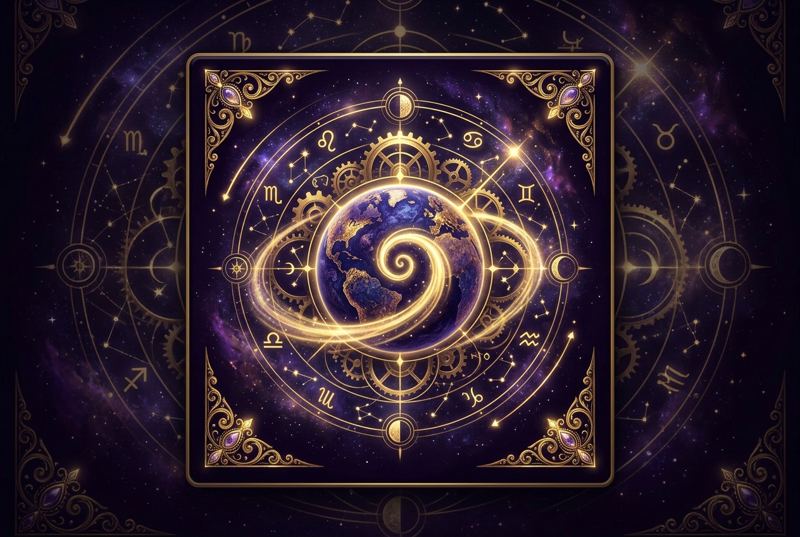
Astrology is an ancient art that interprets the influence of celestial bodies on human life. Explore what it entails, its fundamental concepts, and different astrological systems.
Astrology: What It Is — Fundamentals and Astrological Systems
What is astrology?
Astrology is a symbolic system that interprets the movements of the planets, the Sun, and the Moon, connecting them to human experiences. While not a science in the traditional academic sense, it has served for centuries as a map of meanings, guiding individuals in exploring their emotions, decisions, and life cycles. In practical astrology, the date, time, and place of birth are crucial, as they create an individual arrangement known as the natal horoscope.
Astrology is not merely about making simple predictions about the future; rather, it is a language of symbols that organizes reality and offers a reference point for introspection. The planets, zodiac signs, and astrological houses represent various facets of life, and their interrelations reveal tensions, talents, and themes that call for attention. This perspective can provide support to many people in gaining a deeper understanding of themselves, their reactions, and the moments when it is wise to pause or act more courageously.
If you're wondering what astrology is, the simplest answer is that it's a system of meanings grounded in cosmic rhythms and human interpretation. In Ezostylia, astrology serves as a tool for personal growth, rather than a replacement for decision-making or responsibilities. It also harmonizes well with other intuitive practices, like tarot, which you can explore here: tarot. In both cases, the emphasis is on mindfulness, reflection, and consciously interpreting your own experiences, rather than imposing rigid judgments.
Basic concepts in astrology
The foundational concepts in astrology help to structure the entire horoscope and understand how to read its framework. The zodiac signs describe the quality of energy, indicating ways of acting, feeling, and responding. Each sign possesses its own character, element, and modality, so it offers insights not only about personality but also about one's approach to everyday experiences. It is the signs that add color and rhythm to interpretation, rather than isolated, detached meanings.
The second crucial element is the astrological houses, which correspond to specific areas of life. One house relates to identity, another to relationships, and yet another to work, home, communication, or personal growth. Thanks to the houses, astrology remains practical, showing where a particular energy may manifest. This explains why two horoscopes with the same Sun sign can appear completely different, even when starting from a similar point.
The third key component consists of planetary aspects, which are the angles formed between planets in the horoscope. These aspects indicate whether energies interact harmoniously or create tensions that require heightened awareness. In interpretation, the strength of the planets, their positions within signs, and the overall arrangement of the chart also play significant roles. When considering these elements together, astrology transforms into a coherent language that describes internal processes, rather than merely a collection of random terms.
The history of astrology
Astrology boasts a long and rich history, rooted in ancient sky observations. Its earliest traces can be found in Babylon, where priests tracked planetary movements, lunar phases, and eclipses, seeking signs pertinent to the community's life. Over time, similar practices emerged in Egypt, followed by Greece, where they began to systematize these observations into a more coherent interpretative framework.
In subsequent centuries, astrology evolved alongside the cultures that embraced it. In the Arab world, sophisticated calculations and records were developed, while in medieval and Renaissance Europe, it integrated with medicine, philosophy, and natural observation. It has never been a singular entity; each era brought its own questions, terminology, and methods of interpreting symbols. This has given rise to various traditions that continue to shape how horoscopes are understood today.
For many, astrology is not merely an ancient curiosity, but a vibrant language of symbols. It is founded on the belief that cosmic rhythms can be interpreted as a map of tensions, opportunities, and internal processes. In Ezostylia, this approach aligns well with other interpretative practices, such as tarot, as multiple traditions coexist within astrology: from its Babylonian roots, through Hellenistic, Arab, and medieval traditions, to contemporary psychological, humanistic, and esoteric currents. Each tradition highlights different aspects, which is why the history of astrology is fundamentally a tapestry of paths leading to the understanding of the sky, rather than a singular, closed system.
Different astrological systems
Astrology is not a monolithic system; instead, several primary branches exist, each employing distinct interpretative principles. The most recognized is Western astrology, which is based on the tropical zodiac and involves the analysis of signs, planets, and houses. Its objective is to outline a person's potential, emotions, relationships, and developmental phases based on the celestial arrangement at the time of their birth.
The second significant tradition is Eastern astrology, often linked to Indian practices. It employs its unique methods for counting signs and places a greater emphasis on karma, life cycles, and spiritual growth. Additionally, there is horary astrology, which addresses a specific query posed at a given moment, rather than analyzing the entire natal horoscope. Each of these systems follows different logics and possesses its own symbolic language.
The choice of astrological system reflects what an individual seeks. Some wish to gain a deeper understanding of their character, others look for answers to specific situations, and still others are drawn to long-term cycles. Therefore, the question of "what is astrology" does not yield a single answer but rather invites exploration of several traditions, each offering unique tools while satisfying a common yearning for meaning and guidance in life.
Astrological tools and techniques
The fundamental tool of astrology is the horoscope, which serves as a symbolic record of the positions of the planets, the Sun, and the Moon at a specific moment in time. From this arrangement, a map is created that the astrologer interprets based on the zodiac signs, astrological houses, and aspects between celestial bodies. This enables the identification of areas in life that may be more dynamic, challenging, or supportive. It's not a straightforward diagram, but rather a complex set of interrelationships that requires careful analysis.
Astrological work also employs charts and calculation tables to organize data effectively. Transits, progressions, and other techniques for tracking changes over time are equally important. Each of these elements presents a slightly different level of interpretation: from the natal chart to current influences and potential breakthrough moments. An astrologer does not focus solely on one sign but examines the entirety of the arrangement, for only then does the symbol reveal its deeper significance.
A practical application example is the analysis of transits, which entails comparing the current movement of planets with the natal horoscope. If someone observes Saturn’s transit to a significant point in their chart, they may view this period as one of heightened responsibility, organization, and diligent work. This does not suggest a predetermined outcome, but rather indicates a topic that warrants closer attention. Such tools serve not to judge individuals but to illustrate the energies and processes that may arise within them. That is why astrology is often seen as a form of reflection rather than a prescriptive guide. It allows one to pause and contemplate their pace, emotions, and decisions. Practically, this means adopting a more conscious approach to everyday life, especially when we seek to understand what nurtures us and what requires patience and effort.
Astrology in daily life
Astrology can be utilized as a tool for daily reflection and enhanced self-understanding. For many, it serves as a means to pause and contemplate important questions: where do my reactions stem from, why are some relationships challenging while others feel naturally supportive? In this light, the horoscope does not substitute for decision-making but aids in examining choices with greater awareness and tranquility.
In daily life, astrology can assist in planning actions, selecting the right moments for conversations, relaxation, or shifts in direction. It is not about rigidly adhering to the planetary arrangement but about carefully attuning to the mood and energy of the day. This approach can be beneficial for those wishing to live more consciously and to recognize recurring patterns before they escalate into sources of tension. It is a practice that emphasizes reflection over mere entertainment.
However, it's crucial to regard astrology as inspiration rather than an absolute verdict. Its value is amplified when it aids in gaining a better understanding of one’s needs, boundaries, and development trajectory. In this way, it becomes a tool for cultivating internal guidance rather than evading reality. Understood in this manner, astrology can integrate into both simple, everyday choices and the profound journey of self-discovery.
FAQ
What are the most important zodiac signs?
In astrology, there is no singular most important sign, as each one offers its own unique qualities. Aries embodies initiative, Taurus represents perseverance, Gemini signifies communication, Cancer is linked to sensitivity, Leo is associated with expression, Virgo with order, Libra with relationships, Scorpio with depth, Sagittarius with the search for meaning, Capricorn with responsibility, Aquarius with independence, and Pisces with intuition.
How to read a horoscope?
A horoscope is interpreted by considering the entirety of the arrangement, not just the Sun sign. The Moon, ascendant, planets in houses, and the aspects between them play significant roles as well. Such analysis reveals different levels of experience: emotions, behavioral patterns, relational needs, and areas for development. The more complex a horoscope is, the more cautiously one should draw conclusions and avoid oversimplifying symbols into single statements.
What is the difference between astrology and astronomy?
Astronomy is a science that studies the structure and movement of celestial bodies in a physical and observational manner. In contrast, astrology is a system of symbolic interpretation that links the arrangement of the cosmos with human experiences. These represent two distinct realms. Astronomy explains how the universe operates, while astrology seeks to uncover meanings and correlations. Therefore, they can be distinguished clearly without conflating their purposes and methods, making it vital to maintain the distinction between astrology and astronomy.