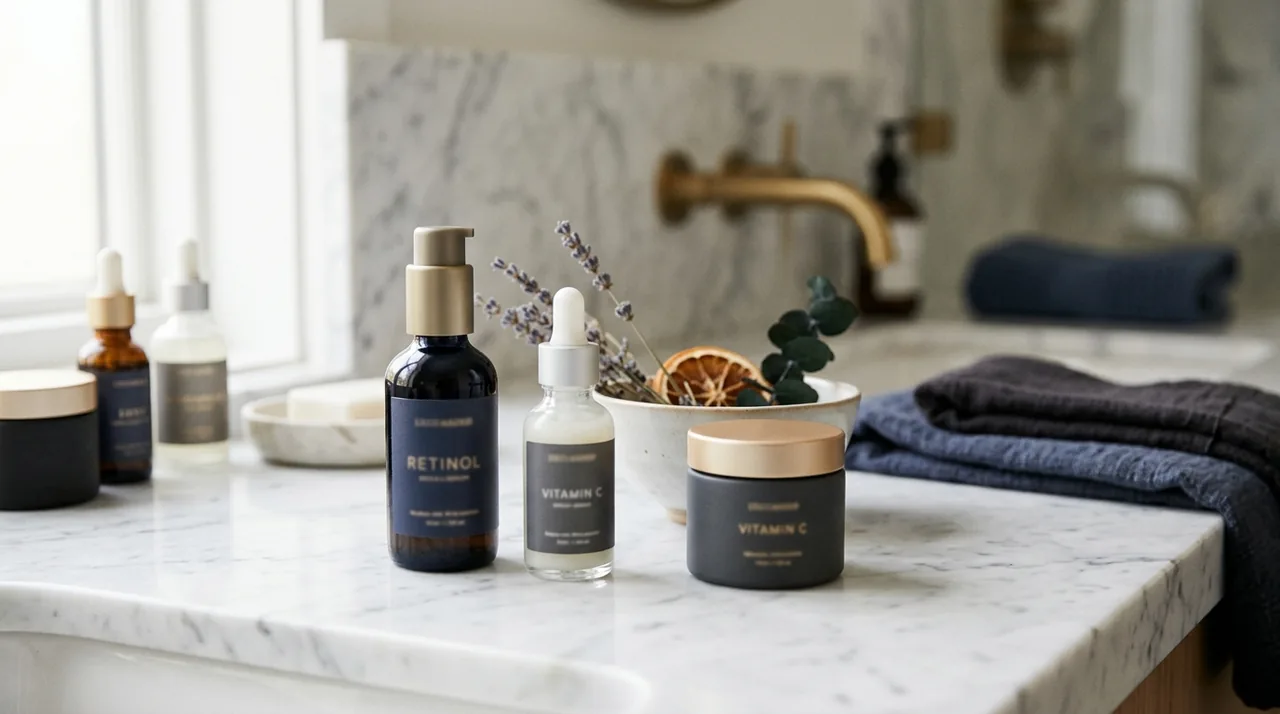
Retinol, acids, and Vitamin C can yield fantastic results, but only when combined thoughtfully. Learn the rules of safe skincare, the application order, and practical rituals.
Retinol, acids, vitamin C: how to combine ingredients in conscious skincare
In modern skincare, it's easy to fall into the trap of excess. On your shelf, there’s a vitamin C serum, next to it a toner with acids, and further along a retinol cream. Each of these products can genuinely benefit your skin, but combining them requires a plan. This is especially important if you want to improve your complexion, texture, fine lines, or tendency for imperfections, while also protecting your skin’s hydrolipid barrier.
According to the American Academy of Dermatology Association, retinoids are among the most well-researched ingredients used topically in aesthetic dermatology and support the skin, particularly in the areas of acne and signs of photoaging. Meanwhile, vitamin C is valued for its antioxidant properties and its ability to help lighten hyperpigmentation, while chemical acids aid in smoothing out the skin and improving its renewal. So the problem isn’t whether these cosmetic ingredients are good, but how to combine them so that the skincare is both effective and comfortable.
When building your own skincare ritual, think of it like a training plan for your skin. Not everything at once, not every day from the first day, and always allowing time for recovery. This approach usually yields better results than aggressively combining multiple potent actives in one evening. Practically, this means reasonable dosing, monitoring your skin's reactions, and patience.
If you want to expand your knowledge about daily skincare, you can treat this article as a foundation for creating your own skin plan. Taking care of your beauty isn’t about using the greatest number of products, but about good compatibility of ingredients and consistency.
What do retinol, vitamin C, and acids do
Retinol is a derivative of vitamin A. In cosmetics, it functions as an ingredient that supports skin renewal, smooths texture, and reduces the visibility of fine lines. According to dermatological reviews published in NCBI resources, topical retinoids are well documented for their anti-acne and anti-aging effects. At the same time, they can cause dryness, stinging, peeling, and temporary irritation, especially at the beginning of use.
Vitamin C, most often in the form of ascorbic acid or its more stable derivatives, supports the skin as an antioxidant. Review studies described in PubMed indicate that it can help protect against oxidative stress caused by UV radiation, support collagen synthesis, and improve the appearance of pigmentation. However, it does not replace sunscreen and functions best as part of a broader skincare routine.
AHA, BHA, and PHA acids mainly act as exfoliants, although their profiles can vary. AHAs, such as glycolic and lactic acid, are more commonly associated with smoothing and brightening. BHAs, primarily salicylic acid, are prized for oily skin and acne-prone skin. StatPearls, 2023, states that alpha hydroxy acids improve skin texture and support skin renewal, but excessive use increases the risk of irritation.
Why these ingredients might clash
Many people have heard the simple rule that retinol, acids, and vitamin C should not be combined. This is an oversimplification. A more accurate statement is that it’s not always advisable to use them together in the same skincare ritual, especially if your skin is sensitive, dehydrated, or if you are just starting with active cosmetic ingredients.
The most common issue arises from the accumulation of irritating potential. Retinol speeds up cellular renewal. Acids exfoliate. Vitamin C in certain forms and high concentrations can also sting and cause discomfort. When you combine several strong products at once, your skin may respond with redness, tightness, stinging, and peeling. This is not a sign that the skincare is working better; often, it signals overloading.
In dermatology, skin tolerance and the epidermal barrier matter. If you weaken it, you may paradoxically worsen your skin condition, increase reactivity, and hinder the consistent use of products that could, in the long run, bring benefits.
The safest rule is to separate active ingredients
For most people, the most sensible model looks like this: use vitamin C in the morning, and retinol or acids in the evening, alternating, not on the same day. This straightforward strategy helps maintain effectiveness while minimizing the risk of irritation.
- Morning: gentle cleansing, vitamin C serum, moisturizer, SPF 30 or 50.
- Evening 1: cleansing, retinol, recovery cream.
- Evening 2: cleansing, just moisturizer or soothing serum.
- Evening 3: cleansing, acid, recovery cream.
- Evening 4: recovery without strong actives.
Such a skincare ritual is especially helpful if your skin is just learning to work with actives. Over time, if your tolerance is good, you can increase the frequency, but there’s no need to rush. Skin beauty usually responds better to consistency than to intensity.
How to combine vitamin C with retinol
These ingredients don’t have to exclude each other, but they often work best when separated into different times of the day. Using vitamin C in the morning makes sense due to its antioxidant action, while retinol in the evening is due to tolerance profiles and dermatological practice. The American Academy of Dermatology Association also emphasizes the importance of daily sun protection when using retinoid treatments.
If you have resilient skin and choose milder formulas, some ready-made products may combine vitamin C derivatives with retinoids. However, in home care, it's safer not to experiment with layering from day one. Especially a high concentration of pure ascorbic acid and retinol in the same evening routine may prove too burdensome.
Good practice suggests that you observe your skin for 4 to 6 weeks. If prolonged stinging, redness, and peeling do not occur, you can maintain the regimen. If discomfort increases, reduce the frequency and return to a simpler skincare routine.
How to combine acids with retinol
This combination requires the utmost caution. Using acids and retinol on the same evening often leads to dryness and irritation. For most skin types, the alternating method is safer—one evening for retinol, another for acids, and in between, restorative nights.
If you have acne-prone skin and are using salicylic acid, remember that even spot treatments can increase reactivity. The same goes for toners with glycolic or lactic acid. Over-exfoliating won't speed up results; instead, it can damage the skin barrier. According to StatPearls, 2023, side effects of AHA include burning, redness, and increased sensitivity, especially with improper use.
If you're eager to combine exfoliation with a retinoid, a more reasonable choice might be a cleanser containing a gentle acid used briefly, rather than a strong scrub right before retinol. Still, it's wise to start cautiously.
How to combine vitamin C with acids
Here, much depends on the product's formulation. Pure ascorbic acid can be quite acidic on its own, so adding another potent acid may increase the risk of stinging. However, if you're using a milder form of vitamin C, and your skin is resilient, some people tolerate this combination. In home practice, a simpler routine is often recommended: vitamin C in the morning, acids in the evening.
If you have rosacea-prone, sensitive skin, or skin with a compromised barrier, don't treat strong actives as mandatory standards. Skincare in accordance with dermatology should meet the skin's needs, not current trends. Sometimes, the best results come from using fewer products and focusing on better recovery.
How to structure your skincare ritual step by step
- Define your primary goal, such as pigmentation, acne, smoothing, or the first signs of aging.
- Choose one main active ingredient to start with, either retinol or acids, but not both at once.
- Add vitamin C in the morning if your skin tolerates the antioxidant serum well.
- Introduce the product twice a week, then increase the frequency every 2 to 3 weeks.
- Use sunscreen with SPF daily. According to the AAD, sun protection is fundamental in preventing photoaging and reducing pigmentation.
- If irritation occurs, reduce the frequency and return to recovery steps.
In practice, it's also important to pay attention to the entire formulation of the product. The skin's reaction is influenced not just by the active ingredient but also by its concentration, pH, the product base, the presence of denatured alcohol, fragrances, or additional soothing ingredients. This is why two vitamin C serums or two retinol creams can behave quite differently on the skin.
If you like to visually organize your skincare routine, it can be helpful to break it down by days or packaging colors. You can find inspiration to create cohesive habits in sections such as colors or mandala, but base your skincare plan on your skin's needs and dermatological principles.
What about the scalp and hair
Although this topic mainly concerns the face, many people ask if similar rules apply to hair and the scalp. Yes, caution is needed here as well. Acids in scalp products can help cleanse and reduce excess sebum, but overuse can lead to dryness or burning. Retinoids are not standard for daily scalp care without clear specialist indications.
If your goal is healthy hair, focus primarily on the condition of your scalp, gentle cleansing, protecting the lengths, and thoughtfully selecting cosmetic ingredients. Hair responds better to consistency and protection from mechanical damage than to random mixtures of active substances.
Common mistakes that weaken the skin
- Introducing retinol, acids, and vitamin C in the same week.
- Not using daily SPF during retinol or acid treatments.
- Exfoliating too frequently because the skin seems rough or congested.
- Ignoring burning and redness for several days.
- Using strong actives on damp, irritated skin without a protective base.
If you want, you can also cultivate more supportive habits around your skincare. For some people, a consistent order of steps, a calm evening routine, and reducing stimuli work well. This approach to beauty care promotes regularity. In this spirit, you might also look for inspiration related to daily wellness, such as aura or chakra rituals, but remember, the effectiveness for the skin is based on dermatology, not symbolism.
When to consult a specialist
If you have an active inflammatory condition, severe acne, rosacea, eczema, significant pigmentation, or very reactive skin, it's worth consulting your skincare plan with a dermatologist. The same applies if, after several weeks of careful use, you continue to experience intense burning, peeling, and redness. An educational article can help you understand the principles, but it does not replace individual diagnosis.
The shortest answer to the question of how to combine retinol, acids, and vitamin C is to do so calmly and strategically. Generally, vitamin C in the morning, retinol or acids in the evening, alternately, with a strong emphasis on recovery and SPF. This approach is more skin-friendly and thus more effective in the long run.
Sources
- American Academy of Dermatology Association, Retinoids: What They Are and How to Use Them, 2024, https://www.aad.org
- American Academy of Dermatology Association, Vitamin C for the Skin: Benefits and How to Use It, 2024, https://www.aad.org
- StatPearls, NCBI Bookshelf, Alpha Hydroxy Acids, 2023, https://www.ncbi.nlm.nih.gov/books/
- StatPearls, NCBI Bookshelf, Topical Retinoids, 2023, https://www.ncbi.nlm.nih.gov/books/
- PubMed, Topical Vitamin C and the Skin: Mechanisms of Action and Clinical Applications, 2017, https://pubmed.ncbi.nlm.nih.gov/
- American Academy of Dermatology Association, Sunscreen FAQs, 2024, https://www.aad.org
This content is for educational purposes and does not replace consultation with a dermatologist or other specialist.
FAQ
Can you use retinol and vitamin C on the same day?
Yes, usually you can, but it's best to separate them into different times of the day. Vitamin C in the morning, retinol in the evening. This arrangement typically reduces the risk of irritation and facilitates regular skincare.
Can acids and retinol be layered?
For most people, this isn't the best idea to start with. It's safer to use them on alternate evenings. Layering increases the risk of dryness, burning, and weakening the skin barrier.
What SPF should be used with retinol and acids?
Daily SPF 30 or 50 with broad-spectrum protection is usually recommended. This is important because the skin may be more sensitive to UV radiation during active treatments.
How can you tell if your skin is overloaded with actives?
Typical signs include burning, prolonged redness, a feeling of tightness, flaking, and excessive reactivity even to mild cosmetics. In such a case, limit active ingredients and focus on regeneration.